
Pregnancy Due Date Calculator – Estimate Your Baby’s Due Date
Use this free pregnancy due date calculator to estimate your baby’s due date, current pregnancy week, conception date, and trimester timeline. Enter the first day of your last menstrual period, an estimated conception date, or a known due date to see your estimated pregnancy dates instantly.
How Does a Pregnancy Due Date Calculator Work?
This pregnancy calculator estimates your due date using one of three starting points: the first day of your last menstrual period, an estimated conception date, or an existing due date you already have from a doctor or ultrasound. Depending on the information you enter, the calculator can also estimate your conception date, current pregnancy week, and trimester timeline.
A common method for estimating a due date is Naegele’s rule, which uses 280 days (40 weeks) from the first day of the last menstrual period (ACOG). This is an estimate based on a typical 28-day cycle and does not account for every person’s actual ovulation timing. If your cycle length differs from 28 days, the estimated date may shift.
If you are not sure of your cycle dates, the period calculator can help you keep track of recent start dates and work out your usual cycle length.
Due Date vs. Conception Date vs. Last Period Date
These three dates are related but different, and mixing them up is a common source of confusion.
- Last period date: the first day of your most recent menstrual period. Pregnancy dating is commonly based on this date.
- Conception date: the date fertilization occurred or is estimated to have occurred. It is usually later than the first day of the last menstrual period.
- Due date: the estimated date of birth based on pregnancy dating.
Conception timing is not exact for every pregnancy. If you want to understand when ovulation may have occurred, you can estimate your ovulation date and fertile window. These tools give calendar-based estimates and cannot confirm when conception happened.
How Accurate Is a Due Date Calculator?
A pregnancy due date is an estimate, not a guaranteed delivery date. Pregnancy length varies, and the actual date of birth may be earlier or later than the estimated due date.
A calculation based on your last menstrual period depends on having an accurate period date and makes assumptions about cycle length and ovulation timing. If your cycles are irregular or you are unsure of your last period date, the estimate may be less reliable.
An ultrasound dating scan can provide a more accurate assessment of how far along the pregnancy is because pregnancy dating can be based on measurements made during the scan.
Understanding Your Trimesters
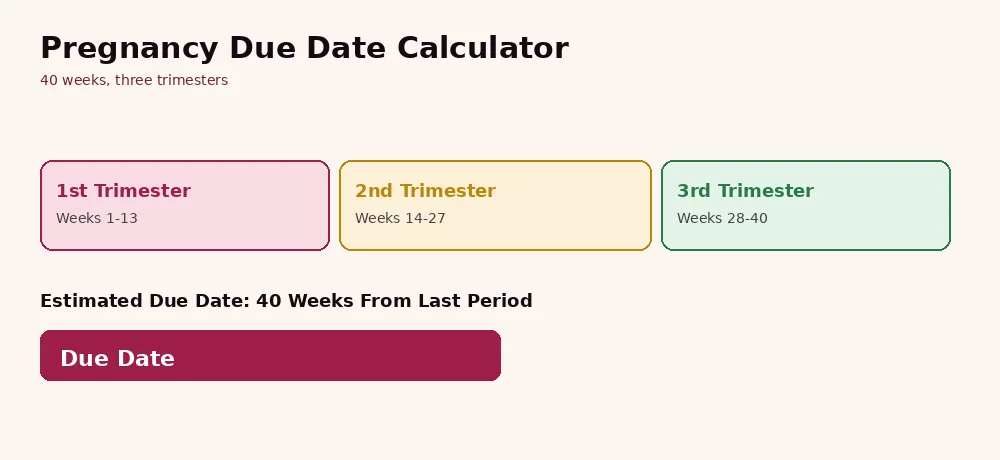
| Trimester | Weeks | General Focus |
|---|---|---|
| First | Weeks 1–13 | Early pregnancy and fetal development |
| Second | Weeks 14–27 | Ongoing fetal growth and changes during pregnancy |
| Third | Weeks 28–40 | Final fetal growth and preparation for birth |
These week ranges are general guidelines, not strict boundaries. Individual pregnancies vary, and your healthcare provider will track your own progress.
How Many Weeks Pregnant Am I?
Pregnancy is commonly measured in weeks starting from the first day of your last menstrual period, rather than from the date of conception. This means pregnancy dating can include approximately two weeks before conception in a typical cycle. The exact timing can vary because ovulation and conception do not occur on exactly the same day in every pregnancy.
This is called gestational age. Fetal age, which counts from conception, is usually about two weeks less, so the two terms are not interchangeable.
This pregnancy due date calculator handles the week calculation automatically based on the information you enter.
How Is a Due Date Counted for Each Method?
- Last menstrual period (LMP): by convention, the estimated due date (EDD) is 280 days after the first day of the LMP (ACOG).
- Conception date: because conception usually happens about two weeks after the LMP, the count from conception is commonly about 266 days (38 weeks).
- IVF: if you conceived with IVF, the due date is usually assigned from the age of the embryo and the date of transfer rather than from a last period. Your clinic will confirm the date that applies to you.
- Ultrasound: the date is based on measurements made during the scan. A first-trimester ultrasound is generally the most accurate ultrasound method for establishing or confirming gestational age (ACOG).
Comparing Due Date Calculation Methods
| Method | What It Needs | Best For |
|---|---|---|
| Last period date | First day of your last menstrual period and cycle information | A common starting point for pregnancy dating |
| Conception date | Known or estimated conception date | When conception timing is known or estimated |
| Known due date | A due date already provided by a healthcare professional | Estimating related pregnancy dates |
| Ultrasound dating | Fetal measurements from an ultrasound scan | Pregnancy dating performed by a healthcare professional |
If your calculator-based estimate and a healthcare professional’s ultrasound-based estimate differ, the healthcare professional may recommend which date should be used based on the timing and findings of the scan.
Can My Due Date Change?
Yes, it can. Healthcare providers usually set the estimated due date once they have your last period date, a first accurate ultrasound, or both. According to ACOG, if an early scan differs from the last-period date by more than 5 days before 9 weeks, or by more than 7 days before 14 weeks, the due date is generally changed to match the scan. After that, changes are reserved for rare circumstances.
If your provider gives you a different date from this calculator, follow your provider’s date and use the calculator’s result as a general guide.
Early Term, Full Term and Late Term: What the Weeks Mean
A due date falls at 40 weeks, but a healthy pregnancy can end before or after it. ACOG describes the weeks around the due date as follows (ACOG).
| Term | Gestational age |
|---|---|
| Early term | 37 weeks 0 days to 38 weeks 6 days |
| Full term | 39 weeks 0 days to 40 weeks 6 days |
| Late term | 41 weeks 0 days to 41 weeks 6 days |
| Postterm | 42 weeks 0 days and beyond |
A birth before 37 weeks is called preterm. Your healthcare provider will advise you on the timing that is right for your pregnancy.
Frequently Asked Questions
How does a pregnancy due date calculator work?
How accurate is a due date calculator?
What is the difference between a due date and a conception date?
How many weeks pregnant am I?
Can I calculate my due date without knowing my last period?
When does each trimester start and end?
Is an ultrasound due date more accurate than a calculator?
How is an IVF due date calculated?
Can my due date change?
What is gestational age?
What week is full term?
Why do due date calculations sometimes differ?
Medical Disclaimer
This pregnancy due date calculator provides estimates for general pregnancy tracking and does not replace care from a qualified healthcare professional. Due dates can change as pregnancy dating is assessed. Speak with your healthcare provider for personal medical advice or questions about your pregnancy.


Scientific References
- Committee on Obstetric Practice, American Institute of Ultrasound in Medicine, and Society for Maternal-Fetal Medicine. “Methods for Estimating the Due Date.” ACOG Committee Opinion No. 700. Obstetrics & Gynecology (2017). Clinical guidance on estimating the due date from the last menstrual period and early ultrasound, and on when the estimated due date should be revised. Used for this page’s 280-day (40-week) dating method, the IVF dating note, first-trimester ultrasound dating and the re-dating thresholds in “Can My Due Date Change?”. acog.org
- American College of Obstetricians and Gynecologists (ACOG) and Society for Maternal-Fetal Medicine. “Definition of Term Pregnancy.” ACOG Committee Opinion No. 579 (2013). Defines early term, full term, late term and postterm by gestational age. Used for the term-weeks table on this page. publications.smfm.org
- Jukic, Anne Marie, Donna D. Baird, Clarice R. Weinberg, Daniel R. McConnaughey, and Allen J. Wilcox. “Length of Human Pregnancy and Contributors to Its Natural Variation.” Human Reproduction 28, no. 10 (2013): 2848–55. Prospective study showing that pregnancy length varies naturally, even when ovulation timing is known. Background for this page’s note that a due date is an estimate and that birth may happen earlier or later. doi.org
- Mongelli, Max, Marion Wilcox, and Jason Gardosi. “Estimating the Date of Confinement: Ultrasonographic Biometry versus Certain Menstrual Dates.” American Journal of Obstetrics and Gynecology 174, no. 1 (1996): 278–81. Comparative study of ultrasound-based and menstrual-date-based estimates of the delivery date. Background for this page’s comparison of dating methods. pubmed.ncbi.nlm.nih.gov
- American College of Obstetricians and Gynecologists (ACOG). “How Your Fetus Grows During Pregnancy.” Frequently Asked Questions. Accessed 2026. Patient overview of fetal development across the trimesters. Background for this page’s trimester week ranges. acog.org
- Office on Women’s Health, U.S. Department of Health & Human Services. “Stages of Pregnancy.” womenshealth.gov. Accessed 2026. Consumer reference on the first, second and third trimester. Used to cross-check this page’s general trimester guidance. womenshealth.gov