
Normal Menstrual Cycle: What a Period Is, Length and Phases
A normal menstrual cycle lasts 21 to 35 days for most adults, and your period is only the bleeding part of it. This guide explains what a period is, how long cycles and periods usually last, the four phases, common symptoms, and when to see a doctor.
Most people only think about their cycle when something feels off: a period arrives late, the blood looks different, or a friend’s pattern seems nothing like their own. The reassuring part is that normal covers a wide range, and your own steady pattern matters more than any average.
That pattern is easier to see when you write it down. A period calculator turns your start dates into a clear cycle length, and an ovulation calculator estimates when the fertile part of the cycle falls.
Key Takeaways
- A period is the bleeding. The menstrual cycle is the whole monthly sequence, counted from the first day of one period to the day before the next.
- Most adults have cycles of 21 to 35 days. A 28-day cycle is an average, not a rule.
- Periods usually last 2 to 7 days, and 3 to 5 days is the most common length.
- Cycles are less predictable in the first years after the first period and again in the years before menopause.
- A lasting change, such as no period for 3 months or bleeding that regularly runs past 7 to 8 days, is worth a doctor visit.
What Is a Period?
A period, also called menstruation, is the monthly bleeding that happens when the lining of the uterus (the endometrium) sheds and leaves the body through the vagina. Each cycle the lining thickens in case an egg is fertilised. When no pregnancy happens, estrogen and progesterone fall and the body lets the lining go. The blood, tissue and mucus that come out are your period.
Quick answer: a period is the monthly shedding of the uterine lining. It usually lasts 2 to 7 days, and its first day is day one of a new menstrual cycle.
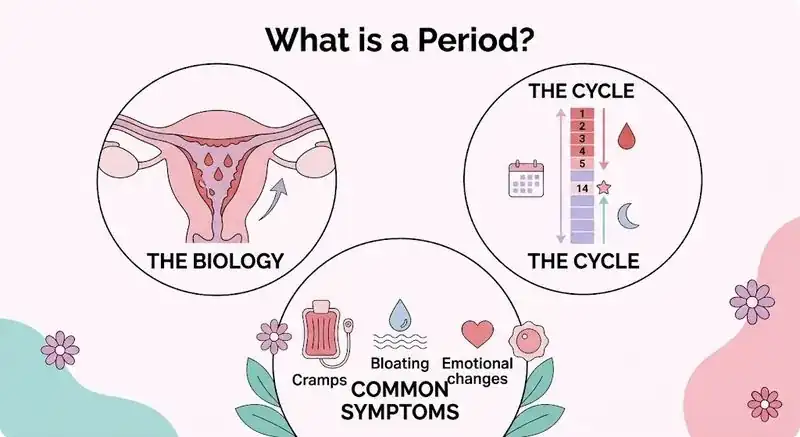
Periods begin at puberty, pause during pregnancy and stop at menopause. For the step-by-step process behind the bleeding, read what causes menstrual bleeding.
What Is a Menstrual Cycle?
The menstrual cycle is the full sequence of changes between the first day of one period and the day before the next. Its two big jobs are to release an egg (ovulation) and to prepare the uterus for a possible pregnancy. A period is just one visible stage inside it, and that is the main difference between the two terms.
A feedback loop between the brain and the ovaries, driven by FSH, LH, estrogen and progesterone, runs the process. Our guide to the female reproductive system shows the organs involved.
The Ovarian Cycle
The ovarian cycle covers what happens in the ovaries: the follicular phase, when one egg matures; ovulation, when it is released; and the luteal phase, when the corpus luteum makes progesterone.
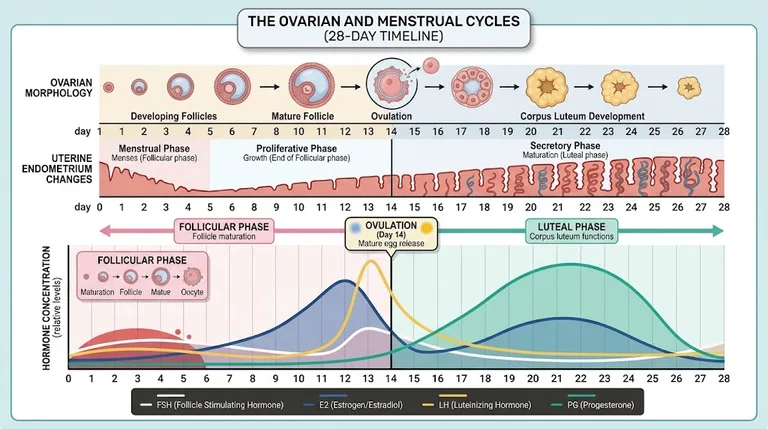
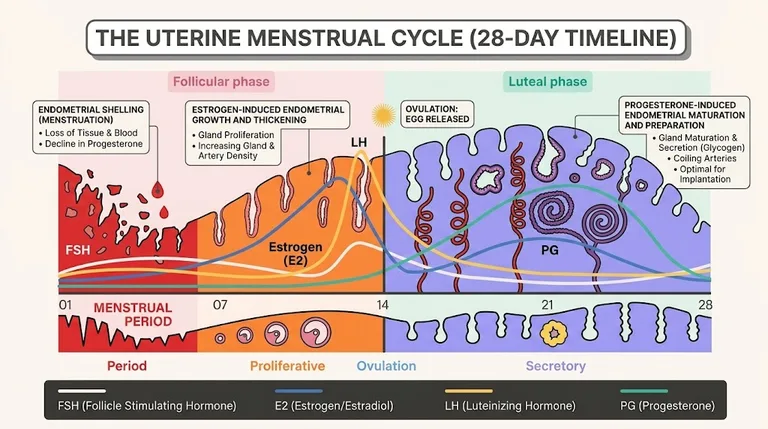
The Uterine Cycle
The uterine cycle covers the lining: it sheds during the period, rebuilds under estrogen, then is prepared by progesterone after ovulation. It runs in parallel with the ovarian cycle.
What Is a Normal Menstrual Cycle Length?
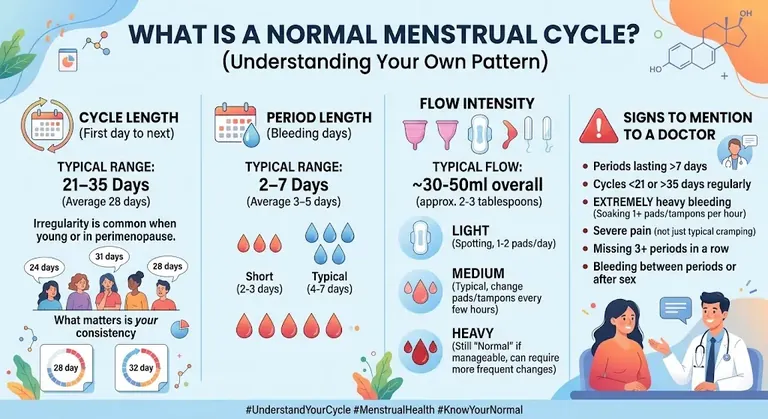
Most adults have a cycle of 21 to 35 days, counted from the first day of one period to the first day of the next. The American College of Obstetricians and Gynecologists describes 21 to 35 days from one period to the next as the typical adult range. The 28-day cycle is the average, not a rule. A cycle that is steadily 24 days or steadily 33 days can be perfectly healthy for you, and the key word is consistently.
Studies put the median cycle at 28 days, with most cycles falling between 25 and 30 days. Gynaecology guidelines such as FIGO describe 24 to 38 days as normal, so a small gap from the textbook figure is rarely a concern.
How Many Days Between Periods Is Normal?
For most adults, 21 to 35 days between periods is normal. Teenagers can have gaps up to about 45 days in the first few years. A cycle counts as regular when the shortest and longest over several months differ by no more than about 8 days.
How Long Does a Normal Period Last?
Bleeding usually lasts 2 to 7 days, and most people bleed for 3 to 5. The first two or three days are often the heaviest, then flow lightens. A period that regularly runs longer than 7 to 8 days is worth mentioning to a doctor, and our article on how long a period lasts goes through typical patterns in detail.
Is a Three-Day Period Normal?
Yes, a three-day period is normal if it is your usual pattern. A sudden change to much shorter or lighter periods is worth noting: take a pregnancy test if pregnancy is possible, and see a doctor if it continues for several cycles.
How Cycle Length Changes Phase Timing
Most of the difference between a 24-day and a 35-day cycle comes from the follicular phase, while the luteal phase stays close to 14 days. So a shorter cycle means earlier ovulation, not necessarily on day 14. A study of more than 600,000 app cycles found an average length of 29.3 days, and only 13% were exactly 28 days (Bull et al., 2019).
Menstrual Cycle Timeline
Here is a quick overview of the four cycle phases in a typical 28-day cycle:
| Phase | Days | Main hormone | Main event |
|---|---|---|---|
| Menstrual | 1 to 7 | Low estrogen and progesterone | Bleeding |
| Follicular | 1 to 13 | FSH and estrogen | Egg develops |
| Ovulation | Around day 14 | LH | Egg released |
| Luteal | 15 to 28 | Progesterone | Uterus prepares |
This table reflects an average 28-day cycle. If your own cycle runs shorter or longer, the days shift, though the overall order of the cycle phases and the hormonal pattern stay the same.
What Are the Four Phases of the Menstrual Cycle?
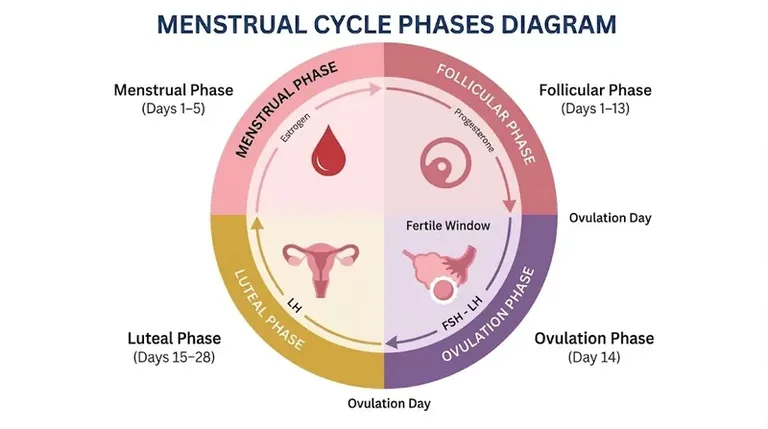
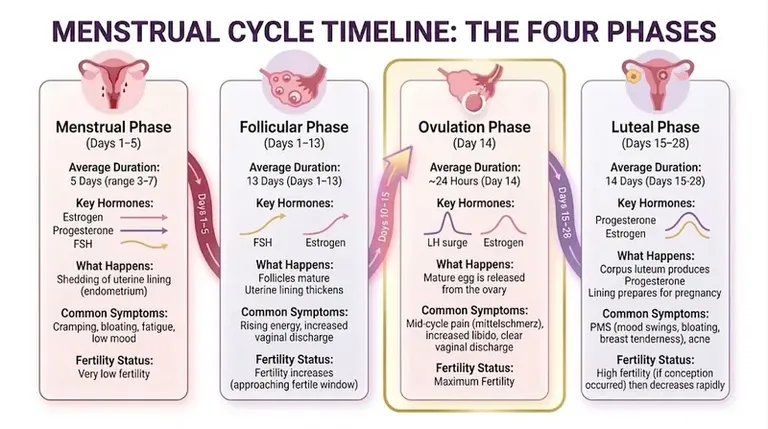
The cycle is usually divided into four overlapping phases. The day numbers below use a 28-day example, but yours will differ, and the follicular phase changes most from person to person. The chart shows how long each phase lasts, which hormones lead it and how fertile you are.
Menstrual Phase
Day 1 is the first day of visible bleeding. Hormone levels drop and the thickened uterine lining sheds. Cramps are most common now.
Follicular Phase
This phase starts on day 1 alongside your period and continues after bleeding stops. FSH prompts follicles to develop, usually one becomes dominant, and rising estrogen rebuilds the lining. It lasts roughly 10 to 16 days and varies most between people.
Ovulation Phase
A surge of LH triggers the dominant follicle to release an egg, usually about 14 days before the next period (day 14 in a 28-day cycle, day 12 in a 26-day cycle). The egg survives 12 to 24 hours and sperm up to five days, so the fertile window covers about six days. Estimate it with the ovulation calculator and learn the body clues in our guide to the signs of ovulation.
Luteal Phase
After ovulation the corpus luteum makes progesterone to keep the lining ready. Without a pregnancy it breaks down and the next period begins. This phase is steady at about 12 to 14 days, which the safe days calculator uses for estimates, not contraception. See the luteal phase guide for more.
Which Hormones Drive the Four Phases?
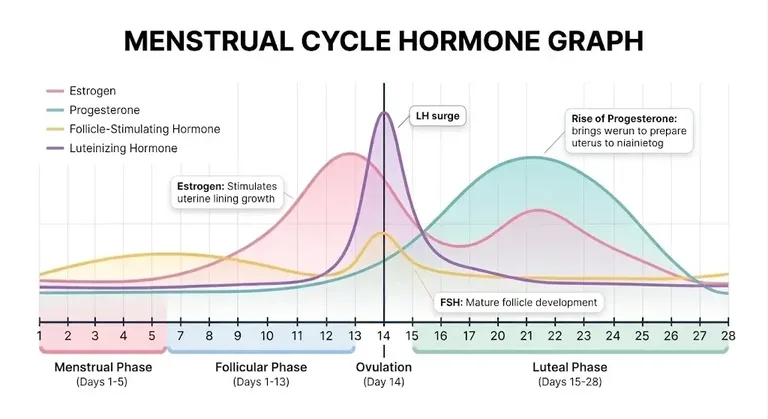
Four main hormones rise and fall in a coordinated pattern that moves you from one phase into the next.
Follicle-Stimulating Hormone (FSH)
FSH stimulates follicles in the ovaries to start developing early in the cycle.
Estrogen
Estrogen rebuilds the uterine lining and helps trigger the LH surge that leads to ovulation.
Luteinizing Hormone (LH)
A sharp rise in LH triggers ovulation, and ovulation predictor kits detect this surge.
Progesterone
After ovulation the corpus luteum makes progesterone to maintain the lining. If pregnancy does not happen, it drops and the next period begins. See how hormones change during the menstrual cycle.
| Hormone | Role | Peaks during |
|---|---|---|
| FSH (follicle-stimulating hormone) | Stimulates follicle development | Early follicular phase |
| Estrogen | Matures the egg and rebuilds the uterine lining | Late follicular phase |
| LH (luteinizing hormone) | Triggers egg release | Just before ovulation |
| Progesterone | Prepares and maintains the uterine lining | Luteal phase |
How Does the Menstrual Cycle Change With Age?
The hormonal system that runs the cycle changes over a lifetime, so what is normal at 14 is different from what is normal at 28 or 48.
The Teenage Years and the First Period
The first period, called menarche, usually happens between ages 9 and 15, and the average is around 12 or 13, although some sources give a range of 8 to 16. Most people have regular periods by 16 to 18. In the first one to three years ovulation is not yet settled, so cycles can be irregular, longer, or skipped, and cycles of 21 to 45 days are common. Seek medical advice if there is no period by age 15 or 16, if there is none within about three years of breast development, or if puberty signs begin before age 8. Our first period guide explains what to expect.
Your 20s and 30s
Cycles are usually most regular in the twenties and thirties. Pregnancy, breastfeeding, starting or stopping hormonal birth control, and high stress can still shift the pattern. After a baby, the return of periods varies, as explained in our guide to periods while breastfeeding.
Perimenopause
Perimenopause often starts in the mid-forties, though it can begin earlier. Ovulation becomes less regular, so cycles may get shorter first, then longer, with skipped periods and changes in flow. Menopause most often happens between ages 45 and 55 and is confirmed only after 12 months without a period, and any bleeding after menopause should be checked by a doctor.
Why Do Menstrual Cycles Differ Between People?
No two cycles are exactly alike. Genetics, age, health, lifestyle and hormone levels all play a part, and even your own cycle can vary from one month to the next. Common influences include:
- Stress, poor sleep, shift work and travel across time zones (see how stress affects your period)
- Starting, stopping or changing hormonal contraception
- Thyroid problems, high prolactin and PCOS
- Recent illness, certain medicines, pregnancy and breastfeeding
- Age-related changes, especially near puberty and perimenopause
One late or early cycle is rarely a concern. If you are wondering why your period is late or why your period came early, those guides cover the usual causes.
Weight, Eating and Exercise
Very low weight, rapid weight loss, restrictive eating or heavy training with too little food can switch off the brain signals that start the cycle, causing late, light or missed periods. A higher BMI is linked with higher estrogen and conditions such as PCOS. Read more on weight changes and your cycle and exercise and your menstrual cycle.
How Stress Disturbs the Cycle
Elevated cortisol can suppress GnRH, the signal that starts the hormonal chain, so ovulation may be delayed or skipped. Long-term stress affects regularity more than a single stressful day.
An occasional shift does not necessarily point to a problem, but a pattern that persists over several cycles is worth mentioning to a doctor, especially alongside very heavy bleeding, bleeding between periods or periods that stop unexpectedly.
What Symptoms Come With the Menstrual Cycle?
Your body gives signals throughout the cycle, and learning your own pattern makes it easier to tell what is normal for you.
Signs Your Period Is Coming
Premenstrual signs can start a few days to two weeks before bleeding. Common ones are bloating, breast tenderness, mood changes, tiredness, food cravings, acne, headaches and mild cramps. The signs your period is coming soon guide lists them and explains how they differ from early pregnancy symptoms.
What Does a Period Feel Like?
Every body is different, and a period can feel slightly different from one cycle to the next. Cramps are the most common symptom. They happen when the uterus tightens to shed its lining, and the ache is felt low in the abdomen and can spread to the lower back and thighs, often strongest in the first one or two days. Our guide to period cramps explains causes and relief. Many people also notice tender breasts, headaches, tiredness and a heavy, bloated feeling, and period bloating has its own guide. Shifting hormones can also make you feel irritable, more emotional or simply tired.
Symptoms Around Ovulation
Some people notice a mild one-sided pelvic twinge, clear stretchy cervical mucus or light spotting. Many notice nothing, which is also normal.
Symptoms in the Luteal Phase
Progesterone can cause bloating, sore breasts, fatigue and mood shifts that ease once bleeding starts. If low mood is severe every month, ask a doctor about PMDD; see PMS vs PMDD.
Physical and Emotional Changes in Each Phase
Physical and emotional symptoms often shift alongside the cycle phases:
- Menstrual phase: cramping, fatigue and lower energy are common as hormone levels bottom out.
- Follicular phase: energy and mood often improve as estrogen rises.
- Ovulation: some people notice clearer, stretchier cervical mucus, a small rise in basal body temperature or brief one-sided pelvic discomfort.
- Luteal phase: premenstrual symptoms such as bloating, breast tenderness and mood changes are common in the days leading up to the next period, especially later in this phase.
Everyone’s experience varies, and some people notice very few symptoms tied to phase changes at all.
Supporting Yourself During the Menstrual Phase
Small habits can make the first days of the cycle easier:
- Rest and sleep: lower energy is common, so protect your sleep.
- Gentle movement: walking or stretching can ease cramps. See exercise and your menstrual cycle.
- Warmth: a heat pad on the lower abdomen can relieve period cramps.
- Food and fluids: iron-rich foods and water help replace what is lost. Read about foods that may help with period pain.
- Pain relief: follow the label and ask a pharmacist or doctor if unsure. The NHS guidance on period pain explains what to try and when to get help.
How Your Brain Responds in Each Phase
Your brain and ovaries are in constant contact: the hypothalamus and pituitary signal the ovaries, and the ovaries send estrogen and progesterone back. Brain areas for mood, memory and attention carry receptors for these hormones.
In a study that scanned one healthy woman every day across a cycle, brain network connectivity shifted with hormone levels (Pritschet et al.). It was one participant, so it shows what is possible, not what everyone experiences.
- Menstrual phase: estrogen and progesterone are low, and some people feel tired or low.
- Follicular phase: rising estrogen often brings better mood and focus (follicular phase guide).
- Ovulation: estrogen peaks and LH surges, and some people feel more energetic.
- Luteal phase: progesterone dominates, and irritability or poor sleep can appear (luteal phase guide).
These patterns are common, not universal. Many people feel little change, and individual responses vary a great deal.
Brain-First Approach: Supporting All Four Phases
A brain-first approach means planning around how you tend to feel in each phase. Treat these ideas as experiments and keep what works.
| Phase | What you may notice | What may help |
|---|---|---|
| Menstrual | Lower energy, cramps, sometimes low mood | Extra rest, gentle movement, heat, a lighter schedule |
| Follicular | Rising energy and focus | Demanding tasks, new routines, regular exercise |
| Ovulation | Peak energy for some, mild one-sided pelvic twinges | Active or social plans, and note symptoms in your tracker |
| Luteal | Bloating, irritability, sleep changes, trouble concentrating | Regular meals, steady sleep, less caffeine and alcohol, realistic deadlines |
Evidence for matching your routine to your cycle is still limited, so use this as a self-awareness tool, not a strict rule.
Brain-Based Solutions Throughout Your Cycle
Most steps that support your brain across the cycle are everyday habits:
- Track mood, sleep and energy for two to three cycles.
- Keep a steady sleep routine, especially in the luteal phase.
- Move regularly. Exercise is widely recommended for premenstrual symptoms.
- Manage stress, as explained in how stress affects your period.
- Notice early signs with our guide to the signs your period is coming soon.
When Mood Symptoms Are Severe
PMS is common and usually mild to moderate. Premenstrual dysphoric disorder (PMDD) is a severe form that disrupts daily life. It is treatable, so speak to a doctor if this sounds familiar.
Emerging Research
Researchers are exploring brain stimulation such as tDCS for menstrual symptoms, but it is early and experimental. Talk to a doctor before trying any device.
Period Blood: Color, Amount and Clots
Menstrual blood can range from bright red to dark brown, or even black, across a single period, and this is normal. It is often brighter at the start when flow is heavier and darker toward the end as flow slows. Small clots are also common on heavier days. Our period blood color guide shows what each shade usually means.
Most people lose about 30 to 40 ml of blood over a whole period, which is only 2 to 3 tablespoons even though it can look like more. The NHS gives a wider normal range of about 20 to 90 ml, and Mayo Clinic describes more than about 80 ml as heavy. Few people measure it, so what counts as normal is partly personal, and changes from your usual flow matter most.
What Is Considered Heavy Menstrual Bleeding?
Bleeding is heavy when it soaks through a pad or tampon every hour for several hours, lasts more than 7 to 8 days, includes clots larger than a quarter, forces you to change protection at night, or leaves you tired or dizzy. Heavy bleeding can lead to iron-deficiency anemia, so see a doctor. Our guide to heavy periods covers causes and treatment.
What Does Light Bleeding Mean?
A light period can be normal for you, particularly if it has always been that way. It can also be linked to hormonal contraception, stress, low body weight, breastfeeding, thyroid problems, perimenopause or pregnancy. A sudden, lasting change to much lighter bleeding is worth discussing with a doctor.
What Is Normal Vaginal Discharge During the Cycle?
Vaginal discharge is a healthy way for the body to keep the vagina clean, and it changes with hormones across the cycle. Most discharge is clear to white and has a mild smell or none.
- During your period: blood mixes with the usual discharge.
- Soon after your period: little or no discharge, often dry or sticky.
- Before ovulation: creamy or white as estrogen rises.
- Around ovulation: clear, wet and stretchy like raw egg white.
- After ovulation: thicker, creamy or less noticeable as progesterone rises.
See a doctor if discharge turns green, yellow or grey, has a strong fishy smell, looks lumpy like cottage cheese, or comes with itching, burning, pelvic pain or bleeding after sex. These can be signs of an infection such as bacterial vaginosis, a yeast infection or a sexually transmitted infection, and most are easy to treat once diagnosed.
What to Do When You Get Your Period
Getting your period, especially the first few times, can feel unfamiliar. A little preparation makes it much easier.
Choosing Period Products
There is no single best product, so choose what feels comfortable and follow the instructions on the pack.
- Pads: stick the pad inside your underwear with the wings folded around the sides. They are the easiest place to start.
- Tampons: insert them as shown in the leaflet and use the lowest absorbency that manages your flow. Never leave one in longer than 8 hours, and take it out and seek urgent help if you suddenly feel unwell with fever, vomiting, dizziness or a rash while using one.
- Menstrual cups and period underwear: reusable options that need washing between uses. Follow the maker’s instructions for wear time and cleaning.
Managing Cramps
A heat pad, gentle movement, rest and water often ease mild to moderate cramps. Follow the label on any pain relief, and see foods that may help with period pain.
Keeping Clean
Your usual routine is enough. Wash the outside of the genital area with warm water, with a mild unscented soap if you like, and wash your hands before and after changing products. The vagina cleans itself, so avoid douching and scented products, which can cause irritation. A regular shower or bath is fine during your period.
If Your Period Starts Unexpectedly
- Fold a wad of toilet paper into your underwear as a short-term fix until you can get a pad.
- Ask a friend, teacher or colleague, or check a nearby restroom dispenser.
- Tie a jacket or sweater around your waist if you are worried about leaks.
- Keep a small spare kit in your bag, and track your start dates so you can see the next one coming.
When to Change Your Pad or Tampon
As a general guide, change a pad every 4 to 6 hours, or sooner on heavy days, and change a tampon every 4 to 8 hours. Menstrual cups follow the maker wear time. Change any product as soon as it feels full or uncomfortable.
What Is an Irregular Menstrual Cycle?
A cycle is called irregular when it is consistently shorter than 21 days or longer than 35 days, when the length varies by more than about 8 days from cycle to cycle, or when periods are missed. Occasional irregularity is common, especially in the first years after the first period and in perimenopause.
What Causes Irregular Periods?
Frequent causes include PCOS, thyroid disorders, high prolactin, chronic stress, big weight changes, intense exercise, hormonal contraception, breastfeeding and perimenopause. Less often, primary ovarian insufficiency or other medical conditions are involved. Read more in our guide to menstrual cycle irregularities and the article on the thyroid and the menstrual cycle.
When Is an Irregular Cycle a Concern?
It is worth seeing a doctor if you have gone three months or more without a period and are not pregnant, if cycles are repeatedly shorter than 21 or longer than 35 days, or if irregular periods come with pain, very heavy bleeding, excess hair growth or difficulty getting pregnant. Take a pregnancy test first if pregnancy is possible, and see what counts as a late period to judge how late is late.
Common Myths About Periods
Because many people never get a clear explanation of how periods work, myths tend to fill the gap. Here are the ones worth clearing up.
- Myth: you cannot get pregnant during your period. It is less likely but not impossible, especially with a short cycle, since sperm can survive several days and ovulation can occur soon after bleeding ends.
- Myth: ovulation always happens on day 14. Day 14 is only an average for a 28-day cycle, and timing shifts with cycle length and from month to month.
- Myth: you can only get pregnant on the day of ovulation. Sperm can survive up to five days, so sex in the days before ovulation can still lead to pregnancy.
- Myth: a 28-day cycle is the only normal cycle. Typical ranges differ between guidelines, and 28 days is just a commonly cited average.
- Myth: period blood is dirty blood. Menstrual blood is simply blood mixed with uterine lining tissue, not a sign of impurity.
- Myth: irregular periods always mean something is seriously wrong. Irregular cycles are common after the first period or during high stress, though a persistent pattern is worth checking.
How Can You Track Your Menstrual Cycle?
Writing down the start date of every period, plus flow, symptoms and mood, is the simplest way to learn your pattern. After three to six cycles you will have a reliable average. Also note your period length, any cervical mucus changes, ovulation-related symptoms and how you feel in the days before your next period.
How to Calculate Your Cycle Length
Count from the first day of one period (day 1) up to the day before your next period starts. For example, if one period starts on January 5 and the next starts on February 3, your cycle is 29 days long. Repeat for several cycles and average the results. Our guide on how to calculate your next period shows how to use that average to predict the next date.
How a Calculator Can Help
A period calculator does the counting for you, estimates your next period and ovulation, and shows when your cycle changes. The ovulation calculator estimates when ovulation is likely, and the safe days calculator estimates fertile and lower-risk days. All of them give estimates based on past cycles, so they work best when your cycles are fairly regular, and they are not a reliable way to prevent pregnancy.
What About Cycle Syncing?
Some people use phase-by-phase awareness for cycle syncing, adjusting workouts, meals or workload to match how they tend to feel, with more energy in the follicular phase and a wish for more rest in the luteal phase. Evidence for cycle syncing as a formal health practice is still limited, but noting your own energy, mood and symptoms phase by phase is still a useful way to understand your patterns.
Why Does Understanding Your Cycle Matter?
Knowing your phases helps you predict your next period, plan around your fertile window and spot changes early. If timing changes, read about menstrual cycle irregularities.
When Should You See a Doctor?
An occasional outlier is common and rarely a concern. A repeating pattern, or a sudden unexplained change, is more useful information. The NHS guidance on missed or late periods and its page on when heavy periods need medical help list when to get advice.
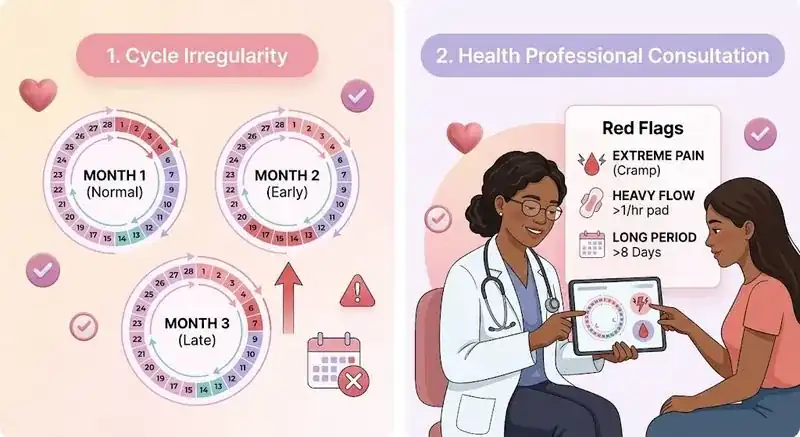
Talk to a doctor if you notice:
- Cycles consistently shorter than 21 days or longer than 35 days
- No period for three months or more, without pregnancy
- Bleeding that regularly lasts longer than 7 to 8 days
- Very heavy bleeding, large clots, or soaking protection every hour
- Severe pain that disrupts daily life, or sudden severe pain with fainting or fever (seek urgent help)
- Bleeding between periods or after sex
- No period within three months of stopping hormonal birth control, when you are not pregnant
- Feeling suddenly sick, such as fever, vomiting, dizziness or a rash, while using a tampon (remove it and seek urgent help)
- A sudden, lasting change from your usual pattern
Conditions like PCOS or thyroid problems can affect the phases specifically. If your period keeps arriving late, see why your period is late and mention the pattern.
Keep notes on dates, flow and symptoms before your appointment, as these help your doctor reach a diagnosis faster.
Ready to Feel Your Best in Every Phase?
Start with one cycle of tracking: enter your dates in the period calculator, then use the ovulation calculator to estimate your fertile window.
Frequently Asked Questions
Is a 28-day menstrual cycle normal?
What is a period, in simple terms?
What is the difference between a period and a menstrual cycle?
How long does a period usually last?
At what age do periods usually start?
Is it normal for periods to be irregular at first?
Can your menstrual cycle change every month?
What color should period blood be?
Can stress affect your menstrual cycle?
What are the four phases of the menstrual cycle?
How long does each phase of the menstrual cycle last?
Is ovulation always on day 14?
Which phase are you most fertile?
What hormones control the cycle phases?
Can cycle phases vary from month to month?
What is a normal menstrual cycle length?
Can you get pregnant during your period?
The Bottom Line
A period is the bleeding part of a longer monthly cycle. For most adults the cycle lasts 21 to 35 days and bleeding 2 to 7 days, but your own steady pattern is the benchmark. Speak to a healthcare professional if cycles are repeatedly outside the usual range, you miss periods for three months, bleeding is very heavy or painful, or a change stays.


Sources & References
- American College of Obstetricians and Gynecologists (ACOG). Your Menstrual Cycle. acog.org
- American College of Obstetricians and Gynecologists. Committee Opinion No. 651: Menstruation in Girls and Adolescents: Using the Menstrual Cycle as a Vital Sign. Obstetrics & Gynecology. 2015;126(6):e143-e146. DOI: 10.1097/AOG.0000000000001215
- Munro MG, Critchley HOD, Fraser IS; FIGO Menstrual Disorders Committee. The two FIGO systems for normal and abnormal uterine bleeding symptoms and classification of causes of abnormal uterine bleeding in the reproductive years: 2018 revisions. International Journal of Gynecology & Obstetrics. 2018;143(3):393-408. DOI: 10.1002/ijgo.12666
- Bull JR, Rowland SP, Scherwitzl EB, et al. Real-world menstrual cycle characteristics of more than 600,000 menstrual cycles. npj Digital Medicine. 2019;2:83. PMC6710244 DOI: 10.1038/s41746-019-0152-7
- Fehring RJ, Schneider M, Raviele K. Variability in the phases of the menstrual cycle. Journal of Obstetric, Gynecologic & Neonatal Nursing. 2006;35(3):376-384. DOI: 10.1111/j.1552-6909.2006.00051.x
- Wilcox AJ, Dunson D, Baird DD. The timing of the “fertile window” in the menstrual cycle: day specific estimates from a prospective study. BMJ. 2000;321(7271):1259-1262. DOI: 10.1136/bmj.321.7271.1259
- Reed BG, Carr BR. The Normal Menstrual Cycle and the Control of Ovulation. In: Endotext. MDText.com; 2018. NCBI Bookshelf
- Harlow SD, Gass M, Hall JE, et al. Executive summary of the Stages of Reproductive Aging Workshop + 10. Journal of Clinical Endocrinology & Metabolism. 2012;97(4):1159-1168. DOI: 10.1210/jc.2011-3362
- Gordon CM, Ackerman KE, Berga SL, et al. Functional Hypothalamic Amenorrhea: An Endocrine Society Clinical Practice Guideline. Journal of Clinical Endocrinology & Metabolism. 2017;102(5):1413-1439. DOI: 10.1210/jc.2017-00131
- Hallberg L, Högdahl AM, Nilsson L, Rybo G. Menstrual blood loss: a population study. Acta Obstetricia et Gynecologica Scandinavica. 1966;45(3):320-351.
- Mayo Clinic. Menstrual cycle: what’s normal, what’s not. mayoclinic.org
- Office on Women’s Health, U.S. Department of Health & Human Services. Your menstrual cycle. womenshealth.gov
- World Health Organization (WHO). Sexual and reproductive health and rights. who.int
- National Health Service (NHS). Missed or late periods. nhs.uk
- National Health Service (NHS). Heavy periods. nhs.uk
- National Health Service (NHS). Periods. nhs.uk
- MedlinePlus, U.S. National Library of Medicine. Menstruation. medlineplus.gov
- UCSF Center for Reproductive Health. Normal menstrual cycle. crh.ucsf.edu
- Pritschet L, Santander T, Taylor CM, et al. Functional reorganization of brain networks across the human menstrual cycle. NeuroImage. 2020. PMC7935041
- Cleveland Clinic. Follicular phase. my.clevelandclinic.org
- Cleveland Clinic. Luteal phase. my.clevelandclinic.org
- NHS. Period pain. nhs.uk
- Schmalenberger KM, Tauseef HA, Barone JC, et al. How to study the menstrual cycle: practical tools and recommendations. Psychoneuroendocrinology. 2021;124:104895. PMC8363181
- International Association for Premenstrual Disorders. Menstrual cycle and PMDs. iapmd.org
- ISRCTN Registry. WIND trial: wearable intervention for neurological dysmenorrhea. ISRCTN15224642
- ClinicalTrials.gov. Transcranial direct current stimulation for menstrual symptoms (NCT06974773). NCT06974773