
Exercise and the Menstrual Cycle What Science Actually Says
“Cycle syncing” is everywhere on social media, but the largest systematic review found only a trivial effect of cycle phase on performance. Here is what the evidence on exercise and the menstrual cycle supports, and what is mostly hype.
Key Takeaways
- Exercise and the menstrual cycle mix safely for most people, and moving during your period often helps cramps, mood and energy.
- A 2025 review of 29 trials found exercise reduces period pain, with clearer benefits after about 8 weeks.
- A 2020 review of 78 studies found only a trivial average effect of cycle phase on performance.
- Track your own energy and pain for a few cycles instead of following a rigid phase plan.
- Very heavy training with low food intake can stop periods. See a doctor after 3 missed periods.
Should you push through a workout on your period, and is “cycle syncing” worth the hype? Interest in exercise and the menstrual cycle has grown quickly as more people notice how hormones affect energy, strength and recovery. Knowing where you are in your cycle is the first step, and our Period Calculator can help with that.
Yes, working out during your cycle is generally safe, and moving on your period often helps cramps, mood and energy. Cycle syncing can feel good for some people, but the largest systematic review found only a trivial average effect of cycle phase on performance. Consistency plus listening to your body beats rigid phase rules.
Is It Safe to Exercise During Your Period?
Yes, for most people. Exercise does not make bleeding heavier or cause harm in healthy individuals.
Safety First
With exercise and the menstrual cycle, safety is usually the first question people ask. For the vast majority of people there is no medical reason to stop moving just because you are menstruating, and regular activity is linked to milder period symptoms over time. Research does not show that exercise makes bleeding heavier or causes harm in healthy individuals.
When to Ease Off
The bigger risk usually comes from stopping movement entirely when you feel able to do something. Choose gentler activity if energy is low or cramps are strong. If you bleed heavily and feel dizzy or short of breath, rest and read our guide to heavy periods.
How Exercise Helps Period Symptoms
Trials show exercise reduces period pain, and the benefit builds over about 8 weeks of regular training.
What the Trials Found
One of the strongest findings is the effect of exercise on period pain (primary dysmenorrhea).
A 2025 systematic review and meta-analysis of 29 randomized controlled trials found exercise significantly reduced menstrual pain intensity (VAS score down by 2.62 points on average), and strength training alone reduced pain by 1.76 points.
A 2024 network meta-analysis found all major exercise types reduced menstrual pain by the eight-week mark of consistent training, with relaxation-style movement often showing the largest early gains.
Why It May Help
Exercise increases blood flow, may help lower prostaglandins (the compounds that trigger cramps) and releases endorphins. Many people also report better mood and less bloating. For other cramp relief options, see period cramps and period bloating relief.
What Is Cycle Syncing?
Cycle syncing means planning workouts around the four phases of your cycle instead of using the same plan all month.
The Basic Idea
Cycle syncing is a way of scheduling training around the hormonal shifts of your cycle. You use gentler sessions when energy tends to be lower and push harder when you usually feel strong. It builds on the four phases of the cycle and needs a rough idea of where you are in them.
How to Start
- Mark the first day of each period to count your cycle days.
- Note energy, pain, mood and sleep next to each workout.
- After two or three cycles, look for patterns that repeat for you.
Our Period Calculator can estimate your next period so you can see which phase you are likely in.
Cycle Syncing Workouts: What the Science Actually Shows
Cycle syncing can feel good, but the best evidence shows only a trivial average effect of cycle phase on performance.
The Popular Advice
Cycle syncing means adjusting workouts by phase: light movement during your period, harder training in the follicular phase, peak effort around ovulation and an easier load in the luteal phase. Some people feel better following this pattern, but the research is more cautious than the trend.
The Largest Review
A 2020 systematic review and meta-analysis in Sports Medicine, pooling 78 studies of women with regular cycles, found only a trivial average effect of cycle phase on exercise performance. The early follicular phase (around the start of the period) showed a slight tendency toward lower performance, but the effect was small (−0.14) and the quality of evidence was rated low. The authors concluded that rigid phase-based guidelines cannot be justified.
What Other Reviews Say
Reviews in elite and team-sport athletes reach similar conclusions: effects exist for some people and outcomes, especially perceived effort, but they are inconsistent and often modest. Recent work on strength training found no clear influence of cycle phase on acute performance or long-term gains. Training consistently and adjusting for how you feel on the day is not shown to be worse than rigid phase programming.
Practical Tendencies by Phase (Not Rules)
Energy often dips around your period and rises through the follicular phase, but individual patterns vary a lot.
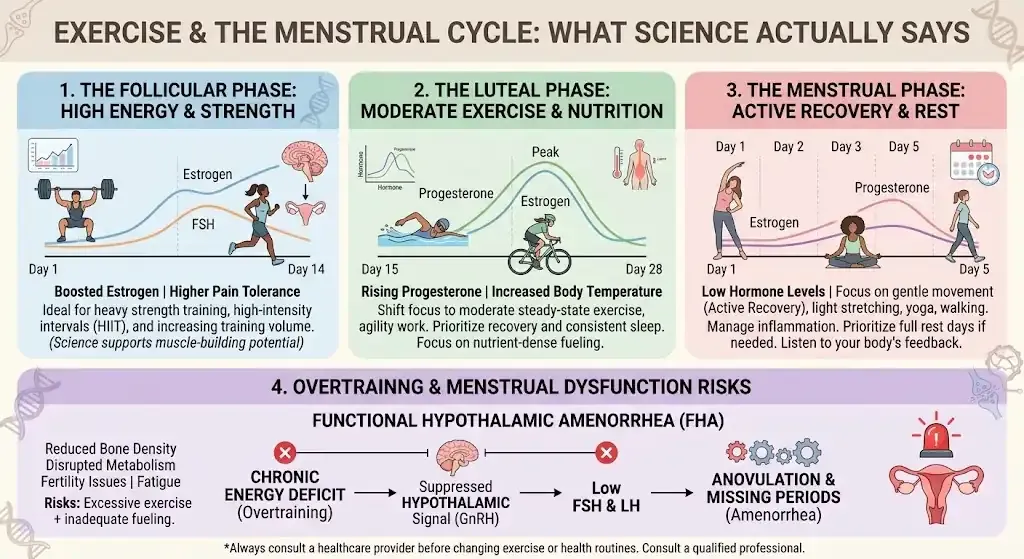
Phase-by-Phase Table
These are general tendencies some people notice, not a fixed formula. If you are unsure which phase you are in, read about the menstrual cycle phases.
| Phase | Common tendency | Possible approach |
|---|---|---|
| Menstruation (days 1 to 5) | Lower energy for some, possible cramps | Walking, gentle yoga or lighter strength work. Modify or rest if pain is high. |
| Follicular (after period to ovulation) | Rising energy and recovery for many | Often a good window for progressive strength work or harder cardio if you feel strong. |
| Ovulation | Peak energy and power for some | A chance for heavier lifts or high-intensity efforts. Be aware of possible joint looseness. See what is the fertile window. |
| Luteal (after ovulation) | Higher body temperature, possible fatigue or PMS | Steady-state work, moderate weights or more recovery if symptoms appear. See PMS vs PMDD. |
Track Your Own Pattern
The most useful approach to exercise and the menstrual cycle is to log energy, pain, sleep and performance for a few cycles. Individual patterns usually become clear, and hormones behind them are explained in how hormones change your cycle.
Do People Really Train Differently by Phase?
Many people report training less around their period and more in the middle of the cycle, but habits vary widely from person to person.
What People Tend to Report
Surveys and app-based tracking studies often find that people report lower activity and effort around menstruation, and more energy in the days before ovulation. These are averages, and they can hide large differences between individuals. Cramps, heavy bleeding, sleep and stress all change how much a person feels like doing.
Why Habits Differ
What you do is shaped by more than hormones. Work schedules, the weather, motivation and injuries all affect training, so a dip in activity on your period is not proof that the phase itself limits performance.
Regular vs Irregular Cycles: Does Training Look Different?
With irregular cycles it is harder to know your phase, so track symptoms and energy instead of counting days.
Regular Cycles
If your cycle is predictable, you can estimate the phases from the calendar and compare them with how you feel. Patterns often show up within a few cycles.
Irregular Cycles
When cycle length varies a lot, calendar phases are only guesses. Follow how you feel on the day, and use signs such as ovulation signs if you want to place yourself. Irregular cycles can also reflect PCOS, thyroid problems or very heavy training, so see menstrual cycle irregularities if the pattern is new.
| Cycle type | How to plan |
|---|---|
| Regular cycles | Estimate phases from the calendar and test whether the pattern matches how you feel |
| Irregular cycles | Skip phase rules, adjust by daily energy and symptoms, and look into the cause if irregularity is new |
Simple Exercise Swaps When You Feel Off
Small swaps keep you moving on harder days without forcing intensity.
Four Easy Swaps
| Instead of | Try |
|---|---|
| Heavy back squats | Goblet squats or leg press |
| Barbell bench press | Dumbbell floor press |
| High-impact HIIT | Steady cycling or swimming |
| Intense core work | Gentle pelvic tilts or breathing-focused moves |
Fuel matters too. See nutrition during menstruation and the best foods for period pain relief.
A Month of Movement: Putting It Together
Keep training steady across the month and adjust the load, not the habit, around your period and late luteal days.
Sample Month at a Glance
| Part of the cycle | Training focus |
|---|---|
| Period days | Walking, gentle yoga, easy swimming or light strength, depending on comfort |
| After your period | Build back up with strength work or harder cardio as you feel strong |
| Around ovulation | Heavier or faster sessions if you feel good, with good warm-ups |
| Late luteal days | Moderate steady sessions, more rest and sleep, extra food if hungry |
This is a starting point, not a prescription. The best plan is the one you can keep up all month.
When Exercise Becomes a Problem
Very heavy training plus low energy intake can stop periods. Three missed periods or extreme fatigue means reduce training and see a doctor.
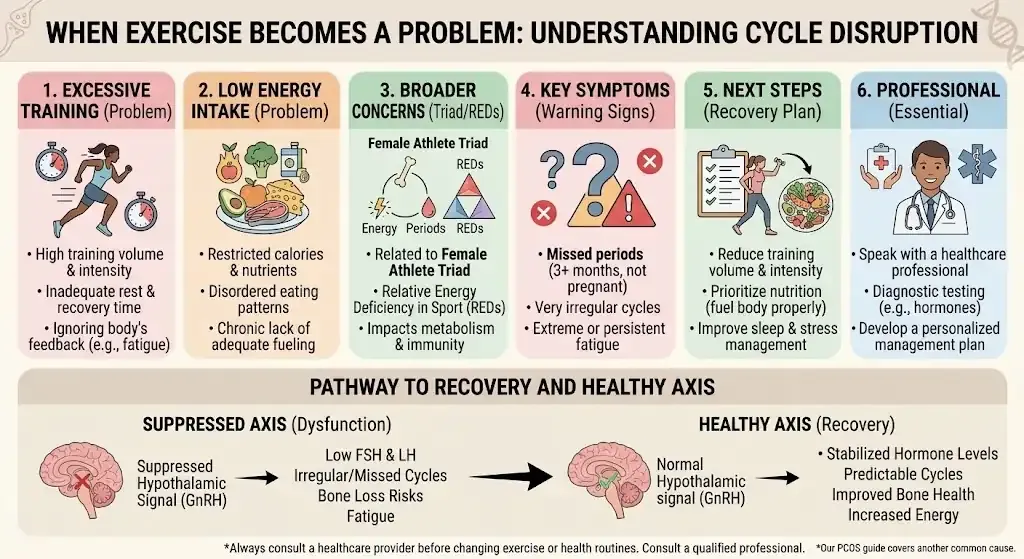
Exercise-Induced Amenorrhea
Excessive training combined with low energy intake can disrupt the cycle. This is sometimes called exercise-induced amenorrhea and is linked to broader concerns such as the Female Athlete Triad and REDs (Relative Energy Deficiency in Sport). It is most relevant to athletes and people in high-training sports.
Warning Signs
- Missed periods for 3 months or more, when not pregnant
- Very irregular cycles that develop alongside a training increase
- Extreme or persistent fatigue
If any of these apply, reduce training volume, improve nutrition and speak with a doctor. Other causes of missed periods include PCOS (see PCOS and ovulation), stress (see how stress affects your period) and weight changes.
When to See a Doctor
See a doctor for 3 missed periods, severe pain, very heavy bleeding or cycles that change after you raise training.
Signs to Get Checked
No period for 3 months or more (and not pregnant) · Severe pain that exercise and heat do not ease, which may need a check for conditions such as endometriosis · Very heavy bleeding with dizziness or breathlessness · Cycles that stay irregular after you raise training. If your period is late for another reason, see why your period may be late.
Frequently Asked Questions
19 questions answeredIs it safe to exercise during your period?
Does exercise help period cramps?
Does cycle syncing actually improve workout performance?
What is the best exercise during each phase of the menstrual cycle?
What exercise swaps help when I feel crampy or bloated?
Can too much exercise stop my period?
Should I follow a strict cycle-syncing workout plan?
Should I skip the gym when I’m on my period?
What are the best exercises to do during your period?
Does working out make your period heavier?
Is it better to do strength training or cardio during your period?
Should I exercise if I have heavy periods?
Does the menstrual cycle affect muscle growth or strength gains?
Can I do HIIT on my period?
What should I do if exercise makes my cramps worse?
What is cycle syncing?
Should I train differently if my cycles are irregular?
Does exercise change the length of my cycle?
Is it safe to exercise if I have a late period?


Sources & References
- McNulty KL, Elliott-Sale KJ, Dolan E, Swinton PA, Ansdell P, Goodall S, Thomas K, Hicks KM. The Effects of Menstrual Cycle Phase on Exercise Performance in Eumenorrheic Women: A Systematic Review and Meta-Analysis. Sports Medicine. 2020;50(10):1813–1827. doi:10.1007/s40279-020-01319-3. PMID: 32661839. 78 studies pooled; found only a trivial (ES = −0.14) average effect of cycle phase on performance, with “low” quality evidence overall. PubMed
- Xiang Y, Li Q, Lu Z, Yu Z, Ma G, Liu S, Li Y. Efficacy and Safety of Therapeutic Exercise for Primary Dysmenorrhea: A Systematic Review and Meta-Analysis. Frontiers in Medicine. 2025;12:1540557. doi:10.3389/fmed.2025.1540557. PMID: 40078380. 29 RCTs; exercise reduced pain intensity by a mean 2.62 points (VAS), strength training alone by 1.76 points. Full text (PMC)
- Tsai IC, Hsu CW, Chang CH, Lei WT, Tseng PT, Chang KV. Comparative Effectiveness of Different Exercises for Reducing Pain Intensity in Primary Dysmenorrhea: A Systematic Review and Network Meta-Analysis of Randomized Controlled Trials. Sports Medicine – Open. 2024;10:63. doi:10.1186/s40798-024-00718-4.
- Meignié A, Duclos M, Carling C, Orhant E, Provost P, Toussaint JF, Antero J. The Effects of Menstrual Cycle Phase on Elite Athlete Performance: A Critical and Systematic Review. Frontiers in Physiology. 2021;12:654585. doi:10.3389/fphys.2021.654585.
- Colenso-Semple LM, D’Souza AC, Elliott-Sale KJ, Phillips SM. Current Evidence Shows No Influence of Women’s Menstrual Cycle Phase on Acute Strength Performance or Adaptations to Resistance Exercise Training. Frontiers in Sports and Active Living. Cited via Journal of Applied Physiology, 2025.
- Office on Women’s Health, U.S. Department of Health & Human Services. Your Menstrual Cycle. womenshealth.gov