
How Long Does a Period Last? What Is Normal?
How long does a period last? For most people it is 2 to 7 days, and 3 to 5 days is the most common. This guide explains what counts as normal, why period length changes, and when a shorter or longer period deserves a closer look.
Most of us wonder at some point whether our period is too short, too long, or just right. The honest answer is that there is a wide normal range, and your own pattern matters more than any single number.
Knowing your usual length makes changes much easier to spot. A period calculator helps you log your start dates and bleeding days, and it is worth learning what a normal menstrual cycle looks like so you can compare the two.
Key Takeaways
- Most periods last 2 to 7 days, and 3 to 5 days is the most common length.
- Period length is the days you bleed. Cycle length is the days from one period to the next. They are not the same thing.
- A period that is a day shorter or longer now and then is usually nothing to worry about.
- Bleeding that regularly goes beyond 7 to 8 days, or a sudden big change, is worth discussing with a doctor.
- Tracking 3 or more cycles gives you the clearest picture of what is normal for you.
How Long Does a Period Last?
For most people, a period lasts between 2 and 7 days. Many bleed for about 3 to 5 days. Flow is usually heaviest in the first 2 to 3 days and then slowly lightens until it stops.
Some sources treat an 8-day period as still within range. What matters is whether your usual length stays steady, not whether you match an average.
Quick answer: a normal period lasts 2 to 7 days, with 3 to 5 days being the most common. Regularly bleeding longer than 7 to 8 days is worth a doctor visit.
What Is Typical for Period Length?
Think of period length as a range rather than a fixed number. Here is how common lengths are usually viewed.
| Length | How it is usually seen | What to do |
|---|---|---|
| 1 day or less | Often too short to count as a full period, though it can be normal for some people | Track it, and ask a doctor if it is new for you |
| 2 days | Can be normal if it is your usual pattern | Nothing, if your cycle is otherwise regular |
| 3 to 5 days | The most common length | Nothing needed |
| 6 to 7 days | Still within the typical range | Watch flow, especially if it is heavy |
| 8 days or more | Occasionally happens, but not as a pattern | Talk to a doctor if it keeps happening |
Age also plays a part. Periods tend to vary more in the first few years after the first one (see our first period guide) and again in the years before menopause.
Period Length vs. Cycle Length
These two terms often get mixed up. Period length is how many days you bleed. Cycle length is the number of days from the first day of one period to the first day of the next.
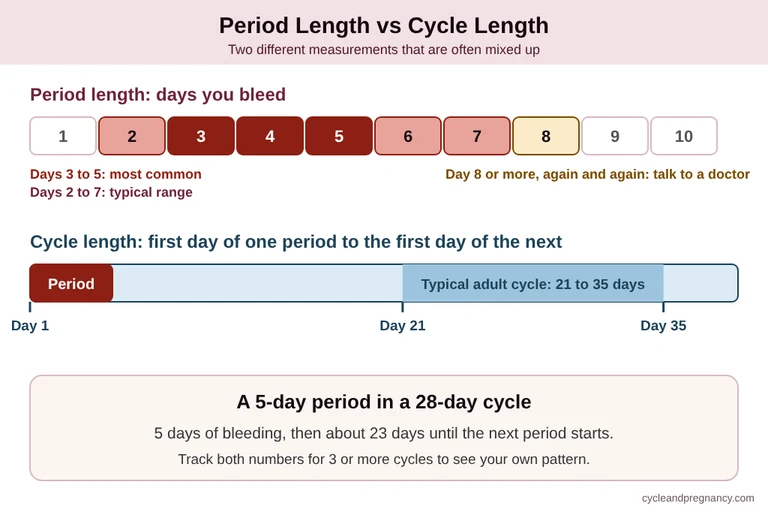
The American College of Obstetricians and Gynecologists describes a typical adult cycle as 21 to 35 days from one period to the next. The bleeding itself is just the first part of that cycle, which is why it helps to understand the phases of the menstrual cycle.
Is a 2-, 3-, 5-, 7- or 8-Day Period Normal?
Yes, for some people. It is normal when it matches your usual pattern.
Yes. This is well within the typical range.
Yes. One of the most common lengths.
Yes. The upper end of the usual range, and normal for many people.
It can happen once in a while. If it keeps happening, see a doctor.
One longer or shorter period is rarely a concern. A change that lasts for several cycles tells you much more.
What Affects How Long Your Period Lasts?
- Age: cycles are often less predictable in the early years after the first period and again during perimenopause.
- Hormonal birth control: pills, patches, rings, injections, implants and hormonal IUDs often make periods lighter or shorter, though they can cause longer bleeding when you start or stop.
- Stress: long periods of pressure can disturb the hormone signals that run your cycle. Read more on how stress affects your period.
- Weight changes: quick weight loss or gain can shift your hormones, as explained in weight changes and your cycle.
- Intense exercise: hard training with too little food can lead to shorter or missed periods. See our guide to exercise and your menstrual cycle.
- Health conditions: PCOS, thyroid problems, fibroids, polyps, endometriosis and adenomyosis can all change how long you bleed.
- Medicines: some medicines, including blood thinners, can change flow and length.
Why Is My Period So Short?
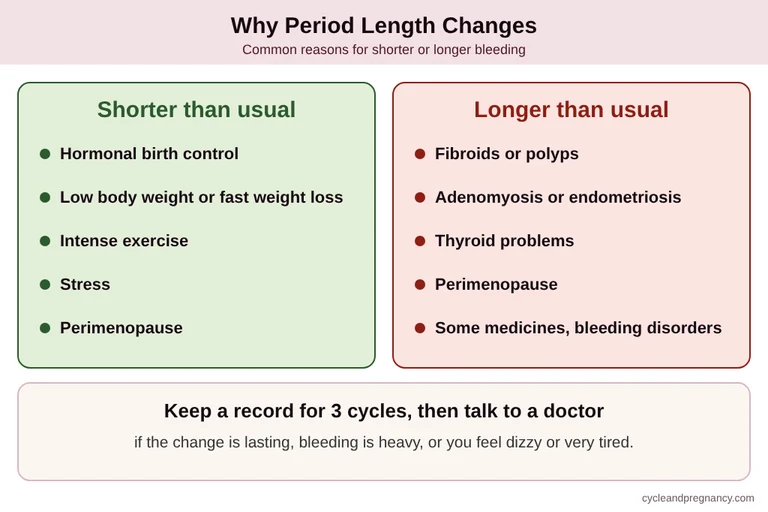
A short period of 2 to 3 days can simply be your normal. If your periods suddenly became much shorter, the cause may be hormonal birth control, low body weight, heavy exercise, stress, or hormone changes as you approach menopause.
Occasionally, very light or very short bleeding can also be implantation spotting early in pregnancy, so take a test if there is any chance you could be pregnant and the timing seems different.
Why Is My Period So Long?
Periods that regularly last more than 7 days can come from hormone imbalances, fibroids or polyps, adenomyosis, endometriosis, thyroid problems, perimenopause, bleeding disorders, or certain medicines. If the bleeding is also heavy, you may be dealing with heavy periods, which can slowly lower your iron levels.
How Much Blood Is Normal During a Period?
Most people lose roughly 30 to 40 ml (about 2 to 3 tablespoons) of blood across a whole period, and losing more than about 80 ml is considered heavy, according to Mayo Clinic. Few of us measure it, so the signs below are more practical.
Signs your bleeding may be heavier than typical: changing a pad or tampon every 1 to 2 hours, passing large clots, or feeling dizzy, short of breath or unusually tired.
The color of your blood can also tell you something, and our page on period blood color explains what is usual. If you are unsure whether light bleeding is your period at all, see spotting from a real period.
What Can I Do If My Period Is Too Long or Too Short?
Start by checking whether this is a real change or just normal variation. These steps usually help.
- Track it. Note your first day, how many days you bleed, how heavy it is, and any pain or spotting for at least 3 cycles.
- Look for a trigger. New birth control, a recent illness, a big change in weight, training or stress levels, or a new medicine can all explain a shift.
- Eat and rest well. Regular meals, enough iron and good sleep support steady cycles. If you bleed heavily, ask about an iron check.
- Rule out pregnancy if your period was unusually light or short and you could be pregnant.
- See a doctor if the change lasts more than 3 months or comes with heavy bleeding, pain or dizziness.
A doctor may ask about your history, check your iron and thyroid levels, or arrange an ultrasound. Treatment depends on the cause, and options may include hormonal methods or other medicines. If your cycles are also unpredictable, our guide to irregular cycles may help.
How to Track Your Period Length
Tracking is the simplest way to find out what is normal for you. Write down the first day of bleeding, how many days it lasts, how heavy it is (light, medium or heavy), any spotting before or after, and your pain or other symptoms.
After a few months you will see your average. Using the period calculator makes this easy and also shows when your next period is likely to start.
When Should You See a Doctor?
Contact a healthcare professional if your period regularly lasts longer than 7 to 8 days, bleeding is much heavier than usual, you soak through a pad or tampon every hour or two, your periods suddenly become much shorter or longer, you have severe pain, you bleed between periods or after sex, or you feel dizzy, weak or short of breath.
The NHS also gives clear advice on when heavy periods need medical help. If you are unsure, it is always fine to ask.
Frequently Asked Questions
What is the normal length of a period?
How many days does a period usually last?
Is a 3-day period normal?
Is a 7-day period normal?
Is an 8-day period normal?
Why is my period lasting longer than usual?
Why is my period so short?
How long is too long for a period?
How long should my period last as a teenager?
The Bottom Line
For most people, a normal period lasts 2 to 7 days, and 3 to 5 days is very common. Your length can shift slightly from cycle to cycle and across different stages of life.
What counts most is your own pattern. Track how many days you bleed and how heavy it is, and speak to a healthcare professional if your period regularly runs past 7 to 8 days, changes suddenly, is very heavy, or comes with severe symptoms. One unusual period is rarely a problem, but a lasting change is worth checking.


Sources & References
- American College of Obstetricians and Gynecologists. Your Menstrual Cycle. acog.org
- Mayo Clinic. Menstrual cycle: What’s normal, what’s not. mayoclinic.org
- NHS. Heavy periods. nhs.uk
- NHS. Periods. nhs.uk
- Cleveland Clinic. Menstrual Cycle (Normal Menstruation): Overview. my.clevelandclinic.org
- American College of Obstetricians and Gynecologists, Committee on Adolescent Health Care. Committee Opinion No. 651: Menstruation in Girls and Adolescents: Using the Menstrual Cycle as a Vital Sign. Obstetrics & Gynecology. 2015;126(6):e143-e146.
- Bull JR, Rowland SP, Scherwitzl EB, Scherwitzl R, Danielsson KG, Harper J. Real-world menstrual cycle characteristics of more than 600,000 menstrual cycles. npj Digital Medicine. 2019;2:83.
- Fraser IS, Critchley HOD, Broder M, Munro MG. The FIGO recommendations on terminologies and definitions for normal and abnormal uterine bleeding. Seminars in Reproductive Medicine. 2011;29(5):383-390.
- Munro MG, Critchley HOD, Fraser IS; FIGO Menstrual Disorders Committee. The two FIGO systems for normal and abnormal uterine bleeding symptoms and classification of causes of abnormal uterine bleeding in the reproductive years: 2018 revisions. International Journal of Gynecology & Obstetrics. 2018;143(3):393-408.
- Hallberg L, Högdahl AM, Nilsson L, Rybo G. Menstrual blood loss: a population study. Acta Obstetricia et Gynecologica Scandinavica. 1966;45(3):320-351.
- Itriyeva K. The normal menstrual cycle. Current Problems in Pediatric and Adolescent Health Care. 2022;52(5):101183.