
Why Is My Period Early? Causes and When to Worry
Why is my period early? Most of the time the reason is ordinary: stress, poor sleep, exercise, weight changes, hormones or a shift in ovulation. This guide explains what counts as early, the common causes, and when it is worth seeing a doctor.
A period that turns up days before you expected it can be unsettling, especially when your cycle is usually predictable. The reassuring part is that a single early period is often temporary and does not mean anything is wrong.
Not all bleeding is a true period, though, so it helps to check the basics first. A period calculator can show whether your date really was off, and the signs your period is coming can help you tell what your body was doing beforehand.
Key Takeaways
- An early period means bleeding started sooner than your usual pattern or than an app predicted. Count the days between periods to see your real cycle length.
- One period a few days early is usually normal variation. A cycle of around 14 days that repeats deserves attention.
- Common causes include stress, sleep and travel changes, weight changes, hard exercise, hormonal birth control, emergency contraception and earlier ovulation.
- Light bleeding can be spotting, breakthrough bleeding or early pregnancy, so test if pregnancy is possible.
- See a doctor for repeated short cycles, heavy bleeding, bleeding after sex or between periods, or significant pain.
What Counts as an Early Period?
Your cycle runs from the first day of one period to the first day of the next. Day 1 is the first day of real bleeding, not a day of light spotting. An early period simply means bleeding began sooner than your usual pattern, or sooner than a calculator predicted.
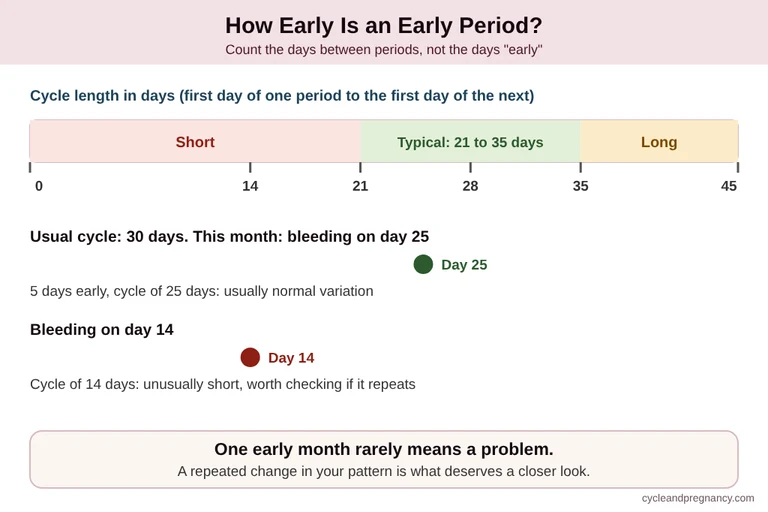
Say your periods usually arrive every 30 days, but this time bleeding starts on day 25. Your cycle was just shorter that month. Predictions come from your past cycles, so they are an estimate and not a promise for the current one. If you want the basics first, read about what a period is.
Quick answer: an early period is bleeding that starts sooner than your normal cycle length. Count the days since your last period began, and compare that number with your usual cycle, not with the date an app showed.
How Early Is Too Early?
No single number of days automatically means a problem. Your own pattern matters most. The American College of Obstetricians and Gynecologists describes a typical adult cycle as 21 to 35 days, although the normal range varies with age.
| What happened | How it is usually seen |
|---|---|
| 3 to 5 days early, once | Often normal month-to-month variation |
| About a week early, now and then | Can happen after stress, travel, illness or a contraception change |
| Cycle of 21 to 35 days | Within the typical adult range |
| Cycle of about 14 days | Unusually short, so worth checking if it repeats |
| A steady 28 to 30 day cycle that suddenly becomes 14 to 20 days | A change in pattern that matters more than one odd month |
To find your true cycle length, mark the first day of your last period and the first day of the new one, then count the days between them. A few cycles give a much clearer picture than a single month.
Is It Really a Period or Just Spotting?
Before you assume your period came early, check how much you are actually bleeding. Light bleeding between periods is usually spotting, and it can have a different cause. Our guide on spotting from a real period goes into more detail.
| Feature | Typical period | Spotting |
|---|---|---|
| Flow | A recognizable menstrual flow | Usually very light |
| Duration | Often several days | Hours to a couple of days |
| Protection | Pad, tampon or cup | Liner or none |
| Timing | Follows your usual cycle | Can happen between periods |
| Color | Often red or dark red | Pink, red or brown |
| Pattern | Similar to past periods | Often different from normal |
If the bleeding looks and feels like your usual period and goes on for several days, it is more likely a true period. If it is very light or brief, spotting is more likely. Spotting that keeps coming back is worth mentioning to a doctor.
What Causes Your Period to Start Early?
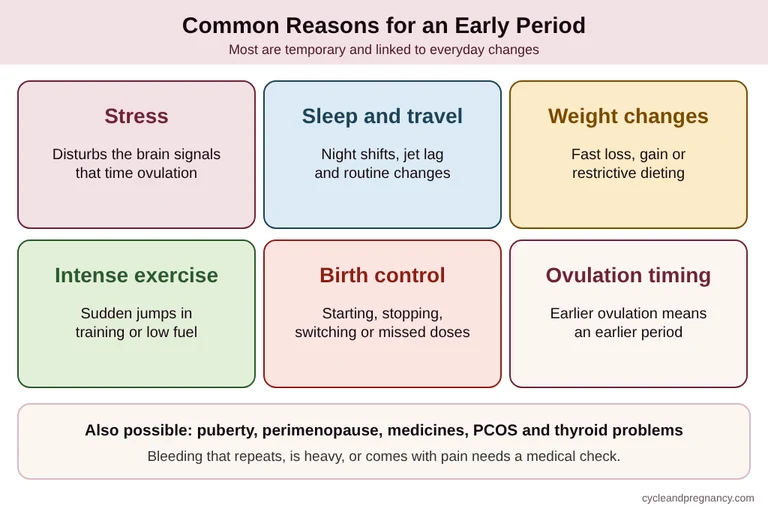
Most causes are common and not serious, which is why a single early period is rarely a worry. Here are the main ones, starting with the everyday explanations.
Normal cycle variation
Your cycle is not a fixed 28-day clock. Hormones shift through the month and the timing of ovulation moves a little, so one cycle can simply run shorter than the last. If the bleeding looks normal and your next cycles go back to your usual length, there is often nothing to fix.
Stress
Stress can disturb the hormone signals between your brain and ovaries, which can change when you ovulate. Your next period may then come early, late or become less predictable. Work pressure, poor sleep, illness, travel and big life changes can all play a part. Read more about how stress affects your period.
Weight changes
Fast weight loss, weight gain, very restrictive dieting or too few calories can affect the hormones that control your cycle, because your body responds to how much energy it has. See weight changes and your cycle for how this works.
Intense exercise
Exercise is good for you, but a sudden jump in training, or hard training without enough food and rest, can shift your cycle. Exercise and your menstrual cycle are closely linked, especially for endurance athletes.
Sleep, travel or routine changes
Night shifts, jet lag and long trips can change menstrual timing, because sleep and body clocks interact with your hormones. This is usually temporary, but track it if it keeps happening.
Puberty
In the first few years after periods begin, cycles are often irregular while the body matures. An occasional early period is common at this stage, though very heavy bleeding or severe pain is still worth a doctor visit.
Perimenopause
As menopause approaches, often in the 40s, ovulation becomes less predictable. Periods can come earlier, later, heavier, lighter, longer or shorter. A new change should not be blamed on perimenopause automatically, particularly if it is heavy or persistent.
Hormonal birth control
Starting, stopping, switching or missing doses of the pill, patch, ring, injection, implant or hormonal IUD can change your bleeding, with early bleeding, spotting or breakthrough bleeding. Do not stop a prescribed method without speaking to a healthcare professional.
Emergency contraception
Emergency contraception can shift the timing of your next period earlier or later, and sometimes causes spotting. If pregnancy is still possible or your period looks very different, follow the testing advice for your method.
Medicines that affect bleeding
Some medicines, such as blood thinners, can increase bleeding, and others affect hormones, ovulation or clotting. If your pattern changed after starting something new, mention it to your doctor or pharmacist.
Can Changes in Ovulation Cause an Early Period?
Yes, ovulation is one of the biggest influences on timing. The first part of your cycle, before ovulation, is the follicular phase, and its length can change a lot from month to month. After ovulation comes the luteal phase, which is more consistent. You can read about each stage in the phases of the menstrual cycle.
If you ovulate earlier than usual, your period tends to arrive earlier too. Sometimes ovulation does not happen at all in a cycle, which can cause irregular or unexpected bleeding. Stress, weight changes, hard exercise, illness, contraception, perimenopause, PCOS and thyroid problems can all affect it. An ovulation calculator gives an estimate of when you are likely to ovulate, which can help explain a shift.
Implantation Bleeding and Your Periods
If pregnancy is possible, do not assume that unexpected bleeding is just an early period. Bleeding alone cannot confirm or rule out pregnancy, and a pregnancy test is usually the most practical first step.
Could it be implantation bleeding?
Some people have light bleeding in very early pregnancy, often called implantation bleeding, and it is easy to mistake for a period. It is usually much lighter and shorter than your normal flow. Because bleeding by itself cannot show that implantation happened, test if the bleeding is unusually light and pregnancy is possible.
Could it be early pregnancy loss?
Very early loss can look like a period, especially if you did not know you were pregnant. Heavier bleeding than usual, strong cramps, passing tissue or large clots, or dizziness are reasons to get checked. If you are pregnant and have bleeding with significant pain, seek urgent help, because an ectopic pregnancy can be serious. The NHS guidance on bleeding in pregnancy lists the warning signs.
Could it be breakthrough bleeding?
This is bleeding outside your expected period, and it is common with hormonal contraception, especially after starting or switching a method. It may look like spotting or brown, pink or red discharge. If you count it as Day 1 by mistake, your calculations will be off, so try to separate light spotting from the start of your real flow.
Health Conditions That Can Make Periods Early
If early periods keep happening, a medical cause may be worth ruling out.
- PCOS can disturb ovulation and cause irregular cycles, sometimes with acne, extra facial or body hair, weight changes or trouble getting pregnant.
- Thyroid conditions, both underactive and overactive, are linked to menstrual changes.
- Endometriosis can bring pelvic pain, painful periods or irregular bleeding, although an early period alone does not point to it.
- Diabetes and other long-term conditions can affect hormones and cycle regularity, especially if poorly controlled.
- Fibroids, polyps or other uterine conditions can cause abnormal bleeding that is not really about timing, such as bleeding between periods or unusually heavy flow.
Solutions for Managing Cycle Irregularities
You cannot control exactly when your period arrives, but a few habits make your cycle easier to understand and sometimes steadier.
- Record the first day of bleeding. That is Day 1 of the new cycle.
- Check the bleeding. Is it like your normal period or just spotting? How long does it last and how heavy is it?
- Work out your real cycle length and compare it with earlier cycles.
- Look at recent changes: stress, sleep, travel, exercise, weight, illness, new medicines or contraception.
- Take a pregnancy test if pregnancy is possible.
- Track the next 2 to 3 cycles, including start date, length, flow, spotting and pain.
For longer-term support, eat regular balanced meals, avoid crash dieting, keep exercise sustainable, protect your sleep, and take any prescribed medicine as directed. The goal is not a perfect 28-day cycle, because healthy cycles vary. If your cycles are often unpredictable, our guide to irregular cycles and the period calculator for irregular periods can help. The NHS also explains what to do about irregular periods.
When Does an Early Period Need Assessment?
Usually fine to monitor: the period is only a few days early, the bleeding looks like your normal one, you feel well, there is no severe pain, and your cycle returns to its usual length.
Worth a medical check: your cycles repeatedly become very short, your pattern changes suddenly, you bleed between periods or after sex, periods become much heavier or longer, pelvic pain gets worse, you have signs of PCOS or thyroid problems, or you are having trouble getting pregnant.
Seek urgent care for very heavy bleeding, severe or worsening pelvic pain, fainting, severe dizziness, shortness of breath with heavy bleeding, or possible pregnancy with significant pain or unusual bleeding.
There is no single test for everyone. A doctor will usually ask about your cycle, recent changes, bleeding, pain, contraception, medicines and the chance of pregnancy. Depending on the answers, they may suggest a pregnancy test, blood or hormone tests, thyroid tests, a pelvic exam or an ultrasound. This article is general information and cannot diagnose the cause of abnormal bleeding.
Common Misconceptions About Early Periods
| Myth | What is actually true |
|---|---|
| An early period means I am pregnant | Pregnancy is only one possible cause. Stress, sleep, exercise, weight, contraception and ovulation changes are far more common. |
| My app is always right about my date | Apps estimate from past cycles. They cannot know exactly when you will ovulate this month. |
| Any early bleeding is a period | Spotting, breakthrough bleeding and pregnancy bleeding can all look like one. |
| Stress cannot change my cycle | Strong stress can disturb the signals that time ovulation, so your period can arrive earlier or later. |
| Every healthy cycle is 28 days | Healthy cycles vary from person to person and month to month. |
| One early period means something is wrong | A single change is often temporary. A repeated change is the real signal. |
Does an Early Period Affect Fertility?
Not automatically. But if early or irregular periods come from irregular ovulation, your fertile window becomes harder to predict. If you are trying to conceive, your real cycle length and ovulation timing are more useful than a fixed calendar guess, and our guide on how to track your fertile window explains the methods. If your cycles stay irregular while you are trying, discuss it with a healthcare professional.
Frequently Asked Questions
Why did my period come early?
Is a period 5 days early normal?
Is a period 1 week early normal?
Is a period 2 weeks early normal?
Why does my period keep coming early every month?
Why did my period come early but I am not pregnant?
Can stress cause an early period?
Can birth control make your period come early?
Can emergency contraception make your period come early?
Can pregnancy cause bleeding that looks like an early period?
Is early bleeding always a period?
When is an early period a concern?
Should I use a period calculator if my period came early?
The Bottom Line
An early period can happen for many reasons, and an occasional one is often temporary. Normal variation, stress, sleep or routine changes, weight changes, intense exercise, contraception and earlier ovulation can all shift your timing. First make sure the bleeding is a real period, since spotting, breakthrough bleeding and pregnancy-related bleeding can be mistaken for one.
Record the first day of real bleeding, work out your actual cycle length, compare it with your usual pattern, and track the next two or three cycles. Test for pregnancy if it is possible. One unusual cycle rarely means something is wrong, but a repeated change is what deserves a closer look.


Sources & References
- American College of Obstetricians and Gynecologists. Your Menstrual Cycle. acog.org
- NHS. Irregular periods. nhs.uk
- NHS. Vaginal bleeding in pregnancy. nhs.uk
- Mayo Clinic. Menstrual cycle: What’s normal, what’s not. mayoclinic.org
- American College of Obstetricians and Gynecologists, Committee on Adolescent Health Care. Committee Opinion No. 651: Menstruation in Girls and Adolescents: Using the Menstrual Cycle as a Vital Sign. Obstetrics & Gynecology. 2015;126(6):e143-e146.
- Bull JR, Rowland SP, Scherwitzl EB, Scherwitzl R, Danielsson KG, Harper J. Real-world menstrual cycle characteristics of more than 600,000 menstrual cycles. npj Digital Medicine. 2019;2:83.
- Fraser IS, Critchley HOD, Broder M, Munro MG. The FIGO recommendations on terminologies and definitions for normal and abnormal uterine bleeding. Seminars in Reproductive Medicine. 2011;29(5):383-390.
- Munro MG, Critchley HOD, Fraser IS; FIGO Menstrual Disorders Committee. The two FIGO systems for normal and abnormal uterine bleeding symptoms and classification of causes of abnormal uterine bleeding in the reproductive years: 2018 revisions. International Journal of Gynecology & Obstetrics. 2018;143(3):393-408.
- Harville EW, Wilcox AJ, Baird DD, Weinberg CR. Vaginal bleeding in very early pregnancy. Human Reproduction. 2003;18(9):1944-1947.
- Bae J, Park S, Kwon JW. Factors associated with menstrual cycle irregularity and menopause. BMC Women’s Health. 2018;18:36.
- Loucks AB, Thuma JR. Luteinizing hormone pulsatility is disrupted at a threshold of energy availability in regularly menstruating women. Journal of Clinical Endocrinology & Metabolism. 2003;88(1):297-311.
- Itriyeva K. The normal menstrual cycle. Current Problems in Pediatric and Adolescent Health Care. 2022;52(5):101183.