
How to Track Your Fertile Window: Common Methods
Knowing how to track fertile window days takes more than watching for symptoms. This guide compares seven common methods, from free calendar and cervical mucus checks to ovulation test kits, wearables and clinic tests, and shows how to combine them.
Not sure where to start? Enter your dates into our free ovulation calculator for a quick estimate, then check it against a normal menstrual cycle length to see if your pattern is typical.
Why Tracking Your Fertile Window Matters
Your fertile window is the stretch of days each cycle when pregnancy is possible: the few days before ovulation, plus ovulation day itself. Sperm can survive inside the body for up to five days, so the window opens well before the egg is released. In a study of healthy women trying to conceive, pregnancy happened only when sex fell within a six-day window ending on ovulation day (Wilcox et al., NEJM 1995).
- Trying to conceive: time sex for the days with the highest chance of pregnancy.
- Avoiding pregnancy naturally: know which days carry the most risk (see the section on fertility awareness below).
- Understanding your body: spot patterns, late ovulation or cycle changes worth mentioning to a doctor.
No single method pinpoints ovulation with certainty, which is why most people combine two or more. For the basics, read what the fertile window is first.
When Am I Ovulating? Calculating Your Monthly Fertility Window
Ovulation usually happens about 14 days before your next period starts, not always on day 14 of the cycle. Count back 14 days from the day your next period is due, then add the five days before it to get a fertility window estimate. Day 1 is the first day of full bleeding.
| Cycle length | Likely ovulation day | Estimated fertile window |
|---|---|---|
| 24 days | Day 10 | Days 5 to 10 |
| 26 days | Day 12 | Days 7 to 12 |
| 28 days | Day 14 | Days 9 to 14 |
| 30 days | Day 16 | Days 11 to 16 |
| 32 days | Day 18 | Days 13 to 18 |
| 35 days | Day 21 | Days 16 to 21 |
The table assumes a 14-day luteal phase, which is typical but varies from person to person. Enter your own dates into the free ovulation calculator to get a personal estimate, or see how to calculate your ovulation day for the step-by-step math.
When Do People Typically Ovulate, and What Happens?
When ovulation usually happens
In a 28-day cycle, ovulation typically falls around day 14. In shorter or longer cycles it moves earlier or later, and it can shift by several days from one month to the next, even in regular cycles.
What happens when you ovulate
- Estrogen rises while a follicle in the ovary matures.
- A surge of luteinizing hormone (LH) triggers the follicle to release an egg, usually within about 24 to 36 hours of the surge starting.
- The egg moves into the fallopian tube, where it can be fertilized.
- The empty follicle becomes the corpus luteum and makes progesterone, which raises body temperature slightly.
How long does ovulation last?
Ovulation itself is brief: the egg survives roughly 12 to 24 hours after release. Because sperm can live up to five days, the fertile window is about six days long. The Cleveland Clinic guide to ovulation explains the process in more detail, and our guide to the signs of ovulation lists the body clues to watch.
Common Methods to Track Your Fertile Window
Each of the methods below answers a different question. Some predict the window before it opens, others confirm that ovulation already happened.
| Method | Cost | Predicts or confirms | Best for |
|---|---|---|---|
| Calendar tracking | Free | Estimates ahead | Regular cycles |
| Cervical mucus | Free | Predicts and signals | Early warning |
| Basal body temperature | Low (thermometer) | Confirms after | Learning your pattern |
| Ovulation test kits | Moderate (strips) | Predicts ahead | Pinpointing timing |
| Wearables and apps | Moderate to high | Estimates, varies | Convenience |
| Ultrasound and blood tests | Clinic cost | Confirms directly | Medical monitoring |
1. Calendar Tracking
Free · simplest starting point
Note the first day of each period for a few months to see your cycle length, then count back from the next expected period. A period calculator can project your next dates from those start days.
It works best with fairly regular cycles. If your cycle length swings by more than a week, pair it with a body-sign method.

2. Cervical Mucus Tracking
Free · early fertile-window clue
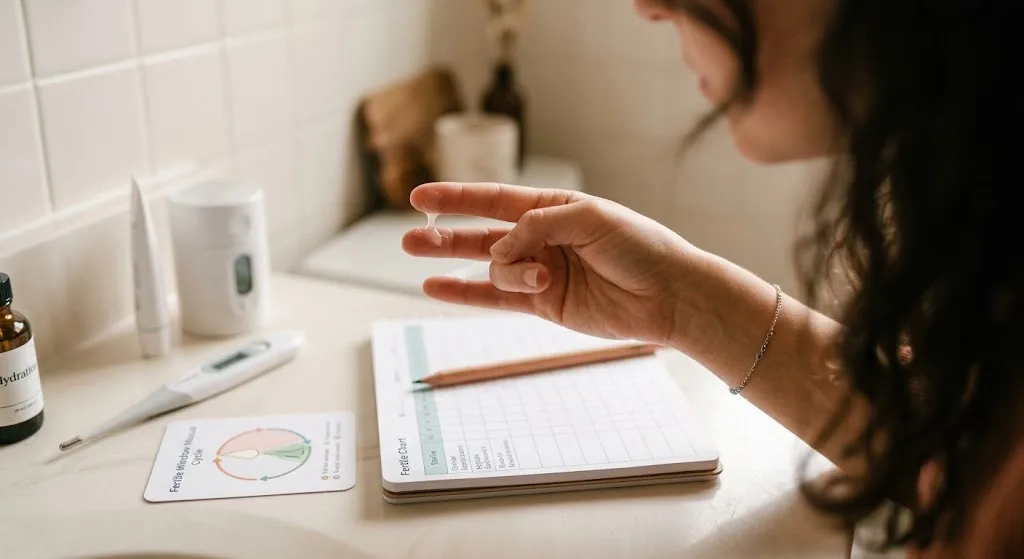
As ovulation approaches, cervical mucus becomes clearer, slippery and stretchy, often compared to raw egg white. This is usually the first sign that the fertile window is opening. Our guide to cervical mucus tracking for ovulation shows how to check and chart it, and the signs of ovulation guide covers other body clues.
Hydration, medicines, infections and hormonal birth control can change mucus, so use it alongside another method.
3. Basal Body Temperature (BBT)
Confirms ovulation after it happens
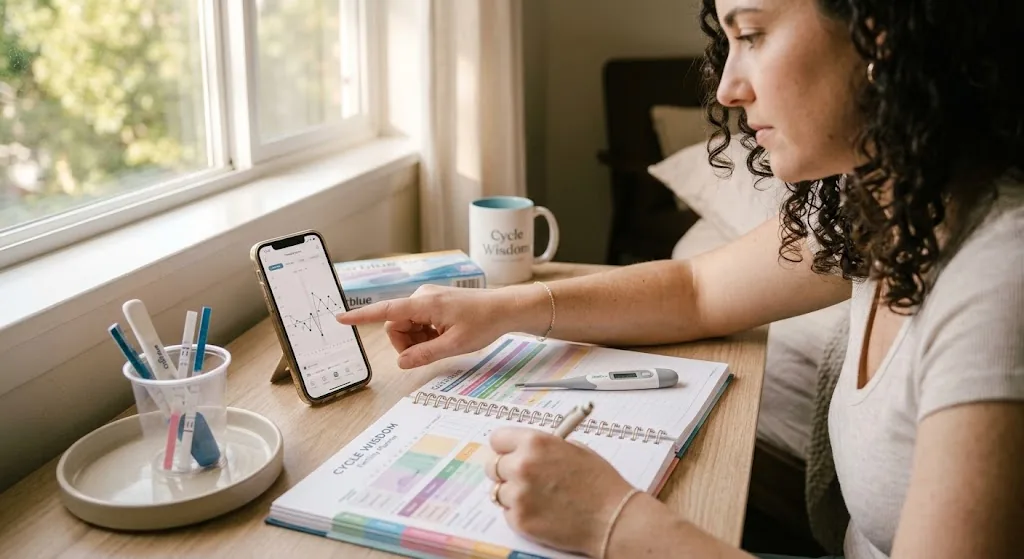
Take your temperature with a basal thermometer at the same time every morning, before getting up. A sustained rise of about half a degree Fahrenheit shows that ovulation has already happened. Our basal body temperature tracking guide explains how to read the chart.
Because the rise comes after ovulation, BBT confirms your pattern rather than predicting the window. It becomes useful after several charted cycles.
4. Ovulation Test Kits (OPKs)
Detects the LH surge before ovulation
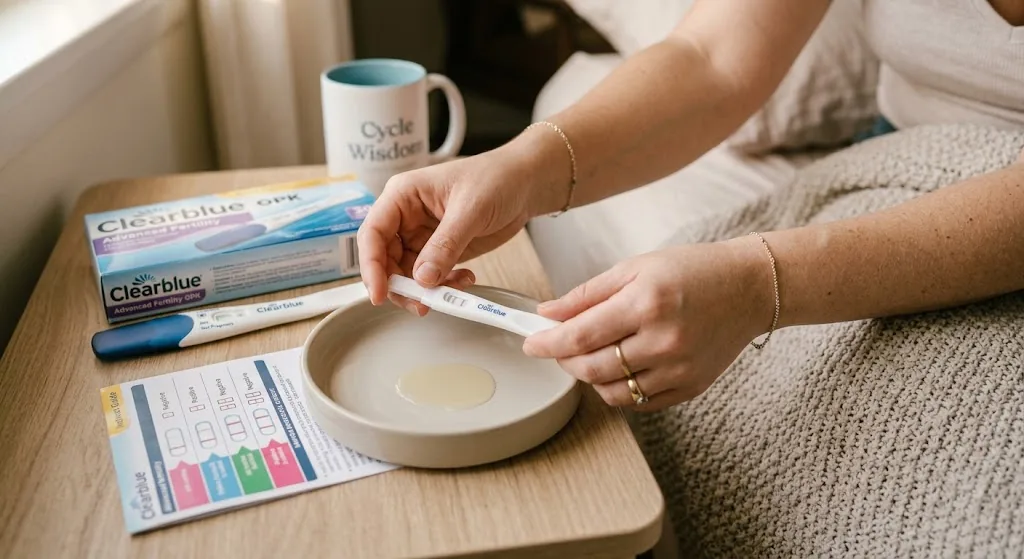
Ovulation predictor kits test urine for LH, which surges in the day or two before ovulation. A positive result means ovulation is likely soon, so it marks the peak of your fertile window. Not sure how to read a strip? See the guide to reading ovulation test results.
Start testing a few days before your expected ovulation and test at the same time each day. A positive test shows an LH surge, not that an egg was definitely released.
5. Wearable Technology and Fertility Apps
Convenient · estimates vary
Wearable rings, wristbands and fertility apps estimate ovulation from changes in skin temperature, heart rate or logged symptoms. They save you from taking a daily reading by hand and show trends over many cycles.
Accuracy differs between devices and between people, and apps that only count days behave like a calendar. Treat their predictions as estimates and cross-check with mucus or an ovulation test.
6. Ultrasound Monitoring and Blood Tests
Clinic-based · confirms directly
A doctor can follow the follicle with transvaginal ultrasound and check hormones such as progesterone in a blood test. Ultrasound shows follicle growth and release, and a mid-luteal progesterone level helps confirm that ovulation occurred.
These tests are usually used when conception is taking longer than expected, when cycles are irregular, or during fertility treatment, not for everyday tracking.
7. Combining Methods
The most reliable approach
Pair a prediction method with a confirmation method, for example cervical mucus plus an ovulation test, or a calendar plus a BBT chart. Each fills the other’s blind spots. Mayo Clinic also lists mucus changes, basal body temperature and ovulation tests as common ways to recognize ovulation. For a deeper comparison, read how to track ovulation with OPKs, BBT and apps.
How to Track Ovulation With an Irregular Period
When cycles vary by more than a week, calendar math becomes unreliable and ovulation can come late or not at all. Body signs and tests carry more weight than a date count.
- Log every period start for at least three months to see your real range.
- Check cervical mucus daily and note the first slippery, stretchy day.
- Use ovulation test strips over a longer stretch of days, since the LH surge is harder to time.
- Add a BBT chart or wearable to confirm that ovulation followed.
- Use a calculator built for variable cycles, such as the period calculator for irregular periods.
Conditions such as PCOS can cause several LH rises without ovulation, which may give confusing test results (see PCOS and ovulation). More detail is in our guide to calculating ovulation with irregular periods.
Ovulation Tracking as Natural Birth Control
Some people use fertility awareness to avoid pregnancy by skipping unprotected sex on fertile days. It relies on tracking mucus, temperature and cycle length together, not on a calendar alone.
- It needs daily records and a few cycles of practice before it is dependable.
- Typical use is less effective than hormonal or barrier methods, and it does not protect against sexually transmitted infections.
- It works poorly with irregular cycles, after childbirth or while breastfeeding.
ACOG explains fertility awareness-based methods and their limits. Our pages on the rhythm method failure rate and how reliable safe days are cover the numbers.
Using an Ovulation Calculator to Estimate Your Window
A calculator gives a quick starting estimate from your last period and cycle length without any charting. Try the free ovulation calculator, then read how to use an ovulation calculator accurately to improve the result. To see the logic behind the dates, see how a period calculator estimates the fertile window.
Calculators work from averages, so your real ovulation day can shift. Pair the estimate with mucus changes or an ovulation test.
Pinpointing Your Ovulation Day Within the Window
To narrow the broad window down to the ovulation day, combine one prediction clue with one confirmation clue.
- Estimate the window with a calculator or your cycle history.
- Watch for slippery, stretchy mucus as the window opens.
- Test with ovulation strips until you see a positive result.
- Confirm with a temperature rise that lasts at least three days.
- Repeat for two or three cycles to learn your own pattern.
Once you know your pattern, you can plan using the period calculator for trying to conceive, and see how long after ovulation you can get pregnant for timing after the window closes.
When to Seek Support
Tracking is a useful tool, but it does not replace medical care. See a doctor if:
- You are under 35 and have been trying to conceive for 12 months, or 35 or older and trying for 6 months (see the NHS infertility guidance).
- Your periods are shorter than 21 days, longer than 35 days, or have stopped for three months.
- Ovulation tests never turn positive, or your temperature never shows a rise.
- You have severe pelvic pain, very heavy bleeding or other symptoms that worry you.
Bring your cycle records with you, because they help the doctor see what is happening.
Conclusion
- Use a calendar or calculator for a starting estimate, then add body signs.
- Cervical mucus and ovulation test kits predict the window; BBT, ultrasound and blood tests confirm ovulation.
- Irregular cycles need tests and body signs more than date math.
- Track for two or three cycles, and ask a doctor if something seems off.
Frequently Asked Questions
Quick answers about tracking ovulation and the fertile window.
What is the most accurate way to track ovulation and your fertile window?
Can I track my fertile window without buying anything?
When am I ovulating in my cycle?
How long does ovulation last?
How long does it take to see a reliable fertile window pattern?
Do ovulation test kits work for irregular cycles?
Are fertility trackers and wearables accurate?
Can I use ovulation tracking as natural birth control?
Is an ovulation calculator accurate enough on its own?


Sources & References
- Cleveland Clinic. Cervical Mucus: Chart, Stages, Tracking & Fertility. Describes fertile cervical mucus as stretchy, slippery, and resembling raw egg whites, typically appearing around cycle days 10–14 and lasting three to four days. Lists hormonal birth control, infections, hydration, medications, and stress as factors that can alter cervical mucus. my.clevelandclinic.org
- Cleveland Clinic. Basal Body Temperature: Family Planning Method. States that basal body temperature typically rises less than half a degree Fahrenheit after ovulation (0.4–1 °F), and that the method confirms ovulation only after it has already happened — once elevated temperatures hold for three consecutive days — rather than predicting it in advance. my.clevelandclinic.org
- Fertility and Sterility (ScienceDirect). Similar Accuracy and Patient Experience With Different One-Step Ovulation Predictor Kits. Peer-reviewed study testing five commercially available OPK brands, finding all highly accurate at detecting the LH surge (91.75%–96.90% depending on brand) with few false positives but more false negatives, and that higher-priced kits did not outperform cheaper ones. sciencedirect.com
- Duane M, Stanford JB, Porucznik CA, Vigil P. Fertility Awareness-Based Methods for Women’s Health and Family Planning. Frontiers in Medicine, 2022. Peer-reviewed review (Google Scholar-indexed) stating that calendar-only formulas “are not precise enough to provide reasonable estimates of the day of ovulation” and are often oversimplified and not individualized, while combining two or more indicators — such as cervical mucus with basal body temperature in the symptothermal method — meaningfully improves reliability over any single method alone. frontiersin.org