
How Long After Ovulation Can You Get Pregnant?
How long after ovulation can you get pregnant? The egg stays fertilizable for only about 12 to 24 hours, but sperm can survive up to 5 days, so the real window opens before ovulation. This guide covers the full timeline, from fertilization to a positive test.
How long after ovulation can you get pregnant? Most search results give you a single number, usually “24 hours”, and stop there. That is true for the egg, but it skips the part that decides whether a cycle ends in pregnancy: sperm survival. The real fertile window is not measured from ovulation forward. It is measured from the days before ovulation, when sperm are already in place. To see where your own window falls, try the ovulation calculator or learn how to calculate your ovulation day.
You can potentially become pregnant within about 24 hours after ovulation, but the highest chances of conception are generally from sex in the days before ovulation. The egg is generally capable of being fertilized for about 12 to 24 hours. After that it’s no longer viable that cycle. But sperm can survive up to 5 days inside the reproductive tract, so sex in the days before ovulation (not just after) is what most often leads to pregnancy. If fertilization occurs, the embryo usually implants in the uterus about 8 to 10 days after ovulation, which is when pregnancy becomes established.
Key Takeaways: Can You Get Pregnant Two Days After Ovulation?
- The egg is generally fertilizable for only 12 to 24 hours after release, so two days later the window has usually closed.
- In the best-known timing study (Wilcox 1995), no pregnancies were attributed to sex after the day of ovulation.
- Most “after ovulation” pregnancies trace back to sex before ovulation, because sperm can survive up to 5 days, or to ovulation happening later than estimated.
- The highest chances are generally in the 1 to 2 days before ovulation and on ovulation day.
- Confirm ovulation with ovulation tests, cervical mucus or basal body temperature instead of relying on the calendar alone.
How Does Ovulation Work?
Ovulation is the release of a mature egg, triggered by an LH surge about 24 to 36 hours earlier.
Ovulation is the release of a mature egg from the ovary. In the first half of the cycle, rising estrogen helps one follicle mature. A surge of luteinizing hormone (LH) then triggers release, usually about 24 to 36 hours later. Our guide to how ovulation works walks through each phase, the menstrual cycle phases show where it fits in the month, and Cleveland Clinic’s guide to ovulation gives a clinical overview.
Because the egg’s lifespan is fixed, this window cannot be extended by position, diet or any timing trick. The hour-by-hour egg timeline is explained further below.
Can You Get Pregnant Two Days After Ovulation?
Very unlikely. The egg has usually broken down, and no pregnancies were linked to sex after ovulation day in the best-known study.
What the Research Found About Pregnancy After Ovulation
Very unlikely. Right after release (the first 12 to 24 hours) fertilization is possible, but by two days later the egg has generally broken down, so there is nothing left for sperm to fertilize that cycle. The 1995 NEJM study by Wilcox and colleagues found that none of the pregnancies could be attributed to intercourse after the day of ovulation. A very small chance can’t be ruled out, because these are estimates from one study.
Why Pregnancy Can Still Happen
If a pregnancy does happen around this time, one of these usually explains it:
- Sperm were already waiting. Sex in the days before ovulation can lead to fertilization when the egg is released, since sperm can survive up to 5 days. The NHS guide to periods and fertility also explains sperm survival.
- Ovulation was later than estimated. Calculators give estimates, and ovulation can shift from cycle to cycle. See our guide to ovulation with irregular periods if your cycles vary.
- Two eggs in one cycle. Rarely, more than one egg is released, usually within the same 24 hours, so this does not extend the window to two days.
Not a safe-day method. The days after ovulation are low risk but not a guaranteed safe period, because ovulation is hard to pinpoint exactly. Read our guide to safe days before and after ovulation before relying on them.
What Is the Chance of Pregnancy After Ovulation?
Low, and it drops quickly: about 33% on ovulation day, 31% the day before and none observed afterward.
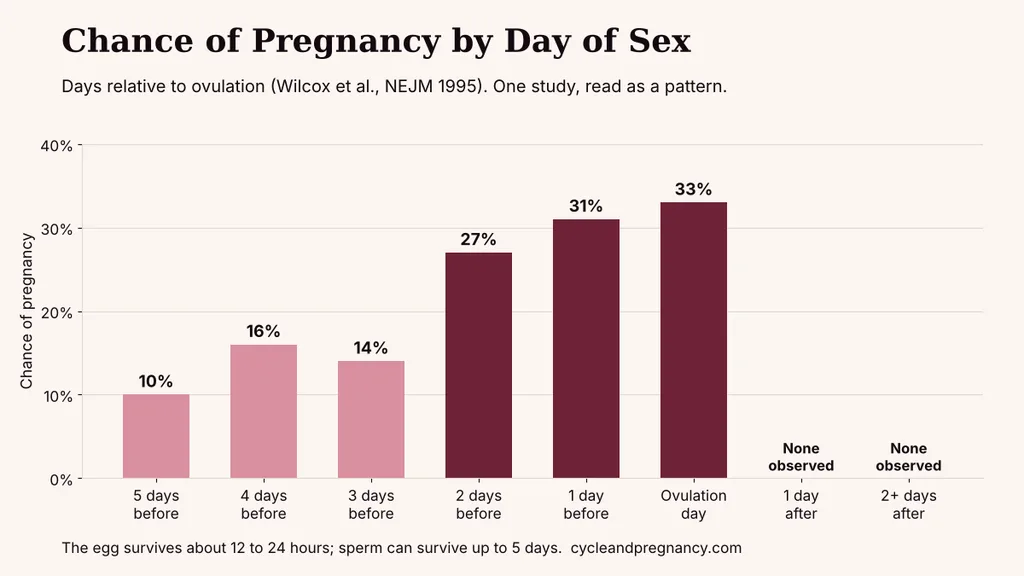
Low, and it drops quickly. The most-cited timing study estimated the chance of pregnancy from sex on each day around ovulation: about 33% on ovulation day and 31% the day before, with no pregnancies observed from sex on the days after. Read these as a pattern, not exact odds, since they come from one study. The full day-by-day table is below, and Wilcox et al., NEJM 1995 has the original data.
How to Predict Your Ovulation Days
Combine two or three methods: a calculator, ovulation tests, cervical mucus and temperature.
Predicting ovulation before it happens matters more than confirming it afterward. Combining two or three methods is more reliable than any single one:
- Calculators: estimate your window from cycle length. Try the ovulation calculator, then refine it with real signs.
- Ovulation predictor kits: detect the LH surge, which usually comes 24 to 36 hours before ovulation. See how ovulation predictor kits work.
- Cervical mucus: clear, stretchy “egg white” mucus signals the fertile days. Our cervical mucus tracking guide shows what to look for.
- Basal body temperature: a sustained rise of about 0.2 to 0.5°C confirms ovulation has already happened. Learn how to track basal body temperature.
- Several methods together: how to track ovulation with OPKs, BBT and apps compares them side by side.
- Irregular cycles or PCOS: calendar estimates are less reliable, so rely more on tests and body signs. See PCOS and ovulation.
Can You Get Pregnant Right After Ovulation?
Yes, but only for about 12 to 24 hours after the egg is released.
Yes, but the window is short and closes fast. Once the ovary releases the egg, it’s swept into the fallopian tube and generally remains capable of being fertilized for about 12 to 24 hours, though this varies between people (the NHS guide to periods and fertility explains how long sperm can survive after sex). If sperm are already present (because sex happened in the day or two before ovulation), fertilization typically occurs within a few hours of the egg’s release.
After that 24-hour mark, the egg begins to break down and is no longer viable. This window can’t be extended. It is tied to the egg’s own lifespan, not to diet, position, or timing tricks.
How Long Does the Egg Live After Ovulation? (Egg Lifespan Explained)
The egg lives 12 to 24 hours, so timing before ovulation matters more than timing after.
This is why timing matters more before ovulation than after. A 24-hour post-ovulation window is short and easy to miss entirely, which is exactly why relying on sex only after ovulation is a much less reliable strategy than having sperm already waiting. For a clinical overview of the fertile window, see ACOG’s explanation of the fertility cycle.
Egg vs Sperm: How Long Does Each Survive?
The egg lasts about a day, sperm up to five days, so the conception window is about six days long.
Survival Times Compared
| Cell | Survival time | What it means for timing |
|---|---|---|
| Egg | About 12 to 24 hours after release | Fertilization is possible only on ovulation day and shortly after |
| Sperm | Up to 5 days in fertile cervical mucus | Sex in the days before ovulation can still lead to pregnancy |
| Fertile window | About 6 days, ending on ovulation day | See what the fertile window is |
Chances of Getting Pregnant, Day by Day Around Ovulation
Chances rise from about 10% five days before ovulation to about 33% on ovulation day, then no pregnancies were observed.
The most cited research on this is a 1995 study in the New England Journal of Medicine by Wilcox, Weinberg & Baird (NEJM 1995). It followed 221 women for 625 cycles, using daily urine hormone tests to estimate ovulation. Its estimates for the chance of pregnancy from sex on each day were:
| Day Relative to Ovulation | Chance of Pregnancy From Sex on That Day (Wilcox 1995) |
|---|---|
| 5 days before | About 10% |
| 4 days before | About 16% |
| 3 days before | About 14% |
| 2 days before | About 27% |
| 1 day before | About 31% |
| Ovulation day | About 33% |
| 1 day after | No pregnancies observed |
| 2+ days after | No pregnancies observed |
The standout finding: none of the pregnancies could be attributed to intercourse after the day of ovulation. Every pregnancy was linked to sex in the six-day window ending on ovulation day. These are estimates from one study with wide margins, and the last three days are statistically close, so read them as a pattern, not exact odds. The general guidance is that chances are highest in the 1–2 days before ovulation. They show that the fertile window is mostly a “before” story, not an “after” one.
What Is the Best Time to Have Sex to Get Pregnant?
Aim for sex every 1 to 2 days across the fertile window, with the highest chances 1 to 2 days before ovulation.
Based on the timing data above, the highest chances are generally in the 1–2 days before ovulation. Practical takeaways for timing intercourse:
- Aim for sex every 1–2 days across your fertile window (roughly the 6 days ending on ovulation day), rather than trying to pinpoint one “perfect” day. You can estimate your fertile window with the ovulation calculator first.
- Don’t wait for a positive ovulation test to start. By the time an LH surge is detected, ovulation is typically only 24–36 hours away, so sperm need to already be present.
- Sex every day or every other day during the fertile window are both reasonable approaches.
- Sex after ovulation isn’t harmful to try, but shouldn’t be relied on as the main strategy, given how narrow and unpredictable that window is.
In short: you can potentially become pregnant within about 24 hours after ovulation, but the highest chances of conception are generally from sex in the days before ovulation. The ovulation calculator can help you estimate when that window falls. For tips on reading the result, see how to use an ovulation calculator accurately.
From Fertilization to a Positive Test: What Happens Next
Implantation happens about 8 to 10 days after ovulation, and most tests are reliable from a missed period.
Even when fertilization succeeds within that first day, pregnancy doesn’t “start” immediately in a way a test can detect. Here’s the timeline that follows:
In the 1999 NEJM study by Wilcox et al. of 221 women, implantation took place 6 to 12 days after ovulation, most often on days 8 to 10.
This is also why a pregnancy test taken a day or two after sex will read negative, regardless of what happened, because there’s no hCG to detect yet, even in a successful conception. For a plain-language walkthrough of this stage, see Cleveland Clinic’s overview of conception.
Signs You May Have Already Ovulated
A sustained temperature rise and drying cervical mucus show that ovulation has already passed.
Since the post-ovulation window is so short, recognizing that ovulation has already happened is more useful for confirming timing than for planning around. Common signs include:
- A sustained rise in basal body temperature: typically 0.2–0.5°C higher and staying elevated, caused by progesterone after ovulation.
- Cervical mucus drying up: the clear, stretchy “egg white” mucus common right before ovulation becomes thicker or disappears afterward.
- A negative OPK after a recent positive: the LH surge that ovulation predictor kits detect is brief, so a positive followed by a negative suggests ovulation has passed.
- Mild one-sided pelvic twinge (mittelschmerz): some people notice a brief ache around ovulation, though it isn’t a reliable marker on its own.
- Light mid-cycle spotting: some people notice a little spotting around ovulation. Ovulation bleeding vs. a period explains how to tell them apart.
See also our full guide to signs of ovulation. Our guide to calculating ovulation day and basal body temperature tracking both go deeper on catching these signals in real time. You can also read Cleveland Clinic’s guide to ovulation for more on the physical signs.
Can You Get Pregnant on Your Period, or Right After It?
Uncommon, but possible in short cycles when ovulation comes early.
Where to Look Next
- Numbers by cycle length: safe days after periods.
- The full meaning of lower-risk days: what safe days are.
Not typically from the period itself, but it’s not impossible, especially with shorter cycles. If ovulation happens early (say, day 9 or 10 of a short cycle) and sperm survive their usual few days, sex near the tail end of a period can theoretically lead to fertile-window overlap. This is uncommon but is exactly why calendar-based assumptions about “safe days” carry real risk for anyone not trying to conceive (our safe days calculator explains the limits of lower-risk days), and why timing intercourse around a calculated or confirmed ovulation day matters more than counting from the period itself.
Summary: Your Conception Window at a Glance
Pregnancy is possible from about five days before ovulation to about a day after it, with the peak in the 2 days before and on ovulation day.
Timeline Summary
| When | What happens | Chance of pregnancy |
|---|---|---|
| 5 to 3 days before ovulation | Sperm can wait for the egg | About 10% to 16% |
| 2 days before to ovulation day | Peak fertility | About 27% to 33% |
| 12 to 24 hours after ovulation | Egg window closing | Very low |
| After 24 hours | Egg no longer fertilizable | None observed |
| 8 to 10 days after ovulation | Implantation (range 6 to 12 days) | Not applicable |
| About 14 days after ovulation | Most tests reliable from a missed period | Not applicable |
Percentages are from Wilcox et al., 1995, and are a pattern from one study, not exact odds.
Frequently Asked Questions
8 questions answeredHow long after ovulation can you get pregnant?
Can you get pregnant the day after ovulation?
What is the best time to have sex to get pregnant?
How long can sperm survive waiting for an egg?
How soon after ovulation does implantation happen?
How soon after ovulation can a pregnancy test detect anything?
What are the chances of getting pregnant after ovulation?
Can you get pregnant if you have sex only after ovulation?
Medical Disclaimer
This article is for general information only and does not replace advice from a qualified healthcare professional. Ovulation and implantation timing vary between people and cycles. If you have been trying to conceive for a while, or have irregular cycles, speak with your healthcare provider.


Sources & References
- Wilcox AJ, Weinberg CR, Baird DD. Timing of Sexual Intercourse in Relation to Ovulation: Effects on the Probability of Conception, Survival of the Pregnancy, and Sex of the Baby. New England Journal of Medicine. 1995;333(23):1517–1521. Tracked daily intercourse against ovulation dated by urine hormone tests in 625 cycles; pregnancies were linked to intercourse in the 6-day window ending on ovulation day, with none attributed to intercourse after ovulation. NEJM 1995 article
- Wilcox AJ, Baird DD, Weinberg CR. Time of Implantation of the Conceptus and Loss of Pregnancy. New England Journal of Medicine. 1999;340(23):1796–1799. Found implantation occurred 6 to 12 days after ovulation, with most pregnancies implanting on days 8, 9, or 10. NEJM 1999 article
- NHS. Periods and fertility in the menstrual cycle. Explains ovulation, how long the egg can be fertilized and when pregnancy is most likely. NHS fertility and the menstrual cycle
- American College of Obstetricians and Gynecologists (ACOG). How Your Fertility Cycle Works. Clinical overview of ovulation, egg viability and the fertile window. ACOG fertility cycle FAQ
- Cleveland Clinic. Conception: Fertilization, Timeline & How To Get Pregnant. Describes fertilization, implantation and the early pregnancy timeline. Cleveland Clinic conception guide
- Cleveland Clinic. Ovulation: Calculating, Process, Pain & Other Symptoms. Covers ovulation timing and common physical signs of ovulation. Cleveland Clinic ovulation guide