
Cervical Mucus Tracking for Ovulation What Each Stage Actually Means
Egg-white cervical mucus is more than folk wisdom: a study of 331 women found that checking it was linked to better odds of conceiving. Here is the Type 1 to 4 scale, how to check correctly and what throws it off.
Key Takeaways
- Cervical mucus tracking uses the changing texture of discharge to show when ovulation is near.
- Type 4 (egg-white: clear, wet, stretchy) is the peak fertility sign and usually appears 1 to 3 days before ovulation.
- Studies link consistent checking to better chances of conceiving each cycle.
- Arousal fluid, semen, some medicines and PCOS can confuse your readings.
- Pair mucus with basal body temperature or LH tests for the most complete picture.
Cervical mucus tracking is one of the oldest fertility awareness methods, and it is backed by clinical research. A study of 331 women found that consistently checking cervical mucus was linked to a higher chance of conceiving each cycle. This guide covers the four mucus types, how to check correctly and what can throw off your chart.
Cervical mucus changes as estrogen rises: dry or sticky early on, then creamy, then clear, stretchy and slippery (egg-white) just before ovulation. Egg-white mucus is the strongest visual sign that ovulation is approaching.
What Is Cervical Mucus and Where Does It Come From?
Cervical mucus is a fluid made by glands in the cervix. It protects the womb and, at the right time, helps sperm get through.
Where It Comes From
The cervix is the narrow lower end of the womb. Glands in its lining make mucus all through the cycle, and the amount and texture depend on your hormones. It leaves the body as the vaginal discharge you notice on underwear or tissue.
What It Does
- Acts as a barrier for most of the cycle, helping keep bacteria out of the womb.
- Turns thin and watery near ovulation so sperm can swim through the cervix.
- Supplies nutrients and a protective channel that helps sperm survive.
What It Can Look Like
Normal mucus ranges from clear to white or pale yellow and from dry to wet, sticky, creamy or stretchy. The four-type scale below puts words on those differences.
Why Cervical Mucus Changes Across Your Cycle
Rising estrogen makes mucus wetter and stretchier before ovulation, and progesterone makes it thick again afterward.
The Hormone Link
Cervical mucus is made by glands in the cervix, and as Cleveland Clinic explains, its texture follows estrogen. Early in the cycle, when estrogen is low, mucus is scant, thick or absent. As estrogen rises toward ovulation, it becomes more abundant, thinner and eventually clear and stretchy, which helps sperm travel through the cervix and survive.
After Ovulation
Once ovulation has passed, progesterone takes over and mucus quickly turns thick and sticky again, or disappears. See menstrual cycle phases for the full hormone picture.
The Four Types of Cervical Mucus
Researchers sort mucus into Types 1 to 4, and Type 4 (egg-white) marks peak fertility.
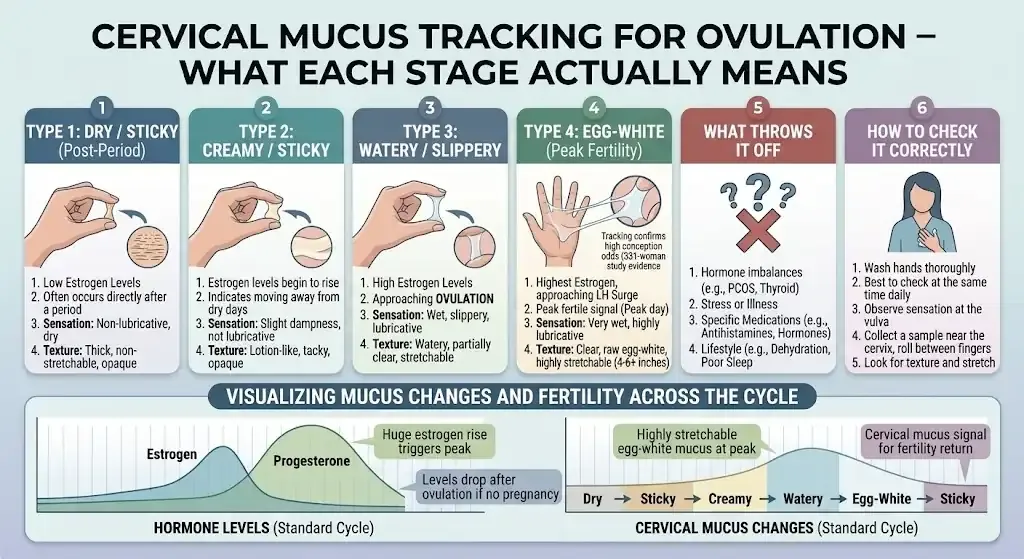
Type 1 to Type 4 at a Glance
Fertility researchers, including the University of North Carolina Time to Conceive program, use four types based on look and feel. This is more precise than the loose “dry, sticky, egg-white” wording many guides use.
| Type | What it looks and feels like | Fertility |
|---|---|---|
| Type 1: Dry or none | Little or no mucus, and the vulva feels dry. Usually just after your period and before your next one. | Low |
| Type 2: Damp or sticky | Present but pasty, tacky or opaque, and it does not stretch. Estrogen is starting to rise. | Low to rising |
| Type 3: Creamy | Thicker, whitish or yellowish and more noticeable. A transitional sign that the fertile window is near. | Entering the fertile window |
| Type 4: Egg-white | Clear, wet, slippery and stretchy, like raw egg white. Usually appears 1 to 3 days before ovulation and may peak on ovulation day. | Peak |
To place these signs in your cycle, read what the fertile window is and the signs of ovulation.
Mucus Through the Cycle and Just Before Ovulation
Mucus moves from dry to sticky to creamy to egg-white as ovulation nears, then dries up again.
A Typical Pattern
| Cycle stage | Typical mucus | What it means |
|---|---|---|
| Period (days 1 to 5) | Blood hides mucus | Low fertility |
| After period (about days 6 to 9) | Dry or sticky (Types 1 and 2) | Low but rising |
| Approaching ovulation (about days 10 to 12) | Creamy (Type 3) | Fertile window opening |
| Peak (about days 13 to 15) | Egg-white (Type 4) | Highest fertility |
| After ovulation | Thick, sticky or dry again | Fertile window closing |
These days are a guide for a 28-day cycle and shift with cycle length. Use our Ovulation Calculator to estimate your own timing.
What Does Discharge Look Like When You Ovulate?
Around ovulation discharge is usually clear, wet, slippery and stretchy, often more plentiful than usual. Many people notice a damp feeling without wiping.
How Many Days Before Ovulation Does Egg-White Mucus Appear?
Egg-white mucus typically shows up 1 to 3 days before ovulation, though some people see it for longer and some barely notice it.
What the Research Shows About Accuracy
The mucus peak day lines up closely with ovulation, and consistent checking is linked to better odds of conceiving.
Two Key Findings
Prospective research gives specific numbers that most consumer guides leave out:
was the probability of conception on the mucus peak day among fertile couples, compared with 0.14 for couples with reduced fertility. In a Creighton Model cohort study, the probability stayed above 0.5 from 3 days before the peak to 2 days after it.
of cycles in a separate study had the mucus peak day within ±4 days of the hormonally confirmed ovulation day, and mucus ratings peaked on the same day as the LH surge.
Does Checking Help You Conceive?
A more recent study of 331 women trying to conceive found that consistent mucus monitoring was linked to a higher chance of conception each cycle, independent of how often couples had sex or whether they used LH tests. That suggests the mucus signal adds value of its own.
How to Check Cervical Mucus Correctly
Wash your hands, check at consistent times, note color and stretch, and record the type daily for several cycles.
Six Steps
Reliable results come down to consistency more than anything else:
Wash and dry your hands before checking.
Check once or twice daily, ideally at consistent times.
Insert a clean finger, or wipe with toilet paper before urinating.
Note the color, and roll what you find between two fingers to test stretchiness.
Record the type daily. Several cycles of records show your personal pattern far better than one month.
Avoid checking right after sex or while aroused.
Common Mix-Ups: Mucus, Arousal Fluid and Semen
Arousal fluid fades within about an hour and semen clears within 12 to 14 hours, so wait before judging what you see.
Three Fluids Compared
| Fluid | What it is | How long it lasts |
|---|---|---|
| Cervical mucus | Made by the cervix, changes through the cycle | Persists as a pattern across days |
| Arousal fluid | Produced by glands around the vagina during stimulation. Clear, wet and slippery. | Disappears within about 1 hour |
| Seminal fluid | Released during sex. Turns watery after 20 to 30 minutes. | Usually clears in 12 to 14 hours |
If You Are Unsure
If you cannot tell which fluid you see, wait an hour for arousal fluid or half a day for semen, or keep charting and look at the overall pattern. If you check soon after sex, what you find may be a mix.
What Can Throw Off Your Readings
Medicines, PCOS, a late estrogen bump, hygiene products and dehydration can all change what you notice.
Common Disruptors
| Factor | Effect on mucus |
|---|---|
| Certain medications | Antihistamines and fertility drugs such as Clomid can dry up fertile-quality mucus |
| PCOS | Some people see several fertile-looking episodes in one cycle without ovulating. See PCOS and ovulation |
| Post-ovulation estrogen bump | About 10 days after ovulation a secondary rise can make mucus look fertile again. It does not mean a second ovulation |
| Vaginal hygiene products | Harsh soaps or douching can change the natural texture of mucus |
| Dehydration | Can reduce mucus volume, so fertile-quality mucus is harder to notice |
Abnormal Discharge and Ways to Support Mucus
Strong odor, green or gray color, itching or burning is not normal. Water and avoiding irritants may help, but no method guarantees more mucus.
What Abnormal Discharge Looks Like
- A strong or fishy smell
- Green, gray or frothy discharge
- Cottage-cheese texture with itching
- Blood outside your period, or burning and pain
These can point to an infection or another condition, so see a healthcare provider. See also spotting vs period if you notice blood.
Can You Increase Cervical Mucus?
Staying hydrated, avoiding douching and harsh soaps, and checking whether a medicine such as an antihistamine is drying you out can help. Mucus also depends on ovulation and hormones, so persistent dryness while trying to conceive is worth discussing with a doctor.
Combining Cervical Mucus With Other Methods
Mucus shows ovulation is coming, BBT confirms it happened and LH tests give a second advance signal.
Mucus and Basal Body Temperature
Mucus predicts fertility as ovulation approaches, but it does not confirm ovulation afterward the way temperature does. A rise in temperature a day or two later shows ovulation already happened. Our basal body temperature tracking guide covers the confirmation side.
Mucus and LH Tests
An LH surge usually lines up with your peak (Type 4) mucus day, so the two give independent signals for the same window. See how to use an ovulation calculator accurately and ovulation predictor kits. For all methods side by side, read how to track ovulation.
Check Your Luteal Phase
Knowing your luteal phase length afterward helps complete the picture. See the luteal phase explained.
Using the Cervical Mucus Method: Fertile and Safer Days
Treat any wet, stretchy or slippery mucus as fertile. It is a fertility awareness method that needs training and is less reliable than many other contraceptives.
How the Method Works
The method uses daily observation to mark your fertile days. Many programs treat any wet, slippery or stretchy day as fertile and count the days after the peak day as fertile for a few more days, then dry or sticky days after that as less fertile. Check the exact rules with a trained instructor or your doctor.
Safe Days to Have Sex?
Dry days right after your period are often called safer days, but sperm can survive for several days and mucus can be misread, so the method alone is not reliable for avoiding pregnancy. Read how reliable safe days are and what safe days are before relying on it.
When to See a Doctor
See a doctor for unusual odor or color, itching or burning, or if you never notice fertile-quality mucus while trying to conceive.
Signs to Get Checked
Most changes picked up by cervical mucus tracking are normal, but a few need medical attention:
Unusual odor · Unusual color, such as green, gray, or with blood outside your period · Itching, burning or irritation · Never noticing fertile-quality mucus despite regular tracking, especially when trying to conceive.
These can point to an infection or another condition rather than a fertility sign, so speak with a healthcare provider instead of self-diagnosing.
Frequently Asked Questions
17 questions answeredWhat does egg-white cervical mucus mean?
How accurate is cervical mucus for predicting ovulation?
Does tracking cervical mucus actually help you get pregnant?
What are the different types of cervical mucus?
What can be mistaken for cervical mucus?
What can dry up or change cervical mucus?
Can PCOS affect cervical mucus patterns?
Why do I have wet mucus a few days before my period?
Should I combine cervical mucus tracking with other methods?
When should I see a doctor about cervical mucus changes?
Where does cervical mucus come from?
What does abnormal cervical mucus look like?
Can I increase cervical mucus?
Is the cervical mucus method reliable for avoiding pregnancy?
How long does egg-white cervical mucus last?
Can I get pregnant without egg-white cervical mucus?
How do I know if my discharge is normal?


Sources & References
- Evans-Hoeker E, Pritchard DA, Long DL, Herring AH, Stanford JB, Steiner AZ. Cervical Mucus Monitoring Prevalence and Associated Fecundability in Women Trying to Conceive. Fertility and Sterility. 2013;100(4):1033–1038.e1. doi:10.1016/j.fertnstert.2013.06.002. PMID: 23850303. 331-woman prospective study; source of the “monitoring linked to higher conception odds, independent of intercourse frequency or LH kit use” finding. PubMed
- Stanford JB, Smith KR, Dunson DB. Vulvar Mucus Observations and the Probability of Pregnancy. Obstetrics & Gynecology. 2003. Creighton Model cohort; source of the 0.38 (fertile) vs. 0.14 (subfertile) peak-day conception probability figures.
- Fehring RJ. Accuracy of the Peak Day of Cervical Mucus as a Biological Marker of Fertility. Contraception. 2002;66(4):231–235. doi:10.1016/S0010-7824(02)00355-4. 108 cycles from 53 women; source of the 97.8% peak-day-within-4-days-of-ovulation figure. Full text (Marquette)
- Najmabadi S, Schliep KC, Simonsen SE, Porucznik CA, Egger MJ, Stanford JB. Cervical Mucus Patterns and the Fertile Window in Women Without Known Subfertility: A Pooled Analysis of Three Cohorts. Human Reproduction. 2021;36(7):1784–1795. Full text (Oxford Academic)
- University of North Carolina, Time to Conceive Study. Cervical Mucus Monitoring. Source of the Type 1–4 classification and the arousal fluid / seminal fluid differentiation timing. med.unc.edu
- Cleveland Clinic. Cervical Mucus: Chart, Stages, Tracking & Fertility. clevelandclinic.org
- American Pregnancy Association. Cervical Mucus and Early Pregnancy. americanpregnancy.org