
Safe Days to Avoid Pregnancy: How Reliable Are They?
Safe days to avoid pregnancy can lower the chance of conception, but they cannot remove it. Here is how safe days work, why pregnancy can still happen on them, and what raises or lowers the risk.
Key Takeaways
- Safe days lower the chance of pregnancy but never remove it.
- Ovulation can shift, and sperm can live up to five days.
- Typical-use failure is about 1 in 4 over a year (NHS, Mayo Clinic).
- Irregular cycles, breastfeeding and recent hormonal birth control make it worse.
- Condoms or a more reliable method are safer, and only condoms protect against STIs.
Can You Avoid Pregnancy by Using Safe Days?
Safe days to avoid pregnancy lower the chance of conception but do not remove it, so on their own they are not a reliable method. Safe days are the days of your cycle when pregnancy is less likely. They are an estimate built from past cycles, and ovulation does not always follow the pattern. Hormonal methods, IUDs, implants and consistent condom use are much more dependable.
To see your estimated lower-risk days first, use the cycle-based calculator, then read how far that estimate can be trusted.
Safe days lower the risk of pregnancy but do not remove it. Ovulation can shift, and sperm can live up to five days. With typical use, calendar-based tracking fails far more often than other methods, so anyone who must avoid pregnancy should use a more reliable method.
How Safe Days Are Meant to Work
Pregnancy is possible only in the fertile window. Calendar methods guess that window from past cycles and call the rest safe.
The Basics
- A person can get pregnant only during the fertile window: about five days before ovulation plus the day of ovulation.
- Sperm can survive up to five days, and the egg survives 12 to 24 hours.
- The calendar method estimates that window from your shortest and longest recent cycles and calls the days outside it “safe”. See how to calculate safe days for the math.
- The Standard Days Method, for cycles of 26 to 32 days, treats days 8 to 19 as the days to avoid (CDC).
Is It Possible to Get Pregnant on Safe Days?
Yes. Pregnancy on safe days is the main reason this method has a high failure rate.
Why It Happens
| Cause | What goes wrong |
|---|---|
| Shifted ovulation | Ovulation came earlier or later than the calendar predicted. |
| Early egg | Sperm from sex a few days before the fertile window met an early egg. |
| Changed cycle | The cycle was shorter or longer than usual that month. |
| Miscounted period | Spotting was counted as a period, or the period was longer than assumed. |
| Weak estimate | The estimate was built on too few cycles, or an old one. |
Days right after your period are a common trap; see safe days after your period.
Are Safe Days Really Safe? How Effective Are They?
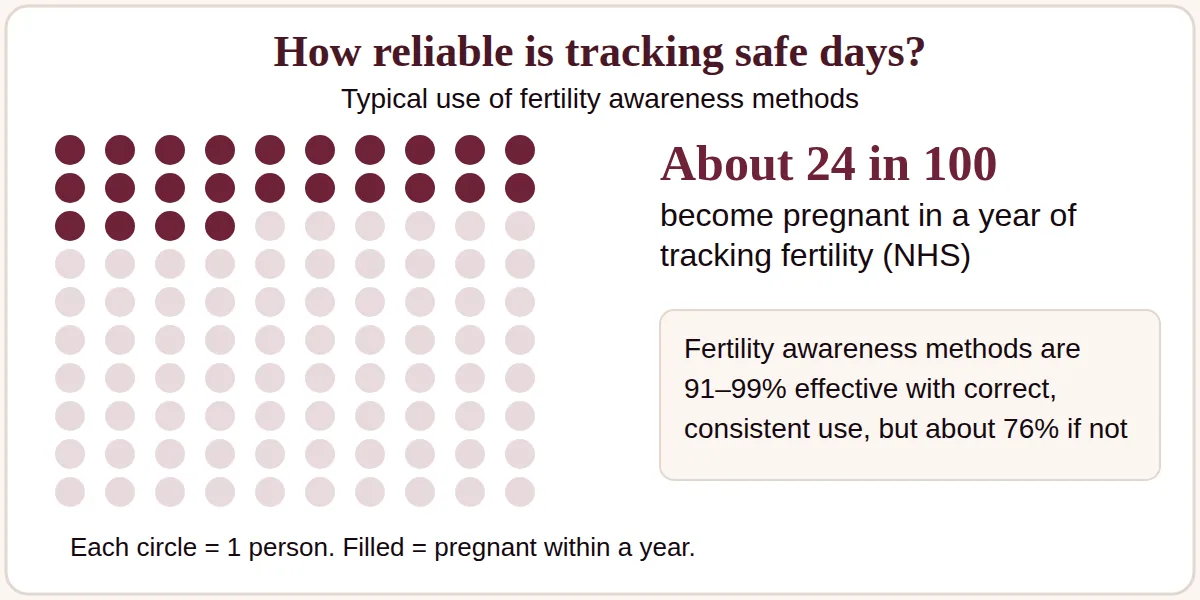
With typical use, about 1 in 4 women using fertility awareness methods become pregnant in a year. Perfect use is much better but hard to keep up.
Perfect Use vs Typical Use
- Perfect use means tracking exactly, recalculating every month and avoiding sex or using a barrier on every unsafe day.
- Typical use is how people actually behave, and it is the number to plan around.
What the Studies Report
| Source | Perfect use | Typical use |
|---|---|---|
| NHS | 91–99% effective | About 76% effective (about 24 in 100 women pregnant in a year) |
| Arévalo et al., 2002 (Standard Days Method, 13 cycles) | About 5% pregnant | About 12% pregnant |
| Trussell, 2011 | Not reported here | Failure near 24% in US data |
| Malarcher et al., 2016 (same trial) | 95% effective | 88% effective |
| Mayo Clinic | Not reported here | About 1 in 4 pregnant with typical use |
If an unplanned pregnancy would be a serious problem for you, do not rely on safe days alone.
What Makes Safe Days Less Reliable
Anything that makes cycles unpredictable makes safe days less reliable.
Cycle Factors
- Irregular periods, including cycles affected by PCOS or thyroid conditions
- Perimenopause
Life Stage Factors
- The first months after stopping hormonal birth control
- After having a baby and while breastfeeding
Lifestyle and Tracking Factors
- Stress, illness, travel and big changes in weight or routine
- Inconsistent tracking, or not recalculating every month
The NHS lists irregular periods among situations where fertility awareness may not suit you, and the Mayo Clinic also lists recent childbirth, breastfeeding, recently stopping hormonal birth control and PCOS.
How to Lower the Risk
Add body signs, use condoms on fertile days and consider a more reliable method.
Steps to Take
- Track at least 6 cycles and recalculate every month.
- Add a body sign to the calendar: basal body temperature, cervical mucus changes or an ovulation predictor kit.
- Use condoms on all estimated fertile days. They also protect against sexually transmitted infections, which safe days never do.
- Talk to a doctor, nurse or pharmacist about a more reliable method such as pills, an IUD or an implant.
- If you have had unprotected sex and want to avoid pregnancy, emergency contraception works best the sooner it is taken. A pharmacist or doctor can advise on options.
Check Your Own Safe Days
Use the calculator as a planning aid, not as contraception.
Our safe days calculator gives an estimate of your fertile and lower-risk days from your last period and cycle length. Treat it as a planning aid, not as contraception. For the full overview, read the complete guide to what safe days are.
Frequently Asked Questions
8 questionsDo safe days exist?
Are safe days real for women?
Is it possible to get pregnant on safe days?
How effective are safe days?
How long do safe days last?
Is there a 100% safe day?
Are safe days safe if I have regular periods?
Do safe days protect against STIs?
Medical Disclaimer
This article is general education, not personal medical advice. Safe days are estimates and never a guarantee. If avoiding pregnancy matters to you, talk to a doctor, nurse or pharmacist about a method that fits your health and cycle. Calendar tracking does not protect against sexually transmitted infections.


Scientific References
- National Health Service (NHS). “Natural Family Planning (Fertility Awareness).” NHS UK. Accessed 2026. Effectiveness with correct and typical use, and who it may not suit, including people with irregular periods. nhs.uk
- Mayo Clinic. “Rhythm Method for Birth Control.” Mayo Clinic Tests & Procedures. Accessed 2026. The calendar method calculation (shortest cycle minus 18, longest minus 11), about 1 in 4 people becoming pregnant with typical use, and who it may not suit. mayoclinic.org
- Centers for Disease Control and Prevention (CDC). “Standard Days Method.” U.S. Selected Practice Recommendations for Contraceptive Use. Accessed 2026. The days 8–19 rule and the 26–32 day cycle requirement. cdc.gov
- Malarcher, Shawn, Jeff Spieler, Michal Fabic, et al. “Fertility Awareness Methods: Distinctive Modern Contraceptives.” Global Health: Science and Practice 4, no. 1 (2016): 13–15. Reports a Standard Days Method trial with 95% effectiveness in perfect use and 88% in typical use. pmc.ncbi.nlm.nih.gov
- Arévalo, Marcos, Victoria Jennings, and Irit Sinai. “Efficacy of a New Method of Family Planning: The Standard Days Method.” Contraception 65, no. 5 (2002): 333–38. Pregnancy rates of about 5% with correct use and 12% with typical use over 13 cycles. doi.org
- Trussell, James. “Contraceptive Failure in the United States.” Contraception 83, no. 5 (2011): 397–404. Typical-use failure rate for fertility awareness-based methods. doi.org