
Safe Days Before and After Ovulation: What to Know
Safe days before and after ovulation are not the same: days before ovulation get riskier as it gets closer, while days after ovulation become lower risk once the egg is gone. The catch is knowing that ovulation has really happened.
Are the Days Before and After Ovulation Safe?
Partly. Both depend on knowing when ovulation happens, and a calendar can only estimate it.
- The fertile window runs from about five days before ovulation to the day of ovulation.
- Days earlier than that are lower risk.
- Days after ovulation become lower risk about a day later, when the egg is no longer viable.
Estimate your fertile and lower-risk days from your last period, then use this guide to understand the days around ovulation.
The 5 days before ovulation and ovulation day are the fertile days. Lower-risk days are earlier in the cycle (before the window opens) and from about a day after ovulation. You can only be sure ovulation has passed if you confirm it with a body sign.
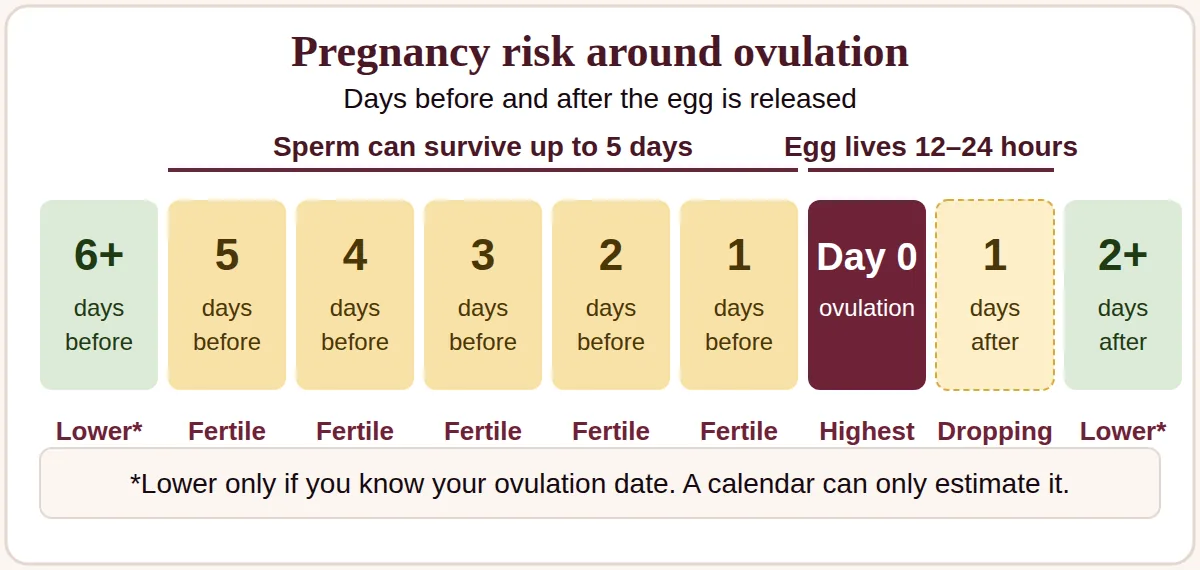
Ovulation Day and the Fertile Window
- The egg lives for 12 to 24 hours after it is released.
- Sperm can survive up to five days.
- That makes the fertile window about six days long (ACOG).
- Ovulation usually happens about 14 days before your next period (Cleveland Clinic). See how to calculate ovulation day.
- Timing differs between women: a BMJ study of 696 cycles found the fertile window fell on different cycle days in different women (Wilcox et al., 2000).
| Day relative to ovulation | Pregnancy risk | Notes |
|---|---|---|
| 6 or more days before | Lower | Only if you know your ovulation date, which a calendar cannot confirm |
| 5 to 1 days before | Fertile | Sperm from these days can meet the egg |
| Ovulation day | Highest | The egg is released |
| 1 day after | Dropping fast | The egg may still be viable for a few hours |
| 2 or more days after | Lower | After the egg is gone; confirm ovulation to be sure |
Safe Days Before Ovulation (Follicular Phase)
The follicular phase runs from the first day of your period to ovulation.
- The first days are lower risk in longer cycles.
- Risk rises as ovulation gets closer.
- In shorter cycles the fertile window can start within days of your period ending. See safe days after your period.
Is 6 Days Before Ovulation Safe?
- It is just outside the fertile window, so it is lower risk, but only if you know your ovulation day.
- If ovulation comes earlier than you expect, that day can fall inside the window.
Is 4 Days Before Ovulation Safe?
- No. It falls inside the fertile window, because sperm can survive up to five days.
Safe Days After Ovulation (Luteal Phase)
- After ovulation the egg survives only 12 to 24 hours, so risk falls quickly.
- The luteal phase lasts about 12 to 14 days and ends with your next period, which makes it the lower-risk part of the cycle.
- Rarely, a second egg is released within about a day of the first, so the day after ovulation is still treated with caution.
- The main problem is confirming that ovulation has actually happened. Read more about the luteal phase.
- The NHS says fertility awareness methods are 91–99% effective only with correct, consistent use, which is why confirming ovulation matters (NHS).
How to Confirm Ovulation Has Passed
- Basal body temperature. A small, steady rise that lasts a few days suggests ovulation has happened. See basal body temperature tracking.
- Ovulation predictor kits. A positive LH test means ovulation is likely within about a day or two. See ovulation predictor kits.
- Cervical mucus. It becomes clear and stretchy near ovulation and thicker afterwards.
- Other signs such as mild one-sided pain are not reliable on their own.
- A calendar alone cannot confirm ovulation. Use one of the signs above if you rely on the days after ovulation.
- MedlinePlus describes the same signs: slippery, stretchy cervical fluid, a basal body temperature rise of about 0.2 degrees or more, and ovulation predictor kits (MedlinePlus).
Follicular, Ovulation and Luteal Phases Compared
| Phase | What happens | Pregnancy risk |
|---|---|---|
| Follicular (day 1 to ovulation) | The egg matures; estrogen rises | Low at first, rising towards ovulation |
| Ovulation | The egg is released | Highest |
| Luteal (after ovulation to next period) | Progesterone rises, then falls | Lower once ovulation has passed |
See the four phases of the menstrual cycle for the full picture.
Estimate Your Own Dates
- Use our safe days calculator for an estimate of your lower-risk and fertile days.
- Use the ovulation calculator for your likely ovulation date.
- See the safe days guide for the overview.
Frequently Asked Questions
8 questionsAre the days after ovulation safe?
Is ovulation day safe?
Is the luteal phase safe?
Is the follicular phase safe?
Is 6 days before ovulation safe?
Can I get pregnant 2 days after ovulation?
How do I know ovulation has passed?
How many days after ovulation can you not get pregnant?
Medical Disclaimer
This article is general education, not personal medical advice. Safe days are estimates and never a guarantee. If avoiding pregnancy matters to you, talk to a doctor, nurse or pharmacist about a method that fits your health and cycle. Calendar tracking does not protect against sexually transmitted infections.


Scientific References
- American College of Obstetricians and Gynecologists (ACOG). “Trying to Get Pregnant? Here’s When to Have Sex.” Accessed 2026. The fertile window is about six days a cycle; sperm can live up to 5 days and an egg about 12 to 24 hours. acog.org
- Cleveland Clinic. “Ovulation.” Health Library. Accessed 2026. Ovulation about 14 days before the next period, egg survival of about 12 to 24 hours, and sperm survival of up to five days. clevelandclinic.org
- MedlinePlus. “Ovulation.” U.S. National Library of Medicine. Accessed 2026. Sperm and egg survival, and signs that help identify ovulation: cervical fluid, basal body temperature and ovulation predictor kits. medlineplus.gov
- Wilcox, Allen J., David Dunson, and Donna Day Baird. “The Timing of the ‘Fertile Window’ in the Menstrual Cycle: Day Specific Estimates from a Prospective Study.” BMJ 321, no. 7271 (2000): 1259–62. Day-specific estimates from 696 cycles showing the fertile window falls on different days in different women. doi.org
- National Health Service (NHS). “Natural Family Planning (Fertility Awareness).” NHS UK. Accessed 2026. Effectiveness with correct and typical use, and who it may not suit, including people with irregular periods. nhs.uk