
What Are Safe Days? Safe vs Unsafe Days Explained
What are safe days? Safe days are the days of the menstrual cycle when pregnancy is less likely. This guide explains how safe and unsafe days work, whether safe days are real and how reliable they are.
Key Takeaways
- Safe days are lower-risk days outside the fertile window, never risk-free.
- The fertile window is about five days before ovulation plus ovulation day.
- In a regular 28-day cycle with a 5-day period, the lower-risk days are about days 6 to 8 and 18 to 28.
- Typical use of safe days fails about 1 in 4 times over a year.
- They do not protect against sexually transmitted infections.
What Are Safe Days?
What are safe days? Safe days are the days in a menstrual cycle when a person is less likely to get pregnant, because an egg is unlikely to be waiting to be fertilized.
- The days when pregnancy is more likely are called unsafe days, or the fertile window.
- The word “safe” is misleading: no day is completely free of risk, so lower-risk days is a more accurate name.
If you already know your cycle length, you can estimate your own safe days with a free calculator and use the rest of this guide to understand the result.
Safe days are lower-risk days outside the fertile window, which covers about five days before ovulation and ovulation day. They are estimated from your cycle length, so they only work as a rough guide for regular cycles, and they never guarantee that pregnancy cannot happen.
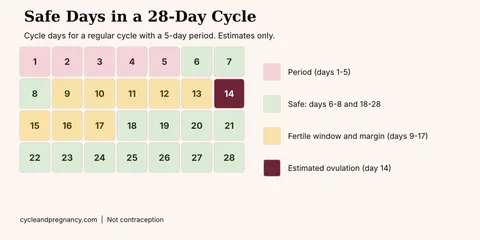
Safe Days Meaning: Safe and Unsafe Days in the Menstrual Cycle
Unsafe days start before ovulation and end soon after it. Safe days are the days outside that range.
Why Unsafe Days Start Before Ovulation
- Pregnancy is possible only when sperm meets a released egg.
- Sperm can survive up to five days in the body.
- The egg survives about 12 to 24 hours after ovulation (ACOG, Cleveland Clinic).
A Regular 28-Day Cycle With a 5-Day Period
| Cycle days | Part of the cycle | Pregnancy risk |
|---|---|---|
| Days 1–5 | Period | Low, but not zero in short cycles |
| Days 6–8 | After bleeding, before the fertile window | Lower risk |
| Days 9–14 | Fertile window, ovulation around day 14 | High |
| Days 15–17 | Safety margin after ovulation | Treat as unsafe |
| Days 18–28 | Until your next period | Lower risk |
- This applies to regular cycles only.
- For other cycle lengths, see the safe days chart.
How Safe Days Work in a Woman’s Cycle
The calendar method works backwards from the expected ovulation date and calls the days outside the fertile window safe.
The Calendar Method
- Ovulation usually happens about 14 days before your next period (Cleveland Clinic); see safe days in the menstrual cycle for each phase.
- Working backwards from that date gives an estimate of the fertile window, and the days outside it are called safe.
- This is the basis of the calendar method, also known as the rhythm method.
- It needs steady cycles because it predicts the future from your past cycles.
The Standard Days Method
- For cycles of 26 to 32 days, it treats days 8 to 19 as fertile (CDC, Global Handbook for Providers).
- See the steps in how to calculate safe days, and the effect of ovulation timing in safe days before and after ovulation.
How Many Safe Days Are There?
A short cycle leaves few safe days after the period. A longer cycle leaves more.
Safe Days After a 5-Day Period
| Cycle length | Estimated ovulation | Lower-risk days after your period | How many |
|---|---|---|---|
| 24 days | Day 10 | None | 0 |
| 26 days | Day 12 | Day 6 | 1 |
| 28 days | Day 14 | Days 6–8 | 3 |
| 30 days | Day 16 | Days 6–10 | 5 |
| 32 days | Day 18 | Days 6–12 | 7 |
| 35 days | Day 21 | Days 6–15 | 10 |
- These are estimates for regular cycles, not guarantees.
- Details are in safe days after periods.
How to Find Your Safe Days
Use a calculator, do the subtraction by hand, check a chart or add a body sign.
- Use a tool. Enter your last period date and cycle length to estimate your safe days with our calculator.
- Calculate them by hand. Subtract 18 from your shortest cycle and 11 from your longest. The steps are in how to calculate safe days.
- Check a chart. Compare cycle lengths from 21 to 35 days on the safe days chart.
- Add a body sign. A rise in basal body temperature or a positive ovulation test shows that ovulation is happening.
Are Safe Days Real?
The idea is real, but predicting the days exactly is not reliable.
What Is Real
- A person can get pregnant only around ovulation, so some days of the cycle carry a lower chance than others.
What Is Not Reliable
- Ovulation can move from month to month, even with regular periods, and a calendar cannot see that.
- In a study of 696 cycles, only about 30% of women had their whole fertile window within days 10 to 17 (Wilcox et al., 2000).
Are Safe Days Really Safe? How Effective Are They?
Not safe enough to rely on alone. Typical use fails about 1 in 4 times over a year.
What the Sources Report
| Source | Figure reported |
|---|---|
| NHS | 91–99% effective with correct, consistent use, about 76% otherwise (about 24 in 100 women pregnant over a year) |
| Mayo Clinic | Similar figure of about 1 in 4 with typical use |
| Trussell, 2011 | US typical-use failure near 24% |
- If avoiding pregnancy is essential, read how reliable safe days are for avoiding pregnancy.
- Talk to a doctor, nurse or pharmacist about a more reliable method.
Not a substitute for contraception. Safe days do not protect against sexually transmitted infections.
When Safe Days Are Least Reliable
Anything that makes cycles unpredictable makes safe days less reliable.
Cycle Factors
- Irregular periods, where cycle length changes a lot
- Cycles shorter than about 24 days
- Perimenopause
Life Stage Factors
- The first months after stopping hormonal birth control
- After having a baby and while breastfeeding
Lifestyle Factors
- Stress, illness, travel or big changes in weight or routine
Safe Days and the Safe Period to Have Sex
Safe days and the “safe period” mean the same part of the cycle.
- If you are looking at it from the angle of when sex carries the least pregnancy risk, read what is the safe period to have sex.
Estimate Your Own Safe Days
Use the calculator for your dates and the chart for the numbers behind it.
- Use our safe days calculator to see your estimated lower-risk and fertile days on a calendar.
- It is a planning aid for regular cycles, not contraception.
- For the numbers behind it, start with the safe days chart and the guide to safe days after periods.
Frequently Asked Questions
9 questionsWhat are safe days?
What is the meaning of safe days?
What are the safe days of a woman?
What are safe and unsafe days in the menstrual cycle?
Are safe days real?
Are safe days really safe?
How effective are safe days?
Can I get pregnant on safe days?
Do safe days work with irregular periods?
Medical Disclaimer
This article is general education, not personal medical advice. Safe days are estimates and never a guarantee. If avoiding pregnancy matters to you, talk to a doctor, nurse or pharmacist about a method that fits your health and cycle. Calendar tracking does not protect against sexually transmitted infections.


Scientific References
- National Health Service (NHS). “Natural Family Planning (Fertility Awareness).” NHS UK. Accessed 2026. Effectiveness with correct and typical use, and who it may not suit, including people with irregular periods. nhs.uk
- Mayo Clinic. “Rhythm Method for Birth Control.” Mayo Clinic Tests & Procedures. Accessed 2026. The calendar method calculation (shortest cycle minus 18, longest minus 11), about 1 in 4 people becoming pregnant with typical use, and who it may not suit. mayoclinic.org
- American College of Obstetricians and Gynecologists (ACOG). “Trying to Get Pregnant? Here’s When to Have Sex.” Accessed 2026. The fertile window is about six days a cycle; sperm can live up to 5 days and an egg about 12 to 24 hours. acog.org
- Cleveland Clinic. “Ovulation.” Health Library. Accessed 2026. Ovulation about 14 days before the next period, egg survival of about 12 to 24 hours, and sperm survival of up to five days. clevelandclinic.org
- Centers for Disease Control and Prevention (CDC). “Standard Days Method.” U.S. Selected Practice Recommendations for Contraceptive Use. Accessed 2026. The days 8–19 rule and the 26–32 day cycle requirement. cdc.gov
- Family Planning: A Global Handbook for Providers. “Fertility Awareness Methods: How to Use.” WHO / Johns Hopkins CCP / USAID. Accessed 2026. Standard Days Method: days 8 to 19 are fertile for cycles of 26 to 32 days; unprotected sex is acceptable on days 1 to 7 and from day 20. fphandbook.org
- Wilcox, Allen J., David Dunson, and Donna Day Baird. “The Timing of the ‘Fertile Window’ in the Menstrual Cycle: Day Specific Estimates from a Prospective Study.” BMJ 321, no. 7271 (2000): 1259–62. Day-specific estimates from 696 cycles showing the fertile window falls on different days in different women. doi.org
- Trussell, James. “Contraceptive Failure in the United States.” Contraception 83, no. 5 (2011): 397–404. Typical-use failure rate for fertility awareness-based methods. doi.org