
How to Calculate Safe Days: Simple 4-Step Method
How to calculate safe days takes four steps, using the shortest and longest cycle from your last six months. This guide gives the formula, worked examples and the reasons the result is only an estimate.
Key Takeaways
- Shortest cycle minus 18 is your first unsafe day.
- Longest cycle minus 11 is your last unsafe day.
- Use 6 to 12 recent cycles and recalculate every month.
- The calendar method needs your shortest and longest cycles, not an average.
- The result is an estimate and is unreliable with irregular cycles.
The Short Answer
To calculate safe days with the calendar method, subtract 18 from your shortest cycle and 11 from your longest. Days outside that range are lower risk.
| Step | Calculation | Result |
|---|---|---|
| First unsafe day | Shortest cycle − 18 | Start of the unsafe range |
| Last unsafe day | Longest cycle − 11 | End of the unsafe range |
| Lower-risk days | Everything outside the range | Never risk-free |
Example: a shortest cycle of 26 days and a longest of 32 days give unsafe days 8 to 21. The Mayo Clinic describes the same calculation.
If you would rather not subtract by hand, get a free safe days estimate from your last period and cycle length.
Shortest cycle − 18 = first unsafe day. Longest cycle − 11 = last unsafe day. Everything outside is lower risk, never risk-free. Recalculate every month from your most recent 6 to 12 cycles.
What You Need Before You Start
Six to twelve recorded cycles and a clear day 1 for each one.
- The length of your last 6 to 12 cycles. Fewer than 6 is too few for this method.
- A clear day 1 for each cycle: the first day of real bleeding, not light spotting.
- A cycle length for each cycle: from day 1 to the day before the next period starts.
- A way to keep track. A period calculator or a notes app both work.
The 4-Step Method
Record, find the shortest and longest, subtract 18 and 11, then mark your calendar.
Step by Step
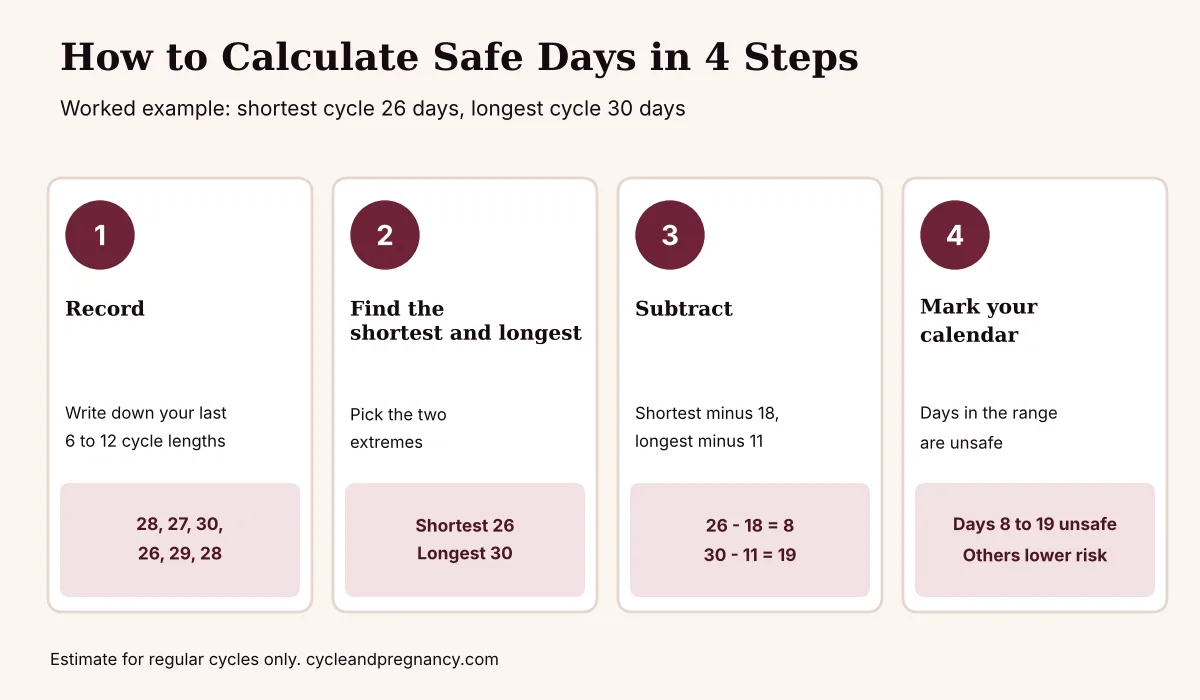
- Record your cycle lengths. Write down the last 6 to 12, for example 28, 27, 30, 26, 29, 28.
- Find the shortest and the longest. In that example, 26 and 30.
- Do the two subtractions. 26 − 18 = 8 (first unsafe day). 30 − 11 = 19 (last unsafe day).
- Mark your calendar. Count from day 1 of your next period: days 8 to 19 are unsafe, the rest are lower risk. Redo the math every month with your newest cycles.
A Slightly More Careful Version
- Many people subtract 19 instead of 18 for the first unsafe day.
- That matches the fertile window, which starts five days before ovulation.
Worked Examples
The more your cycles vary, the wider the unsafe range becomes.
Four Example Cycle Ranges
| Shortest cycle | Longest cycle | First unsafe day | Last unsafe day | Lower risk before | Lower risk after |
|---|---|---|---|---|---|
| 28 | 28 | Day 10 | Day 17 | Days 1–9 | Day 18 onward |
| 26 | 32 | Day 8 | Day 21 | Days 1–7 | Day 22 onward |
| 27 | 30 | Day 9 | Day 19 | Days 1–8 | Day 20 onward |
| 24 | 34 | Day 6 | Day 23 | Days 1–5 | Day 24 onward |
Notes on the Table
- Lower-risk days before the range include period days.
- They are not risk-free.
Safe Days for a 28-Day and a 30-Day Cycle
With a steady cycle, shortest and longest are the same number.
What the Formula Gives
| Cycle length | First unsafe day | Last unsafe day | Lower risk before | Lower risk after |
|---|---|---|---|---|
| 28 days | Day 10 | Day 17 | Days 1–9 | Days 18–28 |
| 30 days | Day 12 | Day 19 | Days 1–11 | Days 20–30 |
Notes on the Table
- Using the more careful 19 instead of 18, the first unsafe day moves one day earlier (day 9 and day 11).
- Lower-risk days before the range include your period days.
- For other lengths see the safe days chart, or enter your own numbers in the free online safe days calculator below.
How to Count Safe Days After Your Period
The lower-risk time after your period is the gap between the last bleeding day and your first unsafe day.
- With a 26-day shortest cycle, the first unsafe day is day 8.
- After a 5-day period, only days 6 and 7 are lower risk.
- For the same idea across cycle lengths, see safe days after your period.
The Standard Days Shortcut
If all your cycles are 26 to 32 days, days 8 to 19 are the unsafe days.
- The Standard Days Method (CDC, Global Handbook for Providers) treats days 8 to 19 as unsafe.
- It works only for people whose cycles never fall outside 26 to 32 days.
Why Counting Safe Days Can Fail
The formula looks backwards and cannot see a month when ovulation shifts.
Limits of the Method
- It looks backwards. The formula uses your past cycles and cannot see a month when ovulation shifts.
- Sperm can survive up to five days, so the margin is thin.
- Irregular cycles make the unsafe range very wide.
- Postpartum, breastfeeding, stopping hormonal birth control and perimenopause all break the pattern.
What the Studies Say
- In the Standard Days Method trial, about 12% of typical users became pregnant over 13 cycles (Arévalo et al., 2002).
- The NHS lists irregular periods among the situations where fertility awareness may not suit you (NHS).
- More figures are in our guide on how reliable safe days are.
Let a Calculator Do the Math
The free calculator does the subtraction for you each month.
- Use our free online safe days calculator if you would rather not do the subtraction each month.
- It works out your estimated fertile and lower-risk days from your last period and cycle length, for a 28-day, 30-day or any other cycle.
- Compare cycle lengths side by side in the safe days chart.
Frequently Asked Questions
11 questionsHow do I know my safe days?
How do I calculate safe days after my period?
How do I count safe days in a 28-day cycle?
How do I count safe days for a 30-day cycle?
Is there a free online safe days calculator?
How many cycles do I need to track?
Can I use my average cycle length instead?
What if my cycles are irregular?
How accurate is the calendar method?
Is the calendar method the same as the rhythm method?
Do I need to recalculate every month?
Medical Disclaimer
This article is general education, not personal medical advice. Safe days are estimates and never a guarantee. If avoiding pregnancy matters to you, talk to a doctor, nurse or pharmacist about a method that fits your health and cycle. Calendar tracking does not protect against sexually transmitted infections.


Scientific References
- Mayo Clinic. “Rhythm Method for Birth Control.” Mayo Clinic Tests & Procedures. Accessed 2026. The calendar method calculation (shortest cycle minus 18, longest minus 11), about 1 in 4 people becoming pregnant with typical use, and who it may not suit. mayoclinic.org
- Family Planning: A Global Handbook for Providers. “Fertility Awareness Methods: How to Use.” WHO / Johns Hopkins CCP / USAID. Accessed 2026. Standard Days Method: days 8 to 19 are fertile for cycles of 26 to 32 days; unprotected sex is acceptable on days 1 to 7 and from day 20. fphandbook.org
- Centers for Disease Control and Prevention (CDC). “Standard Days Method.” U.S. Selected Practice Recommendations for Contraceptive Use. Accessed 2026. The days 8–19 rule and the 26–32 day cycle requirement. cdc.gov
- National Health Service (NHS). “Natural Family Planning (Fertility Awareness).” NHS UK. Accessed 2026. Effectiveness with correct and typical use, and who it may not suit, including people with irregular periods. nhs.uk
- Arévalo, Marcos, Victoria Jennings, and Irit Sinai. “Efficacy of a New Method of Family Planning: The Standard Days Method.” Contraception 65, no. 5 (2002): 333–38. Pregnancy rates of about 5% with correct use and 12% with typical use over 13 cycles. doi.org