
How to Calculate Ovulation Day
“Day 14” is not a fixed rule, it is a coincidence of the average cycle. Here is the real formula behind it, what peer-reviewed data shows about when ovulation happens, and a worked example so you can find your own number.
Key Takeaways
- How to calculate ovulation day: subtract 14 from your average cycle length.
- A 28-day cycle gives day 14, a 32-day cycle gives day 18, a 24-day cycle gives day 10.
- The luteal phase (about 12 to 14 days) is the stable part, the follicular phase varies.
- Only about 30% of women have their whole fertile window within days 10 to 17.
- Confirm the estimate with an LH test, cervical mucus or basal body temperature.
Almost every article on how to calculate ovulation day says the same thing: “ovulation happens on day 14.” That is true for exactly one cycle length, 28 days, and it is the most common thing people get wrong about their own body. If your cycle is 24 days or 33, day 14 tells you nothing useful.
Subtract 14 from your average cycle length. That is your estimated ovulation day, counted from the first day of your period. A 28-day cycle gives day 14, a 32-day cycle gives day 18 and a 24-day cycle gives day 10. The “14” comes from the fairly fixed luteal phase, not from ovulation landing on a universal calendar day.
Why Day 14 Is the Wrong Way to Think About It
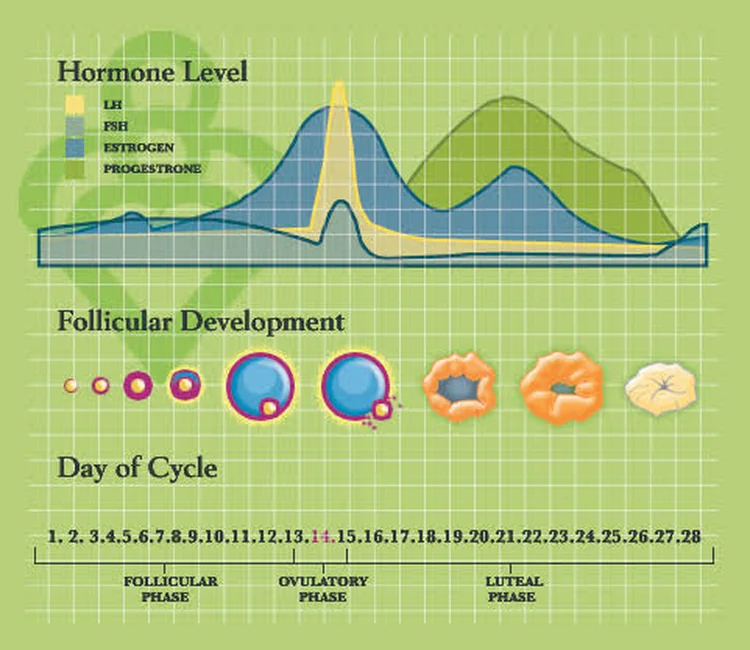
Only the second half of the cycle (luteal phase) is predictable. The first half (follicular phase) varies, which moves ovulation.
Two Phases, One Predictable
Your cycle is not one uniform block of time. It has two phases, and only one is predictable.
From Day 1 of your period until ovulation. This is the part that changes, it can run anywhere from about 10 to 21+ days depending on the person and the cycle.
From ovulation until your next period. Stays relatively consistent at about 12–14 days for most people, cycle after cycle.
That is why counting backward from your next period is more reliable than counting forward from day 1. See our guide to the menstrual cycle phases and the luteal phase explained.
What the Research Shows
A prospective study in the BMJ (Wilcox, Dunson and Baird, 2000) followed 696 cycles in 221 women using daily hormone measurements. On every day between cycle days 6 and 21, at least 10% of women were within their fertile window, and only about 30% had their whole window within days 10 to 17. A separate analysis of over 600,000 cycles (Bull et al., npj Digital Medicine, 2019) confirmed this variability and found a mean cycle length of 29.3 days.
Why the Myth Persists
“Day 14” assumes the cycle splits exactly in half. In reality only the second half is relatively fixed, and the first half decides when you ovulate.
Step-by-Step: How to Calculate Your Ovulation Day
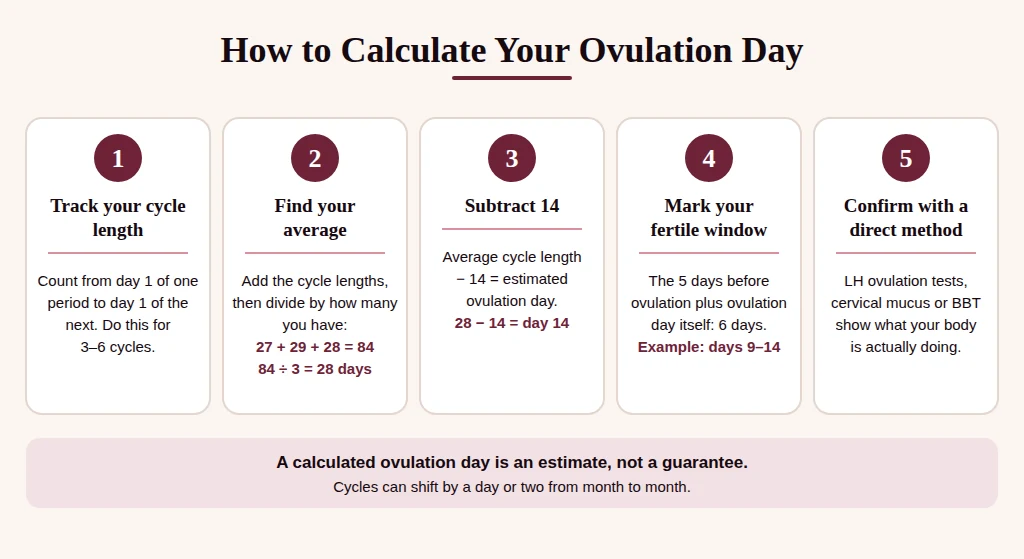
To calculate ovulation day, track 3 to 6 cycles, find the average, subtract 14, mark the 6-day window and confirm with a direct method.
Five Steps
Count from the first day of full bleeding (not spotting) to the first day of your next period. Do this for at least 3 cycles, ideally 6, rather than relying on a single month.
Add your tracked cycle lengths together and divide by the number of cycles. Example: cycles of 27, 29, and 28 days average to 28.
Subtract 14 from your average cycle length. The result, counted from Day 1 of your period, is your estimated ovulation day.
Your fertile window is roughly the 5 days before your calculated ovulation day, plus ovulation day itself, about 6 days total, since sperm can survive up to 5 days while the egg is viable for only about 24 hours.
Layer an LH ovulation test, cervical mucus tracking, or basal body temperature on top of your calculated estimate for real confirmation, since even a regular cycle can shift by a day or two from month to month.
Worked Examples by Cycle Length
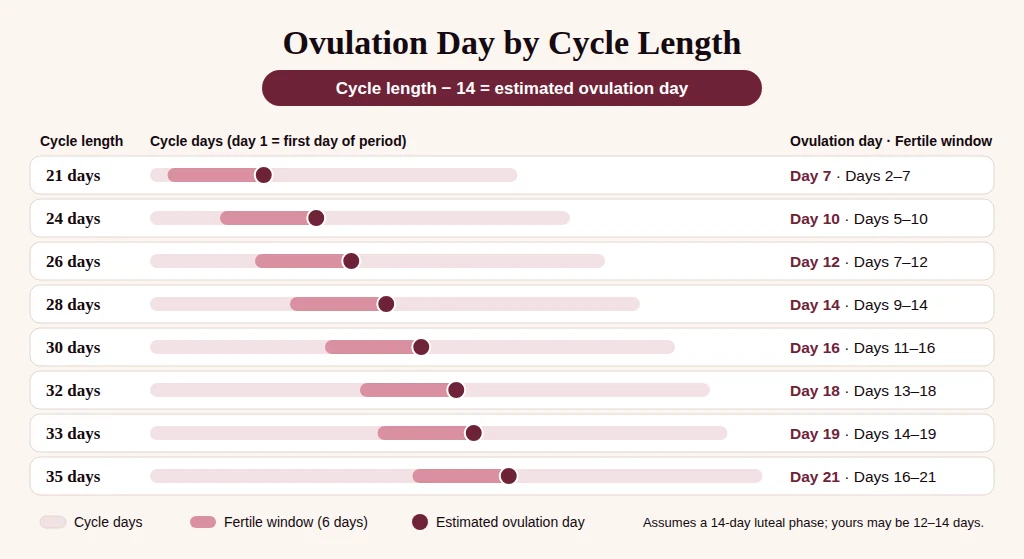
Every extra day in your cycle moves your estimated ovulation day back by one day.
Ovulation Day for Common Cycle Lengths
Here is how to calculate ovulation day with the same formula across cycle lengths, assuming a 14-day luteal phase. Your actual timing may differ.
| Cycle length | Estimated ovulation day | Approximate fertile window |
|---|---|---|
| 21 days | Day 7 | Days 2 to 7 |
| 24 days | Day 10 | Days 5 to 10 |
| 26 days | Day 12 | Days 7 to 12 |
| 28 days (average) | Day 14 | Days 9 to 14 |
| 30 days | Day 16 | Days 11 to 16 |
| 32 days | Day 18 | Days 13 to 18 |
| 33 days | Day 19 | Days 14 to 19 |
| 35 days | Day 21 | Days 16 to 21 |
Why the Day Shifts
As Johns Hopkins Medicine explains, extra cycle length almost always comes from a longer follicular phase. Our Ovulation Calculator can generate a personal estimate from your own cycle history.
A normal cycle can range from 21 to 35 days according to Johns Hopkins Medicine and Cleveland Clinic. Within that range you are not irregular, your ovulation day simply lands earlier or later than the textbook average.
Follicular vs Luteal Phase: Why the Variation Happens
When a period arrives late, it is almost always because ovulation was late, not because the luteal phase stretched.
The Two Halves Compared
To see why your ovulation day shifts from cycle to cycle, look at the two halves around it.
Day 1 of your period until ovulation. This is the variable half, length can range from about 10 to 30 days depending on the person and cycle. Stress, illness, weight changes, and hormone fluctuations all affect how long it takes the dominant follicle to mature.
Ovulation until your next period. This is the stable half, staying close to 12–14 days for most people with little variation, which is exactly why counting back from your next period gives a workable ovulation estimate.
*Mean values, with wide individual ranges, from Bull et al., analysis of 612,613 ovulatory cycles, npj Digital Medicine, 2019.
What This Means
The follicular phase is what drives cycle-to-cycle variability in your calculated ovulation day. For the hormones behind it, read how hormones change your cycle.
Factors That Can Shift Your Ovulation Timing
Stress, illness, weight change, intense exercise, travel, stopping birth control, thyroid problems and PCOS can all shift ovulation.
Common Factors
Most of these act on the hypothalamus and pituitary gland, which control the FSH and LH signals that drive ovulation.
| Factor | How it affects ovulation |
|---|---|
| Stress | Higher cortisol can suppress GnRH release and postpone ovulation. See how stress affects your period |
| Illness or fever | Can temporarily disrupt the hormonal signals driving the cycle |
| Weight changes | Rapid loss or gain can affect ovulation hormones. See weight changes and your cycle |
| Intense exercise | A sudden rise in training can delay or suppress ovulation. See exercise and the menstrual cycle |
| Travel and poor sleep | Changes to your rhythm can shift timing |
| Stopping hormonal contraception | Cycles often take a few months to settle |
| Thyroid disorders | Underactive and overactive thyroid can both disrupt ovulation. See thyroid and your cycle |
| PCOS | A common cause of irregular or absent ovulation. See PCOS and ovulation |
Common Mistakes People Make
Do not assume day 14, count from spotting, use one cycle, treat the day as a guarantee or ignore your own luteal length.
Five Mistakes to Avoid
- Assuming ovulation is always day 14, regardless of actual cycle length
- Counting cycle length from the wrong starting point (spotting instead of full flow)
- Using a single cycle length instead of a multi-cycle average
- Treating the calculated day as a guarantee rather than an estimate with a day or two of natural variation
- Ignoring your own luteal phase length, which can differ (commonly 12 to 14 days, sometimes outside that range)
Does Ovulation Happen Every Month?
Not always. Occasional cycles without ovulation are normal, but frequent ones are worth checking.
Anovulatory Cycles
A cycle without ovulation is called an anovulatory cycle. You can still have bleeding that looks like a period, driven by estrogen changes rather than the usual progesterone drop, but pregnancy is not possible in that cycle. Occasional anovulatory cycles can happen to anyone. More frequent ones, especially with very irregular or absent periods, are worth having evaluated.
Signs a Cycle May Not Have Included Ovulation
- Irregular or absent periods: cycles shorter than 21 or longer than 35 days, or missing periods for several months.
- No sustained BBT rise: progesterone normally causes a small, lasting rise in basal body temperature after ovulation.
- No positive OPK reading: if daily testing never turns positive, the LH surge may not have occurred.
- Low mid-luteal progesterone: a blood test around day 21 of a 28-day cycle is the most definitive clinical check.
When This Calculation Does Not Work Well
The formula is less reliable with highly variable cycles, PCOS, thyroid problems, postpartum months or cycles outside 21 to 35 days.
Situations to Watch
The method assumes a fairly consistent cycle length and a standard luteal phase. It becomes less reliable if:
Your cycle length varies a lot · You have PCOS, a thyroid condition or another cause of irregular ovulation · You are postpartum or breastfeeding · Cycles are shorter than 21 days or longer than 35 days.
What to Do Instead
Read our guide to how to calculate ovulation with irregular periods, which uses a shortest and longest cycle formula. Also see a period calculator for irregular periods and periods while breastfeeding.
How to Know When You Are Ovulating: Calculating vs Confirming
Knowing how to calculate ovulation day gives an estimate. Combine it with two or more direct methods for real confirmation.
Ovulation Predictor Kits (OPKs)
OPKs detect the LH surge in urine, typically 24 to 36 hours before ovulation, making them the most precise widely available at-home method for timing ovulation as it approaches.
Cervical Mucus Monitoring
As ovulation nears, cervical mucus usually becomes clearer, stretchier and more slippery, like raw egg white, often 2 to 3 days before ovulation. See cervical mucus tracking and the signs of ovulation.
Basal Body Temperature (BBT)
After ovulation, progesterone raises resting temperature by roughly 0.2 to 0.5°C. Charting shows your pattern over time but confirms ovulation only after it happens. See basal body temperature tracking.
Ovulation Calculator
An ovulation calculator uses your last period date and average cycle length to estimate your window. It is a solid starting point, especially combined with physical signs.
Go Deeper
Read how to use an ovulation calculator accurately in our accuracy guide, compare methods in how to track ovulation, and see what is the fertile window for why even a well-calculated day carries natural variability.
Frequently Asked Questions
15 questions answeredHow do you calculate ovulation day?
When does ovulation happen exactly?
Why is ovulation not always on day 14?
What is the luteal phase and why does it matter for this calculation?
How long does ovulation last?
Can ovulation day shift even in a regular cycle?
How many cycles should I track to calculate ovulation accurately?
Does this calculation work for irregular periods?
Can you get pregnant right before or after your period?
Does stress really delay ovulation?
Does ovulation happen every month?
What’s the difference between calculating and confirming ovulation?
When should I see a doctor about ovulation timing?
How do I calculate ovulation day for a 35-day cycle?
How do I calculate ovulation day for a 24-day cycle?


Sources & References
- Wilcox AJ, Dunson D, Baird DD. The Timing of the “Fertile Window” in the Menstrual Cycle: Day Specific Estimates from a Prospective Study. BMJ. 2000;321(7271):1259–1262. doi:10.1136/bmj.321.7271.1259. 696-cycle study behind the “only 30% of women fall within days 10–17” finding. bmj.com
- Bull JR, Rowland SP, Scherwitzl EB, Scherwitzl R, Danielsson KG, Harper J. Real-World Menstrual Cycle Characteristics of More Than 600,000 Menstrual Cycles. npj Digital Medicine. 2019;2:83. Source for average follicular (16.9 days) and luteal (12.4 days) phase lengths and mean cycle length (29.3 days). nature.com
- University of Rochester Medical Center (URMC). Ovulation Date Calculator. Source confirming the cycle-length-relative ovulation shift (e.g., 24-day cycle → day 10). urmc.rochester.edu
- Johns Hopkins Medicine. Calculating Your Monthly Fertility Window. hopkinsmedicine.org
- Stanford Medicine Children’s Health. Ovulation Date Calculator. stanfordchildrens.org
- Office on Women’s Health, U.S. Department of Health & Human Services. Ovulation Calculator. womenshealth.gov
- American College of Obstetricians and Gynecologists (ACOG). How to Get Pregnant. Source for the days 11–21 ovulation range and egg-viability window. acog.org
- NHS. How to Get Pregnant – Trying to Get Pregnant. Source for the “10 to 16 days before your next period” ovulation estimate. nhs.uk
- Cleveland Clinic. Menstrual Cycle. Source confirming the normal 21–35 day cycle-length range. my.clevelandclinic.org
- Tommy’s. Ovulation Calculator: When Might You Be Most Fertile? UK pregnancy charity; confirms luteal phase length of 12–16 days. tommys.org
- Wilcox AJ, Weinberg CR, Baird DD. Timing of Sexual Intercourse in Relation to Ovulation. New England Journal of Medicine. 1995;333(23):1517–1521. doi:10.1056/NEJM199512073332301. Source for sperm survival (5 days) and egg viability (24 hours) figures.
- March of Dimes. Ovulation Tracker. marchofdimes.org