
How to Calculate Ovulation With Irregular Periods Find Your Fertile Window When Cycles Vary
A single “day 14” formula doesn’t work when your cycles don’t cooperate. Here’s the actual calendar-based method doctors and fertility organizations use for irregular cycles, the real math behind it, and when to stop relying on calculation alone.
If you’ve ever tried to calculate ovulation with irregular periods, you already know the standard “day 14” advice doesn’t apply to you. When your cycle length swings from 24 days one month to 38 the next, a single fixed formula can’t keep up, but that doesn’t mean calculation is useless. It just needs a different approach.
Track your cycle length for 6–12 months. Subtract 18 from your shortest recorded cycle to find your earliest possible fertile day. Subtract 11 from your longest recorded cycle to find your latest possible fertile day. The days in between are your estimated fertile range, wider than a regular cycle’s, but far more useful than guessing.
Key Takeaways
- To calculate ovulation with irregular periods, subtract 18 from your shortest cycle and 11 from your longest.
- The days between the two results are your estimated fertile range, which is wider than a regular cycle’s.
- Chart at least 6 cycles, ideally 12, before trusting the range.
- The method assumes you ovulate, so anovulatory cycles need direct methods or a doctor.
- Pair the calendar range with LH tests, cervical mucus or BBT for better precision.
How to Calculate Your Ovulation Date Accurately When Periods Are Irregular
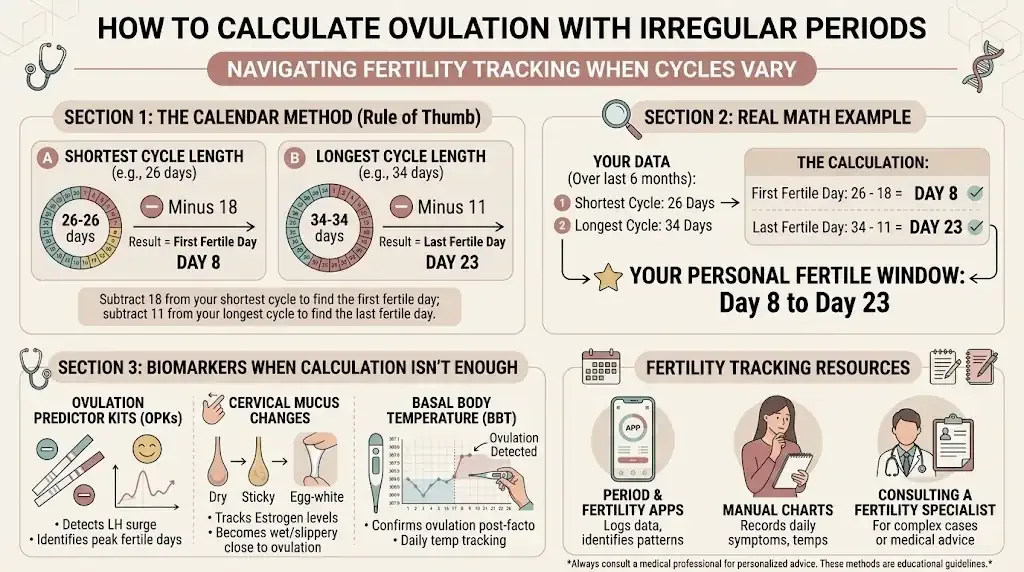
Subtract 18 from your shortest cycle and 11 from your longest. The days between are your estimated fertile range.
The Two Formulas
This is the calendar-based (Knaus-Ogino) method used in fertility awareness education, including by Planned Parenthood. It works differently than a simple day-14 estimate because it uses your cycle range, not a single average:
Why These Specific Numbers?
The formula relies on the fact that the luteal phase (the time from ovulation to your next period) stays relatively fixed even when the rest of your cycle doesn’t, typically 12 to 16 days. The 18 and 11 build in a margin that accounts for how much ovulation timing itself can shift between cycles, combined with typical sperm survival (up to 5 days) and egg viability (about 24 hours). That is why the range comes out wider than most single-day predictions, on purpose.
Worked Example: Calculate Ovulation With Irregular Periods
A shortest cycle of 26 days and a longest of 34 days give a fertile range of Day 8 to Day 23.
The Calculation
Here’s the formula applied to real numbers. Say you’ve tracked 6 cycles and your shortest was 26 days and your longest was 34 days:
| Step | Calculation | Result |
|---|---|---|
| Earliest fertile day | 26 − 18 | Day 8 |
| Latest fertile day | 34 − 11 | Day 23 |
| Estimated fertile range | Day 8 through Day 23, counting the first day of your period as Day 1 | 16 days |
Why the Range Is So Wide
That’s a 16-day range, wider than the typical 6-day fertile window for a regular cycle, which is expected. The more your cycle lengths vary, the wider this calculated range will be. Our guide to the fertile window explains why even regular cycles carry more natural variability than most people assume.
Do Irregular Periods Affect Ovulation?
Often yes: ovulation may come early, late or sometimes not at all, but many irregular cycles still include ovulation.
What Irregular Usually Means for Ovulation
Irregular periods often mean ovulation is happening at different times from cycle to cycle, which is why a fixed day-14 estimate fails. In some cycles ovulation may not happen at all (an anovulatory cycle). Irregular does not always mean no ovulation, so it is worth tracking rather than assuming.
Three Possible Patterns
| Pattern | What it means | What helps |
|---|---|---|
| Ovulation at variable times | Ovulation happens, but earlier or later than day 14 | Calendar range plus LH tests |
| Occasional missed ovulation | Some cycles have no ovulation | Direct methods and a doctor’s advice if frequent |
| Rarely or never ovulating | Cycles are not preceded by ovulation | Medical evaluation |
What Causes Irregular Periods in the First Place?
PCOS, thyroid disorders, weight changes and postpartum cycles can make calendar math far less reliable.
Why the Cause Matters
Understanding the underlying cause matters, because some causes make calendar-based calculation far less reliable than others.
Common Causes at a Glance
| Cause | How it affects cycles | Read more |
|---|---|---|
| PCOS (Polycystic Ovary Syndrome) | One of the most common causes of unpredictable cycles, often with inconsistent or absent ovulation. | PCOS and ovulation guide |
| Thyroid disorders | Both an underactive and overactive thyroid can shift ovulation timing significantly. | Thyroid and menstrual cycle guide |
| Significant weight changes | Both rapid weight loss and weight gain can disrupt the hormonal signals that trigger ovulation. | Weight changes and menstrual cycle guide |
| Postpartum and breastfeeding | Cycles can be highly unpredictable for months after birth. | Periods while breastfeeding |
| Stress, illness or recently stopping birth control | All three can cause temporary irregularity that typically resolves within a few months as your body readjusts. | Speak with a doctor if it continues |
When the Calendar Method Isn’t Enough
Anovulatory cycles, very wide ranges and cycles under 21 days need direct methods or a doctor, not more math.
Three Limits of the Formula
The formula above assumes ovulation is happening every cycle, just at a variable time. That is a reasonable assumption, but not always a safe one. It has real limits:
- Anovulatory cycles (no ovulation occurs) won’t be accurately predicted by any calendar formula.
- Very wide cycle ranges (more than 10 to 14 days between shortest and longest) produce a fertile window so wide it’s barely actionable on its own.
- Cycles shorter than 21 days or missed periods for 3+ months warrant medical evaluation rather than continued calculation.
What to Do Instead
In these situations, calculation should be paired with, or replaced by, direct ovulation detection.
Best Ways to Track Ovulation With Irregular Periods
Start with the calendar range, then confirm with LH tests, cervical mucus or temperature tracking.
Four Direct Methods Compared
The calendar formula gives you a range to work with, but pinpointing ovulation with irregular periods gets meaningfully more precise when you layer in a direct physical signal on top of it:
| Method | What it tells you | Good to know |
|---|---|---|
| LH ovulation tests | Detect the actual hormone surge 24 to 36 hours before ovulation. | With irregular cycles you will likely need to test over a longer stretch of days. |
| Cervical mucus tracking | Clear, stretchy, egg-white mucus typically signals approaching fertility. | Free, real time and not dependent on cycle math. |
| Basal body temperature (BBT) | Confirms ovulation after it happens. | Helps you build a personal pattern over several months. |
| Fertility monitors | Combine multiple signals automatically. | Built for exactly the scenario irregular cycles create. |
A Simple Tracking Plan
- Chart your cycles and work out your range with the formula above.
- Start LH tests on your earliest fertile day and keep going through the range.
- Check cervical mucus daily and note any egg-white days.
- Use BBT afterwards to confirm that ovulation happened and to learn your pattern.
Ovulation Tests: How Do You Use Them With Irregular Periods?
Start testing on your earliest fertile day and keep going until you get a positive result or reach the end of your range.
How to Use LH Tests With a Wide Range
- Work out your earliest fertile day (shortest cycle minus 18) and begin testing then.
- Test once a day at a similar time and follow the instructions on your kit.
- A positive result shows the LH surge, and ovulation usually follows within about 24 to 36 hours.
- If you reach the end of your range with no positive, keep a record and speak with a doctor if this repeats.
What to Keep in Mind
A wide range means you may use more tests per cycle than someone with regular cycles. In conditions such as PCOS, LH can run high more often, so a positive test does not always mean ovulation. Our guide to ovulation predictor kits covers timing and how to read results.
How Reliable Is the Calendar Method, Really?
Fertility awareness methods averaged 69.5% success in one review. Pairing the method with a direct signal helps most.
What the Research Says
Calculating ovulation with irregular periods is inherently less precise than a regular cycle would allow, so it’s worth knowing the real numbers rather than just assuming. A 2024 systematic review pooling 16 studies and 20,339 participants found fertility awareness-based methods, including calendar-based calculation, had an average success rate of 69.5%, with wide variation between methods and how consistently they were followed.
average success rate across fertility awareness-based methods reviewed in a 2024 systematic review of over 20,000 participants, some individual studies reported above 90%, largely depending on how strictly the method and timing were followed.
cycles is the minimum Planned Parenthood says to chart for the calendar method, and a few more months is even better.
How to Read These Numbers
These numbers aren’t meant to discourage using the method. Consistency and pairing it with a direct signal (like an LH test) are the biggest factors separating the lower and higher end of that range, but they do set realistic expectations for how much precision calendar math alone can offer.
When Should You See a Gynecologist About Irregular Periods?
See a doctor for cycles under 21 or over 35 days, 3 missed months, or no conception after 12 months of trying.
Signs to Get Checked
- Cycles consistently shorter than 21 days or longer than 35 days
- Missed periods for 3 months or more, when not pregnant
- No conception after 12 months of trying (6 months if you’re over 35)
- New symptoms alongside irregular cycles, like excess hair growth, significant fatigue, or rapid weight change
Frequently Asked Questions
12 questions answeredHow do you calculate ovulation with irregular periods?
Why subtract 18 and 11 specifically?
How many cycles should I track before calculating?
What counts as an irregular period?
What causes irregular periods?
Does the calendar method work if I don’t ovulate every cycle?
Is the calendar method accurate for irregular cycles?
When should I see a doctor about irregular periods?
Do irregular periods affect ovulation?
How do you use ovulation tests with irregular periods?
Can I use an ovulation calculator if my periods are irregular?
How do I know if I am ovulating with irregular periods?


Sources & References
- Planned Parenthood. What’s the Calendar Method (FAMs)? Describes the Knaus-Ogino calendar formula this article’s calculation is based on. plannedparenthood.org
- Cleveland Clinic. Rhythm Method: Birth Control, Calendar & Effectiveness. Describes the calendar/rhythm method methodology and its basis in tracking cycle length. clevelandclinic.org
- Simmons RG, Jennings V. Fertility Awareness-Based Methods of Family Planning. Best Practice & Research Clinical Obstetrics & Gynaecology. 2020;66:68-82. Peer-reviewed overview of calendar-based and other fertility awareness methods, including their basis in ovum viability (~24 hours) and sperm survival (up to 5 days).
- Simmons RG, et al. Advantages of Determining the Fertile Window With the Individualised Natural Cycles Algorithm Over Calendar-Based Methods. European Journal of Contraception & Reproductive Health Care. 2020. Discusses the historical basis of the calendar/rhythm method (Knaus and Ogino’s discovery that ovulation occurs approximately 14 days before the next period) and its reliance on tracking at least 6 cycles. Taylor & Francis Online