
Period Calculator for Irregular Periods – How to Get a Better Estimate
A standard period calculator assumes your cycle length is roughly the same every month. If yours isn’t — or if a “regular” calculator’s prediction was still wrong this month — here’s how to actually adapt it, the seven real reasons a prediction misses, what irregular cycles mean, and whether a calculator can tell you if you’re pregnant.
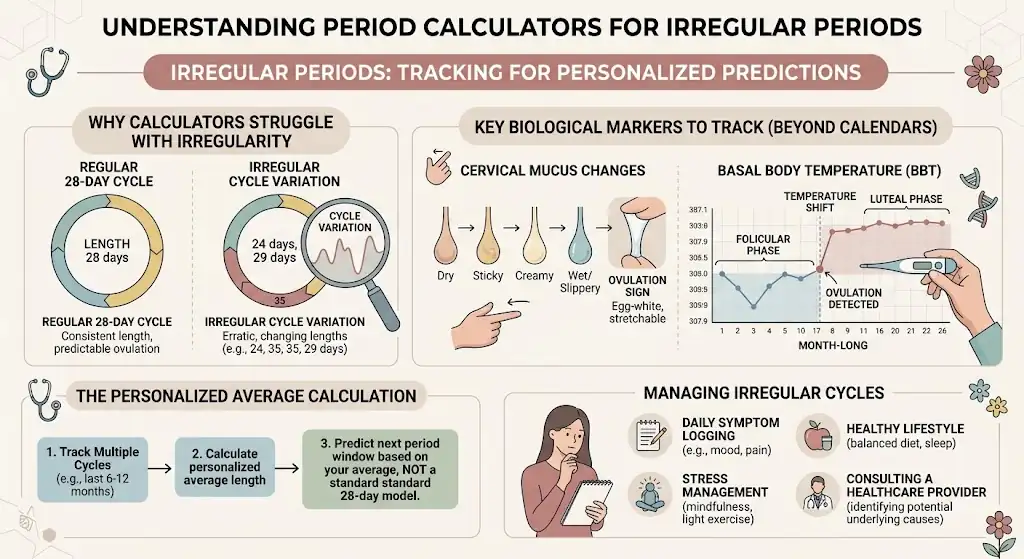
A standard period calculator for irregular periods works by adding your average cycle length to your last period’s start date. That’s a reasonable approach when your cycles are fairly consistent — but if your periods are irregular, or a “regular” calculator’s prediction was still wrong this month, a single average can be misleading. Here’s how to actually adapt the calculator for irregular periods, the real reasons a prediction misses, and how to get a more honest estimate instead of a number that pretends to a precision it doesn’t have.
The best period calculator for irregular periods approach: instead of using one average cycle length, use your shortest and longest recent cycles to calculate a range: earliest possible date (last period + shortest cycle) to latest possible date (last period + longest cycle). Track at least 6 cycles for a reliable pattern, and update the range every month — especially after any month involving stress, illness, travel, weight change, or a birth control change.
Why Period Calculator Predictions Can Be Wrong
A typical period calculator assumes one number represents your cycle well enough to predict a single date. For someone with a consistent 28-day cycle, that assumption holds up fine. For someone whose cycles run 24 days one month and 34 the next, averaging those two numbers to “29 days” produces a prediction that could be off by a week in either direction — while looking just as confident and precise as a regular-cycle result.
This isn’t a flaw unique to irregular cycles, either. An analysis of over 600,000 real-world cycles found that only about 13% land on exactly the textbook 28 days most calculators assume, and a separate review of period-tracking apps found the same limitation across the board: date-based math, not a picture of what’s actually happening hormonally that month. The variation comes almost entirely from one place: the days before ovulation. Real-world cycle data shows the follicular phase (the stretch from your period to ovulation) can range from about 10 to 27 days depending on the cycle, while the days after ovulation stay far more consistent. So when a calculator’s date misses — on a regular or irregular cycle — the actual cause is almost always that ovulation itself happened a few days earlier or later than usual.
The fix isn’t a different calculator — it’s a smarter period calculator for irregular periods strategy, using the same tool’s inputs differently, and knowing which real-world factors are most likely behind a miss.
The 7 Real Reasons Your Period Calculator Was Wrong
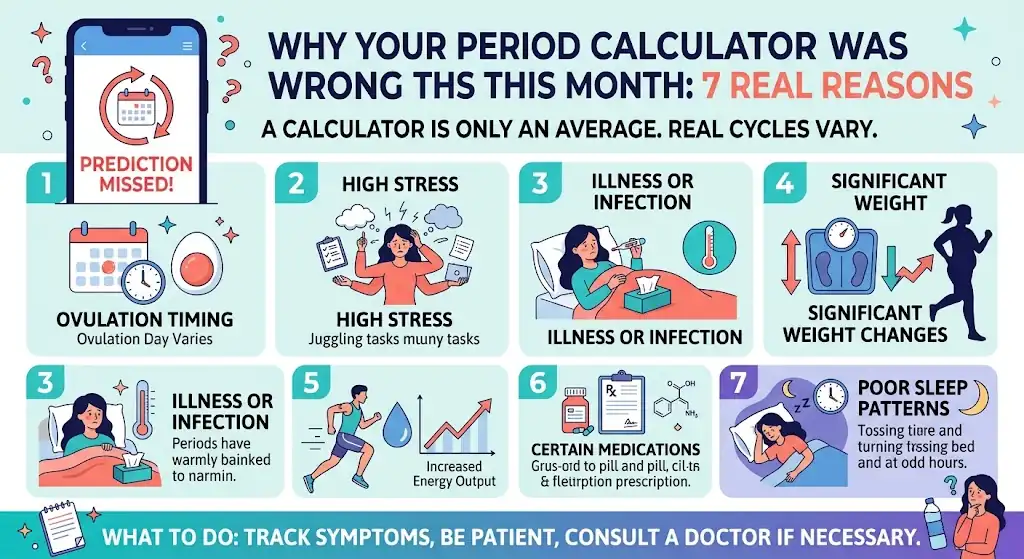
These are ranked roughly by how often each one is the actual explanation:
This is the default explanation, not a special one. Even in healthy, regular cycles, ovulation can happen several days earlier or later than your typical pattern, which shifts your whole cycle length and makes the calculator’s average-based date land early or late. No other cause needs to be present for this alone to explain a few days’ miss.
Most Common CauseSignificant physical or emotional stress raises cortisol, which can interfere with the hormonal signaling that times ovulation. A stressful week or month is one of the most common reasons a period runs later than predicted, and severe stress can delay a cycle substantially.
Very CommonA significant increase or decrease in body weight, or a sudden increase in exercise intensity or volume, can disrupt the hormone balance that regulates cycle timing — sometimes delaying ovulation, sometimes skipping it for a cycle.
CommonBeing sick, especially with a fever, and long-haul travel or jet lag that disrupts sleep patterns can both temporarily throw off the hormonal signaling that governs ovulation timing, pushing that month’s period later than usual.
TemporaryAny change to hormonal birth control — starting it, stopping it, or switching methods — commonly causes several months of unpredictable timing while your cycle resets, which throws off a calculator relying on your prior average.
Often Lasts Several MonthsBreastfeeding raises prolactin, a hormone that can suppress ovulation entirely, especially with frequent nursing. Periods can be delayed for months postpartum, and a calculator based on a pre-pregnancy average won’t reflect this at all. See our guide to periods while breastfeeding.
Postpartum-SpecificConditions like PCOS and thyroid disorders directly interfere with ovulation, and perimenopause brings similar unpredictability as hormone levels shift with age. If your calculator is consistently wrong rather than occasionally off by a few days, one of these underlying causes — not a one-off life event — is more likely behind it. See our PCOS and irregular periods guide and thyroid and menstrual cycle guide.
Consider a Check-Up If RecurringHow to Calculate a Range Instead of One Date
Here’s exactly how a better period calculator for irregular periods approach works, in formula form:
This gives you a realistic window to plan around, instead of one specific date that’s likely to be wrong.
Last period started March 1. Your last 6 cycles ranged from 24 to 33 days.
Earliest likely date: March 1 + 24 days = March 25
Latest likely date: March 1 + 33 days = April 3
Estimated range: March 25 – April 3 — a 9-day window that’s honest about the real uncertainty.
What Counts as an Irregular Period?
Cycles are generally considered irregular if your shortest and longest cycles differ by more than 7 to 9 days, or if cycle length is consistently shorter than 21 days or longer than 35 days, per Cleveland Clinic. A single unusual month — caused by travel, illness, or stress — doesn’t necessarily mean your cycles are irregular; it’s the pattern over several months that matters.
What Causes Irregular Periods?
Understanding the cause helps explain why a period calculator for irregular periods needs a different approach in the first place:
One of the most common causes of unpredictable cycles. See our PCOS and irregular periods guide.
Both an underactive and overactive thyroid can shift cycle length significantly. See our thyroid and menstrual cycle guide.
Can temporarily disrupt the hormonal signals that regulate your cycle.
Your natural cycle can take a few months to settle into a predictable pattern.
All three commonly involve genuinely unpredictable cycles as a normal, temporary phase. See our guide to periods while breastfeeding.
Step-by-Step: Getting a Better Estimate
Track at least 6 cycles, ideally more, rather than relying on just 2 or 3.
Identify your shortest and longest cycle from that tracked data, not just the average.
Calculate your earliest and latest likely dates using the formula above.
Update the range every cycle with your most recent data, so it reflects your current pattern.
Re-check the prediction after any month with a likely cause on the list above — significant stress, illness, travel, a weight or exercise change, or a birth control switch. Expect the calculator to be less precise those cycles, not more.
Can a Period Calculator Tell You If You’re Pregnant?
No. A period calculator for irregular periods only estimates timing based on your cycle history — it cannot detect pregnancy. If your period is later than your calculated range, a home pregnancy test or a conversation with a doctor is the accurate next step, not a calculator. This is especially worth remembering with irregular cycles, since a “late” period may simply be within your normal range of variation rather than a sign of anything else.
When to See a Doctor
- Cycles consistently shorter than 21 days or longer than 35 days
- Missed periods for 3 months or more, when not pregnant
- Previously regular cycles suddenly becoming very irregular
- Irregular cycles alongside other new symptoms (excess hair growth, significant fatigue, rapid weight change)
Frequently Asked Questions
13 questions answeredCan I use a period calculator with irregular periods?
Why is my period calculator prediction so far off, or always wrong?
How accurate are period calculators?
What counts as an irregular period?
What causes irregular periods?
Can stress make a period calculator’s prediction wrong?
Why did my period come earlier than my calculator predicted?
Can hormonal birth control make period predictions inaccurate?
Does breastfeeding affect period calculator accuracy?
Can a period calculator tell you if you’re pregnant?
How many cycles should I track if my periods are irregular?
How can I make my period calculator more accurate?
When should I see a doctor about irregular periods?


Sources & References
- Cleveland Clinic. Menstrual Cycle. Defines a normal menstrual cycle as 21–35 days, with cycles varying by more than 7–9 days from month to month considered irregular. clevelandclinic.org
- Bull JR, Rowland SP, Scherwitzl EB, Scherwitzl R, Danielsson KG, Harper J. Real-World Menstrual Cycle Characteristics of More Than 600,000 Menstrual Cycles. npj Digital Medicine. 2019;2:83. Analysis of 612,613 real-world cycles found only a small share land on exactly 28 days, with average follicular phase length of 16.9 days (range approximately 10.4–26.8 days) versus a far more stable average luteal phase of 12.4 days — the basis for why calculator predictions can miss even in healthy cycles. nature.com
- Verily Magazine, citing University of Washington & Weill Cornell Medical College research. Are Period Tracking Apps Reliable? Here’s Why We Should Still Use Them. Notes that only about 13% of cycles follow the standard 28-day textbook length most calculator algorithms assume, and that a review of 53 free period-tracking apps and websites found only 3 correctly predicted the fertile window for a standard cycle. verilymag.com
- Clue (Hello Clue / BioWink GmbH). Wondering Why Your Period Is Late? Here’s What Might Be Going On. Clinical overview of causes behind a late or delayed period, including stress-driven cortisol changes, weight change, exercise intensity, PCOS, thyroid conditions, hormonal birth control changes, breastfeeding-related prolactin increases, perimenopause, illness, and travel. helloclue.com
- Natural Cycles. Period Calculator: Predict Your Period, Track Ovulation & Fertility Window. Explains that calendar-based period calculators use date calculations only and cannot account for individual month-to-month cycle variability or underlying conditions such as PCOS. naturalcycles.com