
How to Calculate Your Menstrual Cycle From Date to Date: Counting, Averaging and Your Current Cycle Day
Counting days between two calendar dates sounds simple, until your cycle crosses a month boundary and January’s 31 days throw off your math. Here’s the correct counting method, how it differs from period length, how to average 2 or 3 tracked cycles into a real number, and how to figure out what day of your cycle you’re on right now.
When you calculate your menstrual cycle, counting date to date sounds like basic subtraction, until your cycle actually spans two different calendar months and you realize January has 31 days, April has 30, and February has either 28 or 29 depending on the year. Get the month lengths wrong, and your cycle-length count is wrong too, even if you did everything else right. This guide covers the full skill: the correct counting method, how cycle length differs from period length, what to do when your count crosses a month boundary, how to turn 2 or 3 tracked periods into a real average, and how to find what day of your cycle you’re on right now.
Mark the first day of full flow as Day 1, then count forward until the day before your next period starts, that total is your cycle length. If the count crosses a month boundary, count the remaining days left in the starting month, then add the day-of-month number of your end date in the new month. Do this for at least 3 tracked periods, remembering that N period dates give you N−1 cycle lengths to average, not N.
Key Takeaways
- To calculate your menstrual cycle, count from Day 1 to the day before your next period starts.
- Cycle length is not period length: one is the full span, the other is the days you bleed.
- When the count crosses months, count each month’s days separately and use real month lengths.
- N tracked period dates give N−1 cycle lengths to average.
- Your current cycle day is today’s date minus your last start date, plus 1.
Cycle Length vs. Period Length: Not the Same Thing
Period length is how many days you bleed. Cycle length runs from one Day 1 to the next, and it is the number a calculator needs.
Two Different Numbers
This is the single most common mix-up, so it’s worth stating plainly. A period calculator asks for cycle length. If you accidentally enter your period length instead, the prediction will be off by weeks.
| Measure | What it counts | Usual range |
|---|---|---|
| Period length | How many days you actually bleed | 2 to 7 days |
| Cycle length | First day of one period to the first day of the next | 21 to 35 days |
How to Calculate Your Menstrual Cycle: The Counting Method
Day 1 is the first day of full flow. Count forward until the day before your next period starts.

Four Steps
Mark the first day of full menstrual flow. This is Day 1. Spotting beforehand doesn’t count.
Keep counting each day forward, through your period and past it, until the day before your next period begins.
That final count, from Day 1 to the day before the next Day 1, is your cycle length for that month.
Repeat for at least 3 cycles, ideally 6, and average the results for a number worth trusting.
Worked Example: A Simple Count
A period starting October 31 and the next on November 29 gives a 29-day cycle.
The Dates
Say your period started on October 31 and your next one started on November 29.
| Date | What it means |
|---|---|
| Oct 31 | Day 1, the first day of full flow. Start counting here. |
| Nov 28 | The day before your next period starts, the last day counted. |
| Nov 29 | Your next period begins and becomes Day 1 of the next cycle, not part of this count. |
The Result
Cycle length for this month: 29 days (October 31 through November 28, inclusive).
Worked Example: Counting Across a Month Boundary
January 25 to February 22 is 7 days plus 21 days, so a 28-day cycle.
Count Each Month Separately
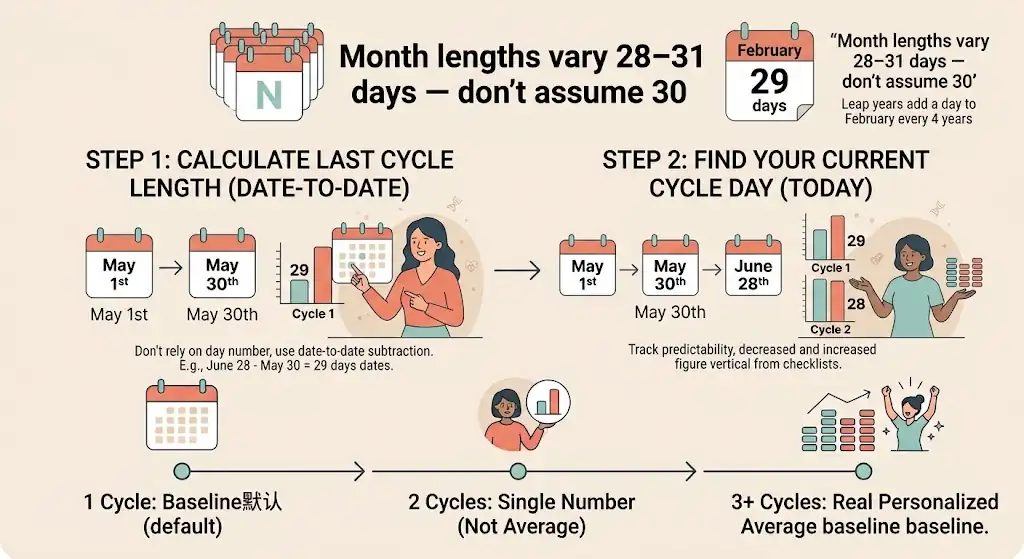
Say your period started January 25 (Day 1), and your next one started February 22 (Day 1 of the next cycle). To find the length of the cycle in between, count up to but not including February 22, since that date belongs to the next cycle.
| Dates | Calculation | Days |
|---|---|---|
| Jan 25 to Jan 31 | 31 − 25 + 1 (the 25th counts) | 7 |
| Feb 1 to Feb 21 | Days before the next period starts on the 22nd | 21 |
| Total | 7 + 21 | 28 days |
Two Mistakes to Avoid Here
- Forgetting to add 1 when the start date itself counts as a full day.
- Including the next period’s start date in this cycle’s total instead of stopping the day before it.
Common Counting Mistakes and Pitfalls
Start on full flow, use real month lengths, remember leap years and never count the next Day 1.
Five Pitfalls
- Starting the count on spotting, not full flow. This can shift your count by a day or two in either direction, which adds up across multiple tracked cycles.
- Assuming every month has 30 days. Months range from 28 to 31 days, so using “30” for every month will misdate your cycle length by a day or two. Cleveland Clinic explains that the cycle is counted from the first day of one period to the first day of the next, which only works with actual calendar days.
- Forgetting leap years. February has 29 days in a leap year instead of 28, so a cycle spanning it adds a day of error if you forget.
- Including the next period’s start day in the count. The new Day 1 belongs to the next cycle, so don’t double-count it.
- Using only one cycle. A single unusually short or long month, caused by stress, travel or illness, will throw off your average if that’s all you count.
What Day of My Cycle Am I On Today?
Today’s date minus your last period start date, plus 1, gives your current cycle day.
The Calculation
This is a different question from “how long is my cycle,” and the same counting skill answers it. Subtract your last period’s start date from today’s date, then add 1, since the start date itself counts as Day 1.
| Step | Example |
|---|---|
| Last period started | 10 days ago |
| Calculation | 10 + 1 |
| Today is | Cycle Day 11 |
Why It Helps
Knowing your current cycle day is useful on its own, for estimating roughly where you are relative to ovulation, or just understanding your current phase without waiting for your next period to arrive. Our Period Calculator shows this automatically alongside your prediction.
2 Periods vs. 3 Periods: What You Actually Get
2 tracked dates give 1 cycle length. 3 dates give 2 cycle lengths, which is the minimum you can average.
Dates Versus Cycle Lengths
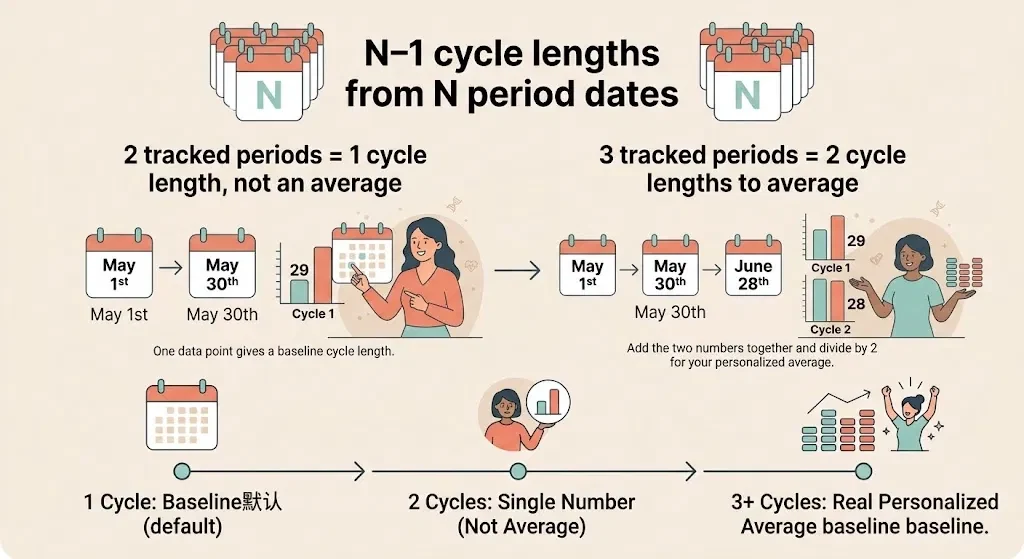
Once you can count a single cycle correctly, the next question is how to turn a few tracked cycles into a real average. Here’s a detail most guides skip: 2 tracked periods give you exactly one cycle length, not an average. 3 periods give you two numbers to actually average.
| Tracked dates | Cycle lengths | Example | What you have |
|---|---|---|---|
| 2 dates | 1 | Jan 1, Jan 29: 28 days | One number, not an average yet |
| 3 dates | 2 | Jan 1, Jan 29, Feb 28: 28 and 30 days | Two numbers to average |
The Averaging Formula
Count each gap, add the cycle lengths and divide by the number of gaps, not the number of dates.
Four Steps to an Average
Here’s the exact process to calculate your average cycle from 2 or 3 periods:
Record each period’s start date in chronological order.
Count the days between each consecutive pair of dates, each gap is one cycle length.
Add all the cycle lengths together.
Divide by the number of cycle lengths you calculated, not by how many period dates you tracked.
Worked Average
Your average cycle length from these 3 tracked periods is 29 days, a personal number built from your own two measured cycle lengths, not a population guess.
What If My Cycle Lengths Are Very Different From Each Other?
A big gap between cycle lengths is a signal to keep tracking and use a range, not to average it away.
Why It Matters
If your calculated cycle lengths differ noticeably, say 24 days and 34 days, that’s a real signal worth paying attention to, not something to average away and ignore. A short tracking history can’t yet tell you whether that’s normal month-to-month variation or a genuinely irregular pattern.
What to Do Next
Tracking a few more cycles will clarify which it is. If it turns out to be irregular, our guide on period calculators for irregular periods covers using a range instead of a single average.
Scaling Beyond 3 Periods
N period dates always give N−1 cycle lengths, and more cycle lengths make a steadier average.
The N−1 Rule
| Period dates tracked | Cycle lengths to average |
|---|---|
| 2 | 1 |
| 3 | 2 |
| 4 | 3 |
| 6 | 5 |
| N | N − 1 |
More cycle lengths generally means a more reliable average, since one unusually short or long month has less influence on the overall result.
What Counts as a Normal Cycle Length?
Normal runs from 21 to 35 days. The average in a large real-world study was 29.3 days, not 28.
The Normal Range
The commonly cited average is 28 days, but the real normal range runs from 21 to 35 days.
What a Large Study Found
days was the average cycle length found in a large real-world study analyzing 612,613 tracked cycles, slightly above the “textbook” 28, which is a good reminder not to worry if your own count doesn’t land exactly on that number.
What to Do With Your Number
Once you have your own reliably counted average, our guide to how to calculate your next period covers what to do with that number, and our Period Calculator does the ongoing math for you automatically.
Frequently Asked Questions
16 questions answeredWhat is the difference between cycle length and period length?
How do I calculate my cycle when it crosses two different months?
Does spotting count as the first day of my cycle?
How do I know what day of my cycle I’m on today?
Do I need to account for different month lengths?
What about leap years?
Can I calculate an average from just 2 periods?
How many cycle lengths do 3 periods give me?
Is a 2-period estimate still useful?
How do I calculate an average from more than 3 periods?
What if my cycle lengths are very different from each other?
How many cycles should I track before trusting my average?
How many days between periods is normal?
Why does date-to-date counting matter if I can just remember roughly?
Does a calculator handle date-to-date counting automatically?
How do I calculate your menstrual cycle from date to date?


Sources & References
- Cleveland Clinic. Menstrual Cycle: What’s Normal, What’s Not. Source of the standard date-to-date cycle-counting methodology and the 21–35 day normal range this article builds on. clevelandclinic.org
- Jukic AMZ, Weinberg CR, Wilcox AJ, McConnaughey DR, Hornsby P, Baird DD. Accuracy of Reporting of Menstrual Cycle Length. American Journal of Epidemiology. 2008;167(1):25–33. doi:10.1093/aje/kwm265. 352 women; found only moderate agreement (adjusted kappa 0.45) between self-reported and diary-tracked cycle length — direct evidence for why counting real dates beats estimating from memory. PubMed
- Bull JR, Rowland SP, Scherwitzl EB, Scherwitzl R, Danielsson KG, Harper J. Real-World Menstrual Cycle Characteristics of More Than 600,000 Menstrual Cycles. npj Digital Medicine. 2019;2:83. doi:10.1038/s41746-019-0152-7. 612,613 real tracked cycles from 124,648 users; mean cycle length 29.3 days. Nature
- Bhattacharya S, et al. Menstrual Cycle Length Variation by Demographic Characteristics From the Apple Women’s Health Study. npj Digital Medicine. 2023. 165,668 cycles from 12,608 participants; mean cycle length 28.7 days, with cycle variability differing meaningfully by age — independent confirmation that population averages sit close to, but not exactly at, the textbook 28-day figure. Nature