
How Does a Period Calculator Estimate Your Fertile Window?
A period calculator estimates your fertile window from your last period date and average cycle length, using the same information it uses to predict your next period and ovulation date. Here is the method, why it works, worked examples across cycle lengths and where the estimate breaks down, backed by data from over 600,000 real menstrual cycles.

Wondering how a period calculator works out your fertile days, and why it can also give you an ovulation date, as if it were running two separate calculations? It isn’t. Your period and ovulation are connected through basic reproductive physiology, and many calculators just show you the date without the formula, a worked example, or when the estimate stops being reliable. This page explains each of those.
A calendar-based period calculator estimates your fertile window in four steps: add your cycle length to your last period date to predict your next period, subtract an assumed luteal phase of approximately 14 days to estimate ovulation, then mark the six days ending on ovulation day as the fertile window. It can do this because the days after ovulation (the luteal phase) are generally more consistent from cycle to cycle, while the days before ovulation (the follicular phase) account for most of the difference between shorter and longer cycles. It is an estimate: calendar methods cannot precisely predict ovulation for any one person.
Key Takeaways
- To estimate your fertile window, a period calculator needs only your last period date and average cycle length.
- It predicts the next period, subtracts about 14 days to estimate ovulation, then marks the six days ending on ovulation day as the fertile window.
- The follicular phase varies more than the luteal phase, so longer cycles mean later ovulation.
- The 14-day figure is an estimate. In one dataset the mean luteal phase was 12.4 days.
- Irregular cycles, PCOS and anovulatory cycles make the estimate less reliable. Add an ovulation test for precision.
Why One Calculator Can Predict Both Your Period and Ovulation
One set of inputs, last period date and cycle length, gives both predictions because the cycle has two phases that add up to its length.
A period calculator needs only two things: the first day of your last period, and your average cycle length. Many ovulation calculators ask for the same information, although different tools may use slightly different algorithms. No separate “ovulation data” is entered, the same cycle information is simply used differently, because a menstrual cycle has two distinct phases that behave differently.
The follicular phase runs from the first day of your period until ovulation. The luteal phase runs from ovulation until your next period starts. Your total cycle length is just those two phases added together, so knowing your cycle length and knowing where ovulation typically falls within it are really the same problem viewed from two angles, which is also why a good cycle tracker can plot your period, fertile window, and ovulation day on one calendar instead of running three unrelated tools.
How Does a Period Calculator Estimate Your Fertile Window? The Formula
Add cycle length to your last period, subtract about 14 days to estimate ovulation, then mark the six days ending on that date.
The Four Steps
This is the common calendar method used to estimate a fertile window from cycle length, broken into four steps so you can run it yourself with a calendar. Different calculators can use slightly different algorithms:
Find your next predicted period. Add your average cycle length to the first day of your last period. A period starting January 1 with a 28-day cycle predicts a next period of January 29.
Subtract the luteal phase to estimate ovulation. Count back approximately 14 days (a commonly used estimate of the luteal phase) from that predicted next period. In the example above, that lands on January 15 as the estimated ovulation day.
Mark the five days before ovulation as fertile. Sperm can remain viable for up to about five days under favorable conditions, so the days leading up to ovulation carry real conception odds, not just ovulation day itself.
Include ovulation day as the final fertile day. The fertile window is generally defined as the six-day interval ending on ovulation day. The egg remains capable of fertilization for only a relatively short time after ovulation.
The Real Reason Ovulation Is Calculated Backward
The luteal phase is steadier than the follicular phase, so counting back from the next period works better than counting forward from the last one.
What the Data Shows
Here is the part many calculators skip. An analysis of 612,613 ovulatory cycles, published in npj Digital Medicine (Bull et al., 2019), found that the follicular phase and the luteal phase do not vary the same amount:
Mean follicular phase in this dataset, the phase before ovulation showed substantial variation and accounted for most of the differences in overall cycle length.
Mean luteal phase in this dataset, although the luteal phase was less variable than the follicular phase, it was not fixed at exactly 14 days.
The researchers found that differences in overall cycle length were predominantly associated with differences in follicular phase length. In plain terms: shorter or longer cycles are driven mainly by what happens before ovulation, although the luteal phase can vary too. That is why the calendar method commonly estimates ovulation by counting backward approximately 14 days from the predicted next period, but this remains an assumption, not a confirmation of when ovulation actually occurred.
Worked Example: Same Math, Three Different Cycle Lengths
A longer cycle shifts ovulation later. The 14-day gap and the 6-day window stay the same.
Three Example Cycles
This is easier to see with real numbers. Each example assumes a period starting January 1 and a commonly used 14-day luteal-phase estimate counted backward from the next period:

Based on a 14-day luteal-phase assumption
Based on a 14-day luteal-phase assumption
Based on a 14-day luteal-phase assumption
Notice what stays constant in these examples: ovulation is placed 14 days before the next period (an assumption), and the fertile window is six days wide. What changes is the follicular side, the days from period start to ovulation stretch from 11 to 19 days as the cycle lengthens. Most of the variation in cycle length is explained by differences in the follicular phase, although the luteal phase can also vary. This is why a generic “fertile days are day 10 to day 17” rule of thumb is misleading outside of a 28-day cycle. See what the fertile window is and how to calculate your ovulation day for more.
Why the Window Is 6 Days, Not 1
Sperm survive up to about 5 days and the egg 12 to 24 hours, so the window runs from 5 days before ovulation to ovulation day.
Sperm and Egg Survival
This is why the fertile window has width at all:
Sperm can remain viable for up to about 5 days under favorable conditions. This is why the fertile window starts several days before ovulation, sex that far out can still result in pregnancy if sperm are still viable when the egg is released.
Approximate egg viability after ovulation. The egg remains capable of fertilization for only a relatively short time after it is released.
The fertile window is generally defined as the six days ending on ovulation day. This reflects the ability of sperm to remain viable for several days before ovulation and the short period during which the egg can be fertilized after release (Wilcox et al., NEJM 1995; see also Medical News Today’s review of conception timing). The 1–2 days before ovulation are generally the most fertile days within that window (see how long after ovulation you can get pregnant). Because a calendar-based calculator only estimates ovulation, the six-day fertile window should also be treated as an estimate rather than a guaranteed boundary.
An Important Caveat About the 14-Day Estimate
Fourteen days is a useful average, not a fixed rule, and even regular cycles can have short luteal phases.
The “approximately 14 days back from the next period” rule is a useful estimate, not a biological law. A 2024 study in Human Reproduction (Henry et al., 2024) from the University of British Columbia tracked 53 healthy women across an average of 13 cycles each and found real variation in luteal phase length even among people with regular periods.
In that study, 55% of the women experienced more than one short luteal phase (under 10 days) over the year. The takeaway: a regular, month-apart period does not automatically confirm a “textbook” 14-day luteal phase or that ovulation happened exactly on schedule.
For most people planning around an estimated date, this doesn’t change much, the average still holds reasonably well. But for anyone trying to conceive, timing intercourse precisely, or investigating unexplained fertility difficulty, it’s a reason to treat any single calculator estimate as a starting point rather than a confirmed ovulation day.
Fertile Window Calculator vs. Three Other Methods
Calendar math is free and instant. Temperature charts and ovulation tests give direct signals.
How the Methods Compare
The calendar method a period calculator uses is just one way to estimate your fertile window. Here’s how the main approaches compare:
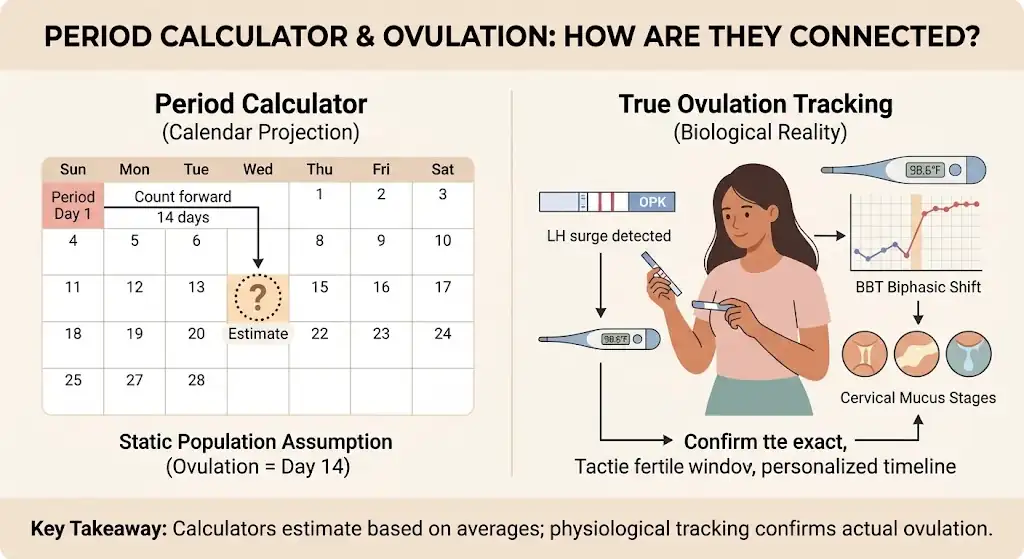
Cervical mucus changes (becoming clear and stretchy near ovulation) are a fourth, no-cost signal that can be tracked alongside any of the above. For a wider margin of error, combine the free calendar estimate from a period calculator with ovulation predictor kits or basal body temperature tracking for confirmation.
When the Calculator’s Estimate Breaks Down
Irregular cycles, anovulatory cycles and PCOS all make it harder to estimate your fertile window reliably.
Three Situations to Watch
The calendar method above assumes a reasonably predictable cycle. It gets less reliable in a few specific situations:
If your cycle length swings by more than a week from month to month, the “average cycle length” input becomes a rough midpoint rather than a reliable predictor, and since ovulation and the fertile window are derived from that average, both estimates inherit the same uncertainty.
Wider Estimate RangeSome cycles don’t involve ovulation at all, even when bleeding occurs on a roughly normal schedule. A calendar-based calculator has no way to detect this, it will still generate a fertile window and ovulation estimate for a cycle where ovulation may not have occurred.
Calendar Math Can’t Detect ThisSince the follicular phase is already the more variable half of the cycle, conditions that delay ovulation stretch it even further, sometimes by many days, while calendar-based tools keep assuming a standard average.
Consider Symptom-Based TrackingIn any of these situations, layering in ovulation predictor kits or basal body temperature tracking gives you a direct physiological signal instead of relying on calendar math alone. Our guide to calculating ovulation with irregular periods covers these cases in depth.
Putting It Together
Start with the calculator, treat the result as an estimate and add an ovulation test if you need precision.
Once you understand how a period calculator, ovulation, and your fertile window all relate, using them well comes down to three simple steps:
Start with our free period calculator using your last period date and average cycle length, this gives you a next-period prediction, an estimated ovulation date, and a fertile window from the same two inputs, no separate ovulation calendar needed.
If your cycles are fairly regular, treat the estimated ovulation date and fertile window as useful planning estimates, remembering that the actual timing can shift from cycle to cycle.
If your cycles are irregular or you need precision (trying to conceive, avoiding pregnancy, or investigating a health concern), pair the calculator estimate with a direct signal like LH testing rather than relying on the calendar estimate alone.
Frequently Asked Questions
12 questions answeredHow is the fertile window calculated?
How are a period calculator and ovulation connected?
Why is ovulation calculated backward from the next period instead of forward from the last one?
Is the luteal phase always exactly 14 days?
Why is the fertile window 6 days long instead of just the ovulation day?
What are my most fertile days in a cycle?
Does a longer cycle mean ovulation happens later?
How accurate is a fertile window calculator for irregular periods?
Can you ovulate right after your period ends?
Can I find my fertile window without an app?
When should I take a pregnancy test after ovulation?
Does the calendar method account for sperm survival?
Ready to see your own estimated fertile window and ovulation date? Use our free period calculator, it applies the calendar method explained above to your last period date and cycle length, with nothing stored.
Want the single most likely ovulation day as well as the full fertile range? Try our ovulation calculator, which shows both from the same two inputs.
Medical Disclaimer
This article explains how calendar-based calculators estimate ovulation and the fertile window. These are estimates and cannot confirm ovulation, and they should not be relied on alone to prevent pregnancy. For personal advice, speak with a healthcare provider.


Scientific References
- Bull, Jonathan R., Simon P. Rowland, Elina Berglund Scherwitzl, Raoul Scherwitzl, Kristina Gemzell Danielsson, and Joyce Harper. “Real-world Menstrual Cycle Characteristics of More Than 600,000 Menstrual Cycles.” npj Digital Medicine 2 (2019): 83. Large analysis of real-world cycles. Analysis of 612,613 ovulatory cycles. Source of the mean follicular (16.9 days) and luteal (12.4 days) phase lengths in that dataset and the finding that differences in cycle length were predominantly associated with follicular phase length. ncbi.nlm.nih.gov
- Henry, Sarah, Sahar Shirin, Azita Goshtasebi, and Jerilynn C. Prior. “Prospective 1-Year Assessment of Within-Woman Variability of Follicular and Luteal Phase Lengths in Healthy Women Prescreened to Have Normal Menstrual Cycle and Luteal Phase Lengths.” Human Reproduction 39, no. 11 (2024): 2565–74. Source of the finding that 55% of 53 healthy women experienced more than one short luteal phase (under 10 days) over a year, used to explain why the 14-day luteal phase is an estimate. doi.org
- Wilcox, Allen J., Clarice R. Weinberg, and Donna D. Baird. “Timing of Sexual Intercourse in Relation to Ovulation: Effects on the Probability of Conception, Survival of the Pregnancy, and Sex of the Baby.” New England Journal of Medicine 333, no. 23 (1995): 1517–21. Source of the six-day fertile window ending on the day of ovulation. doi.org
- Medical News Today. “How Many Days After Ovulation Can You Get Pregnant?” Accessed 2026. Consumer overview of egg viability after ovulation (about 12–24 hours) and sperm survival (up to about five days under favorable conditions). Cited on the page as a secondary reference. medicalnewstoday.com