
Period Calculator for Trying to Conceive A Step-by-Step Plan From Your Cycle Data
Most fertile-window calculators hand you a date range and leave you to figure out what to actually do with it. This turns that estimate into a real plan: when to time intercourse, which confirmation methods to add and how to adjust the plan as you track more cycles.
A fertile-window estimate is only useful if you know what to do with it. This guide is about using a period calculator for trying to conceive, turning its output into an actual plan: how many cycles to track first, how often to time intercourse, which confirmation methods make the estimate more reliable, and how to adjust the plan as new cycle data comes in.
Track at least 3 cycles so your average cycle length reflects your real pattern, then use that average to estimate ovulation (roughly 14 days before your next predicted period) and mark the six-day fertile window around it. Time intercourse every 1 to 2 days through that window, per guidance many healthcare providers give as noted by the American Pregnancy Association, and layer on basal body temperature charting or an ovulation predictor kit to confirm the estimate rather than relying on calendar math alone.
Key Takeaways
- Track at least 3 cycles first so your average cycle length is reliable.
- Mark a six-day fertile window ending on the estimated ovulation day.
- Time intercourse every 1 to 2 days through the window.
- Add basal body temperature, an ovulation test or cervical mucus to confirm the estimate.
- See a doctor after 12 months of trying if under 35, or after 6 months at 35 to 39.
How to Turn a Period Calculator Into a Conception Plan
Track three cycles, mark the six-day fertile window, time intercourse every 1 to 2 days, add a confirmation method and update the plan each cycle.
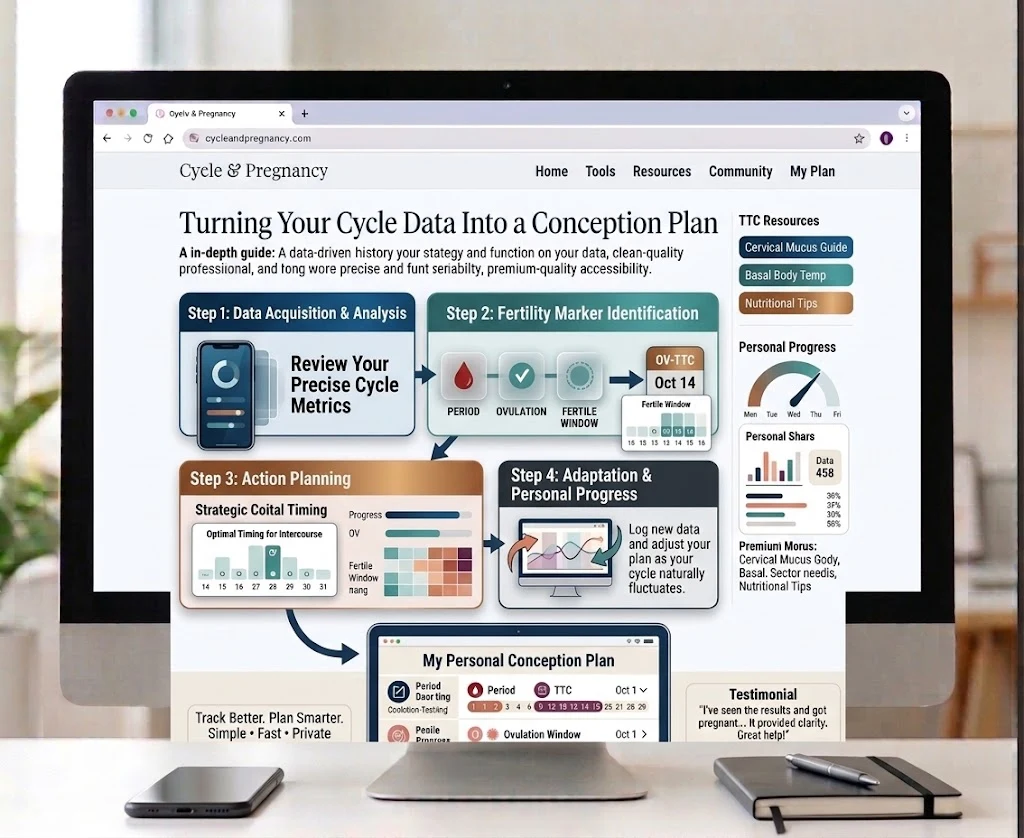
The Five Steps
Here are the five steps, with the reasoning for each:
Track at least 3 cycles before planning around the estimate. Log your last several period start dates so the calculator’s average cycle length reflects your actual pattern, not a single cycle that may not be typical.
Calculate your fertile window for conception. Use your average cycle length to estimate ovulation, roughly 14 days before your next predicted period, and mark the six-day fertile window: five days before ovulation plus ovulation day itself.
Time intercourse every 1 to 2 days through the fertile window. The American Pregnancy Association notes that many healthcare providers suggest intercourse every 1 to 2 days during the fertile window, which keeps sperm reasonably available without requiring daily timing pressure.
Add a confirmation method. Layer basal body temperature charting, an ovulation predictor kit (OPK), or fertile cervical mucus (egg-white in texture and considered one of the more reliable self-detection signals) on top of the calculator estimate to confirm ovulation is actually happening close to when the calendar predicted.
Adjust the plan each cycle with new data. Update your average cycle length and fertile-window estimate as each new cycle completes, rather than relying on the same fixed estimate month after month.
Example Fertile Windows by Cycle Length
The same steps give a different window for each cycle length, because ovulation is counted back about 14 days from the next period:
| Cycle length | Estimated ovulation day | Fertile window (cycle days) |
|---|---|---|
| 26 days | Day 12 | Days 7 to 12 |
| 28 days | Day 14 | Days 9 to 14 |
| 32 days | Day 18 | Days 13 to 18 |
Before You Start: Quick Checklist
- Last 3 period start dates logged.
- Average cycle length worked out.
- Fertile window marked on your calendar.
- One confirmation method chosen (OPK, temperature or mucus).
Why Every 1–2 Days Beats Daily Timing
Sperm survive 3 to 5 days, so intercourse every 1 to 2 days through the window keeps sperm present without daily pressure.
The Biology Behind the Schedule
A lot of TTC advice defaults to “have intercourse every day of the fertile window,” which can turn conception into a stressful scheduling exercise. The American Pregnancy Association notes that many healthcare providers instead suggest intercourse every 1 to 2 days during the fertile window (or every 2 to 3 days across the whole cycle), a lighter-touch schedule built on the same underlying biology:
What This Means in Practice
This lines up with why the calculator estimate matters in the first place: knowing roughly where the six-day window falls lets you plan an every-other-day schedule around it, instead of guessing at timing from memory or trying to cover every single day.
Simple Weekly Rhythm
- Start intercourse on the first day of your estimated window.
- Repeat every 1 to 2 days until ovulation day.
- Keep going through ovulation day, then stop worrying about timing until next cycle.
- Skip the pressure: a missed day does not ruin the cycle.
Where the Calculator Estimate Falls Short
A calculator estimates ovulation from an average, so adding basal body temperature or an ovulation test closes the gap.
Why an Average Is Not a Measurement
Any period calculator for trying to conceive is only as good as the average it’s built on: the fertile-window estimate comes from your average cycle length, which means it’s an average, not a measurement of what’s actually happening in the current cycle. Real-world cycle research helps explain why that gap matters: an analysis of over 612,000 cycles (Bull et al., 2019) found that cycle-length variation comes mostly from the days before ovulation, not after it, so the exact day ovulation happens can shift from cycle to cycle even when your average length looks stable.
That’s the case for adding a confirmation method rather than treating the calculator estimate as the whole plan. Basal body temperature charting confirms ovulation after it has already happened, while an OPK detects the LH hormone surge shortly before ovulation, giving you a heads-up rather than a retrospective. Used together with the calculator estimate, they close most of the gap between an average-based prediction and what’s actually happening that cycle.
Confirmation Methods Compared
Each method answers a slightly different question, so many people combine two of them:
| Method | What it tells you | Timing |
|---|---|---|
| Period calculator | Estimated fertile window from your average cycle | Before the cycle starts |
| Ovulation predictor kit | LH surge that comes shortly before ovulation | A heads-up before ovulation |
| Basal body temperature | A temperature rise that shows ovulation has happened | After ovulation |
| Cervical mucus | Egg-white mucus that signals fertile days | In the days before ovulation |
A Practical Note on Lubricants
One practical detail worth knowing: most personal lubricants, including saliva, can slow sperm down or interfere with movement. If you use lubricant during the fertile window, look for one labeled “fertility-friendly” (such as Pre-Seed), which is formulated to match sperm-friendly pH and osmolality rather than working against it.
Signs Your Estimate May Be Off
- Your cycle length changes a lot from month to month.
- A positive ovulation test comes days away from the calendar prediction.
- Your temperature rise lands well before or after the predicted date.
- You rarely see fertile cervical mucus near the predicted window.
If two or more of these keep happening, rely on your confirmation method for timing and treat the calculator as a rough guide only.
When to Talk to a Doctor
See a doctor after 12 months if under 35, after 6 months at 35 to 39 and sooner at 40 or with known risk factors.
Timelines by Age
Most of the time, a well-timed plan just needs patience, but the American College of Obstetricians and Gynecologists (ACOG) sets clear timelines for when it’s worth moving from self-tracking to a medical evaluation:
When to Check in Sooner
It’s also worth checking in sooner, regardless of age or how long you’ve been trying, if you have known risk factors such as PCOS, endometriosis, very irregular cycles, or a history of pelvic surgery or infection, since these can affect both the calculator’s usefulness and the underlying odds each cycle.
Risk Factors That Mean Checking in Sooner
- PCOS
- Endometriosis
- Very irregular or absent periods
- A history of pelvic surgery or infection
- Age 40 or over
Adjusting the Plan Cycle to Cycle
Log every cycle, compare confirmed ovulation with the estimate and give the plan several cycles before changing it.
Log every cycle, not just the ones you’re focused on. Each new period start date refines your average cycle length, which keeps the fertile-window estimate current instead of resting on outdated data.
Watch for a pattern in your OPK or BBT results relative to the estimate. If confirmed ovulation consistently lands a few days earlier or later than the calculator predicts, that’s useful information for timing the next cycle’s plan.
Give the plan several cycles before reassessing. One cycle without a positive result isn’t unusual; the American Pregnancy Association’s guidance is built around sustained timing across cycles, not a single attempt.
If your cycles are irregular, the calendar estimate becomes less reliable on its own, see our guide on calculating ovulation with irregular periods or the period calculator for irregular periods for how to adjust this same plan when cycle lengths vary more than usual.
What to Record Each Cycle
- First day of your period.
- Date of any positive ovulation test.
- Day your temperature rises, if you chart it.
- Days you notice egg-white mucus.
- Days you had intercourse.
The Plan at a Glance
Five steps, each with one action and one tool. Come back to this table each cycle.
| Step | Action | Tool |
|---|---|---|
| 1. Track | Log at least 3 cycles | Period calculator |
| 2. Estimate | Mark the six-day fertile window | Period calculator |
| 3. Time it | Intercourse every 1 to 2 days | Calendar |
| 4. Confirm | Check ovulation is on schedule | OPK, temperature or mucus |
| 5. Adjust | Update cycle length and repeat | Cycle log |
Frequently Asked Questions
How do I use a period calculator for trying to conceive?
How often should you have intercourse when trying to conceive?
Is a period calculator accurate enough on its own for trying to conceive?
How many cycles should I track before trusting the fertile window estimate?
What if my cycles are irregular while trying to conceive?
Should I use ovulation predictor kits alongside a period calculator?
How long should I try before seeing a doctor about fertility?
When is the best time to have sex when trying to conceive?
Can I get pregnant outside my calculated fertile window?
Is daily intercourse better than every 1 to 2 days?
Ready to put this period calculator for trying to conceive plan into practice? Use the free period calculator to track your cycles, or see our fertile-window guide for how the underlying math works.


Sources & References
- American Pregnancy Association. How to Conceive: Medical Tips & Best Practices. States that many healthcare providers suggest intercourse every 1–2 days during the fertile window, or every 2–3 days throughout the cycle, as an alternative to daily timing — the basis for this article’s every-1-to-2-days recommendation. americanpregnancy.org
- American Pregnancy Association. Ovulation Kits & Fertility Monitors. Explains that luteinizing hormone (LH) rises 24–48 hours before ovulation, that the three days after a positive ovulation test are the best window for intercourse, and that sperm can survive in the body 3 to 5 days — the source for this article’s OPK and sperm-survival figures. americanpregnancy.org
- Bull JR, Rowland SP, Scherwitzl EB, Scherwitzl R, Danielsson KG, Harper J. Real-World Menstrual Cycle Characteristics of More Than 600,000 Menstrual Cycles. npj Digital Medicine. 2019;2:83. Analysis of 612,613 real-world cycles confirming that cycle-length variation comes predominantly from the days before ovulation (the follicular phase) rather than the days after it — the basis for why a single average-based estimate can miss the actual ovulation day from cycle to cycle. nature.com
- Sandhu RS, Wong TH, Kling CA, Chohan KR. In Vitro Effects of Coital Lubricants and Synthetic and Natural Oils on Sperm Motility. Fertility and Sterility. 2014;101(4):941–944. doi:10.1016/j.fertnstert.2013.12.046. Peer-reviewed lab study finding that common lubricants (Astroglide, K-Y) significantly reduced sperm motility, while Pre-Seed (a lubricant formulated for fertility) did not — the basis for this article’s fertility-friendly lubricant note. sciencedirect.com
- American College of Obstetricians and Gynecologists (ACOG). Trying to Get Pregnant? Here’s When to Have Sex. Source of the age-based timeline for seeing a doctor: 12 months if under 35, 6 months if 35–39, and sooner at 40 or older or with known risk factors such as PCOS or endometriosis. acog.org