
Ovulation Bleeding vs. Period How to Tell Ovulation Spotting From Your Period Using Calculator Dates
Mid-cycle spotting can look enough like the start of a period to cause real confusion, especially if it lands close to a date your calculator flagged. Here is how to use your calculator’s predicted dates alongside color, duration and timing to tell the two apart.
Light bleeding that shows up when your period calculator says you are mid-cycle, not near your predicted period date, is a common source of confusion. Most of the time it is ovulation spotting, a normal hormonal event, not an early or irregular period. This guide to ovulation bleeding vs. period bleeding walks through the color, duration and timing differences, and how to line them up against your calculator’s dates.
Ovulation bleeding is light spotting (pink or light red, occasionally brown) that lasts a day or two and shows up around the midpoint of your cycle, near your calculator’s predicted ovulation date. A period is heavier, lasts several days, follows a heavier-to-lighter flow pattern, and starts around your calculator’s predicted period date. About 8% of women experience ovulation spotting at least occasionally.
Key Takeaways
- Ovulation bleeding vs. period comes down to color, duration and timing.
- Ovulation spotting is light, pink or brown and lasts 1 to 2 days near mid-cycle.
- A period is heavier, red and lasts several days from cycle day 1.
- Your calculator’s predicted dates tell you which is more likely.
- Heavy or prolonged bleeding is worth discussing with a provider.
What Is Ovulation Bleeding?
Ovulation bleeding is light spotting around the time an egg is released. It is usually harmless and many people never notice it.
Ovulation bleeding, also called ovulation spotting or mid-cycle spotting, is a small amount of vaginal bleeding around the time of ovulation, roughly the middle of the cycle. It is much lighter than a period and does not need treatment.
Key Facts
- It is light: a few drops or a little blood when wiping.
- It appears around mid-cycle, not at the start of your cycle.
- Only some people notice it. Most ovulate without any bleeding.
- It is a normal hormonal event, not an early or irregular period.
What Causes Ovulation Bleeding?
Hormone changes around ovulation can make a small amount of the uterine lining shed, causing light spotting.
Ovulation is driven by hormone changes: estrogen rises, a surge of luteinizing hormone (LH) triggers the release of the egg, and estrogen then dips. For some people this dip brings on light bleeding as a small amount of the uterine lining sheds. The American College of Obstetricians and Gynecologists lists changes like this among the signs people watch for in fertility awareness-based methods (reference 1).
What Is Behind It
- The drop in estrogen just after the egg is released.
- Individual sensitivity to normal hormone shifts.
What It Is Not
Ovulation spotting is not a sign of a problem and does not affect fertility. Bleeding that is heavy or does not fit this light mid-cycle pattern is a different matter, covered under atypical bleeding below.
Ovulation Bleeding vs. Period: Side-by-Side Differences
Ovulation spotting is light, pink or brown and lasts 1 to 2 days. A period is heavier, red and lasts several days.
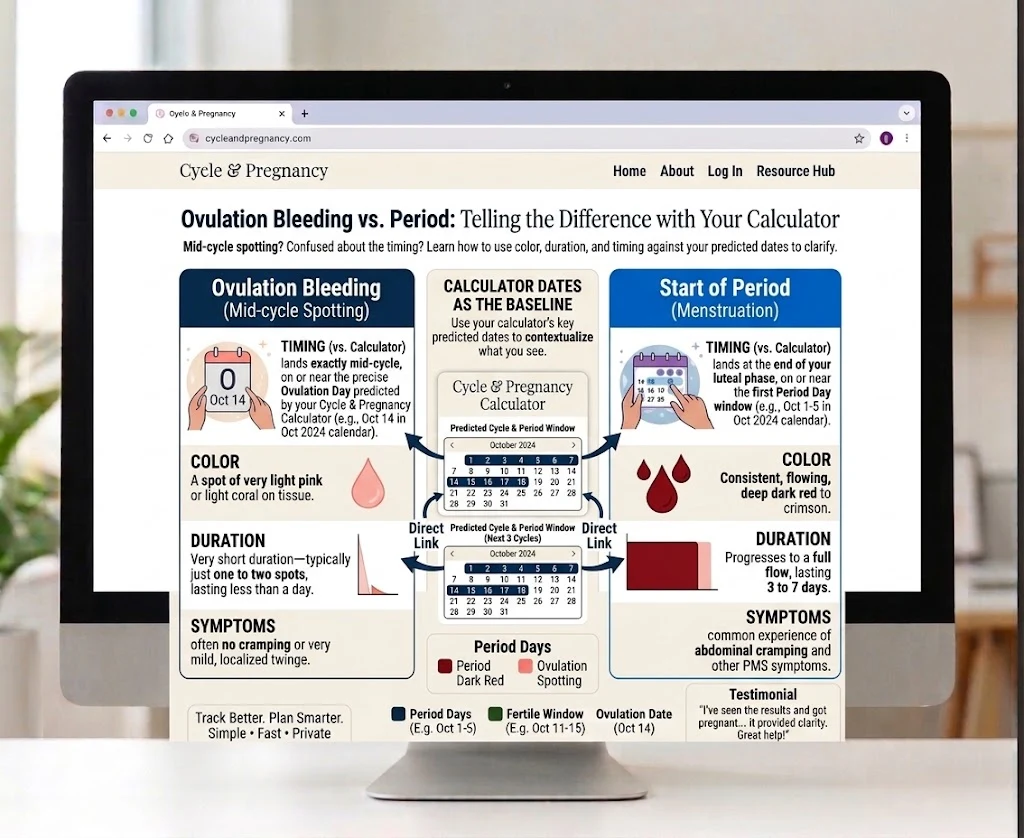
The Three Signals
These are the three signals that reliably tell the two apart, especially when read together rather than one at a time:
Why Ovulation Spotting Happens
The hormonal cause of ovulation spotting is straightforward: estrogen drops just after ovulation (see the signs of ovulation), and for some people that brings on light bleeding as a small amount of the uterine lining sheds. It doesn’t affect fertility, and for some people it’s actually a useful sign that ovulation is happening that cycle.
Where the Dates Fall by Cycle Length
Counting back about 14 days from your next period gives the day spotting is most likely to be ovulation-related:
| Cycle length | Ovulation spotting most likely | Next period starts |
|---|---|---|
| 26 days | Around day 12 | Day 27 |
| 28 days | Around day 14 | Day 29 |
| 32 days | Around day 18 | Day 33 |
Quick Checklist: Is It Ovulation Spotting?
- It is light: a few drops or a little blood when wiping.
- It is pink, light red or brown.
- It lasts 1 to 2 days and stays light.
- It falls near the middle of your cycle, close to the calculator’s ovulation date.
What Does Ovulation Spotting Look Like?
Light, pink or brown, a day or two, mid-cycle. It can come with a mild one-sided twinge and egg-white mucus.
| Feature | What to expect |
|---|---|
| Amount | A few drops, or a little blood when wiping |
| Color | Pink or light red, sometimes brown |
| Duration | Usually 1 to 2 days |
| Flow | Stays light the whole time |
| Timing | Around the cycle midpoint |
Symptoms That May Come With It
- A mild twinge or ache on one side of the lower abdomen around ovulation (reference 2).
- Clear, stretchy, egg-white cervical mucus (see cervical mucus and ovulation).
- A rise in basal body temperature after ovulation has happened.
Ovulation Spotting vs. Period Spotting
Spotting right before your period is a different thing from mid-cycle spotting:
| Feature | Ovulation spotting | Period spotting |
|---|---|---|
| Timing | Around mid-cycle | In the days just before your period |
| What follows | Nothing. The spotting stops and stays light | Usually turns into a heavier flow |
| Length | 1 to 2 days | Short, then your period starts |
| Color | Pink, light red or brown | Often brown or dark red |
Using Your Calculator Dates to Narrow It Down
Spotting near your predicted ovulation date points to ovulation. Bleeding near your predicted period date points to your period.
Three Common Situations
If light, brief spotting shows up close to the ovulation date your calculator estimated, roughly the midpoint of your cycle, ovulation spotting is the more likely explanation, especially if the color and short duration match.
Most Likely: Ovulation SpottingIf the bleeding lines up with your calculator’s predicted period start date and follows your usual flow pattern (heavier at first, tapering over several days) it’s almost certainly your period arriving on schedule.
Most Likely: PeriodThis is the trickiest case. It could be your period starting lighter than usual, or it could be implantation bleeding, which typically occurs about 6 to 12 days after ovulation, a few days before a period is due. If it’s notably lighter and shorter than your normal period and stops within about two days, implantation bleeding is worth considering alongside a pregnancy test (see why your period may be late).
Needs Closer TrackingSee a Provider If
- Bleeding is heavy.
- It lasts more than a couple of days outside your expected period window.
- It comes with significant pain.
- It does not fit the light mid-cycle pattern after several tracked cycles.
Ovulation Bleeding vs. Implantation Bleeding
Implantation bleeding comes later, about 6 to 12 days after ovulation. Ovulation spotting comes around mid-cycle.
What Is Implantation Bleeding?
Implantation bleeding is light bleeding that can happen when a fertilized egg attaches to the uterine lining. It is lighter and shorter than a normal period, and it comes a few days before your period would be due. Not everyone who is pregnant has it.
How to Tell Ovulation Bleeding From Implantation Bleeding
- Timing is the biggest clue: ovulation spotting is around two weeks before your next period, implantation bleeding is much closer to it.
- Both are light, so compare the dates, not just the color.
- If you could be pregnant, take a pregnancy test if your period does not arrive.
Ovulation, Implantation and Period Compared
| Type | Timing | Pattern |
|---|---|---|
| Ovulation spotting | Around the cycle midpoint, near the predicted ovulation date | Light, pink or brown, usually 1 to 2 days |
| Implantation bleeding | About 6 to 12 days after ovulation, a few days before a period is due | Lighter and shorter than a normal period, stops within about two days |
| Period | Cycle day 1, near the predicted period date | Heavier at first, tapering over 3 to 7 days |
Causes of Atypical Bleeding
Bleeding outside the light mid-cycle pattern can have other causes and is worth discussing with a provider.
Not all bleeding between periods is ovulation spotting. These are some of the other things that can be linked to unexpected bleeding:
- Starting, stopping or changing hormonal contraception.
- Stress and big lifestyle changes (see how stress affects your period).
- Thyroid problems (see thyroid and the menstrual cycle).
- PCOS (see PCOS and ovulation).
- Fibroids, polyps or infections.
- Pregnancy-related causes.
Note: A list like this cannot tell you the cause. Heavy bleeding, bleeding that lasts more than a couple of days or bleeding with significant pain needs a provider. See also heavy periods.
When to Check With a Provider
Log each episode. See a provider for heavy bleeding, bleeding beyond a couple of days or significant pain.
Three Steps to Take
Track the date, color, and duration each time. Logging spotting against your calculator’s predicted dates over a few cycles makes the pattern, or lack of one, much clearer than judging a single instance.
Watch for anything that doesn’t fit the light, brief pattern. Bleeding that’s heavy, lasts more than a couple of days outside your expected period window, or comes with significant pain is worth discussing with a healthcare provider rather than assuming it’s ovulation-related.
Use it as a fertility signal if you’re trying to conceive. Because ovulation spotting tends to cluster around ovulation itself, some people use it, alongside basal body temperature or an ovulation predictor kit, as one more data point for timing (see how to track ovulation with OPKs, BBT and apps).
Learn How the Dates Are Calculated
For more on how a calculator arrives at your ovulation and fertile-window estimate in the first place, see how a period calculator estimates your fertile window.
Key Points to Remember
Match the bleeding to the date, the color and the length. When two or three agree, the answer is usually clear.
- Light spotting near your predicted ovulation date is most likely ovulation spotting.
- Bleeding near your predicted period date, heavier at first, is most likely your period.
- Light spotting close to your period date is the tricky case, so track it and consider a pregnancy test.
- Spotting does not affect fertility.
- Heavy or prolonged bleeding needs a provider.
References
- The American College of Obstetricians and Gynecologists. FAQ: Fertility Awareness-Based Methods of Family Planning [internet]. Washington DC: ACOG; 2019. Read the ACOG FAQ
- Jones RE, Lopez KH. Human reproductive biology. Academic Press; 2013.
- Won HR, Abbott J. Optimal management of chronic cyclical pelvic pain: an evidence-based and pragmatic approach. Int J Womens Health. 2010;2:263-77.
Frequently Asked Questions
What does ovulation bleeding look like compared to a period?
How long does ovulation bleeding last?
When does ovulation bleeding happen in my cycle?
Can I use my period calculator dates to tell ovulation bleeding from period bleeding?
Is ovulation bleeding the same as implantation bleeding?
Should I be concerned about ovulation bleeding?
How do I tell ovulation bleeding vs. period bleeding apart?
Can I get pregnant if I have ovulation bleeding?
Should I take a pregnancy test if I spot near my period date?
Want to settle ovulation bleeding vs. period questions with your own dates? Use the free period calculator to see your predicted ovulation and period dates side by side, or see our fertile window guide for how the estimate is built.


Sources & References
- Cleveland Clinic. Spotting During Ovulation: Bleeding, Causes and Concerns. Reports that roughly 8% of women experience spotting during ovulation, describes it as light and usually lasting just a day or two, pink or light red in color (sometimes brown), and explains the estrogen-drop mechanism behind it. Confirms ovulation spotting does not affect fertility. clevelandclinic.org
- Cleveland Clinic. Implantation Bleeding: Causes, Symptoms & What To Expect. States implantation bleeding typically occurs about 10 to 14 days after ovulation, often close to when a period is expected, describes it as brown, dark brown, or pink and light/spotty in flow, and notes it usually stops on its own within about two days. clevelandclinic.org
- Mayo Clinic. Implantation Bleeding: Common in Early Pregnancy? Confirms implantation bleeding is lighter than menstrual bleeding, occurs around the time a period would be expected, and is commonly mistaken for a light period. mayoclinic.org
- American College of Obstetricians and Gynecologists (ACOG). Abnormal Uterine Bleeding. Clinical guidance on when bleeding outside the expected pattern — heavy, prolonged, or irregular — warrants evaluation by a healthcare provider. acog.org