
Period Tracker vs. Period Calculator Which Do You Actually Need? Calculator vs. App Compared
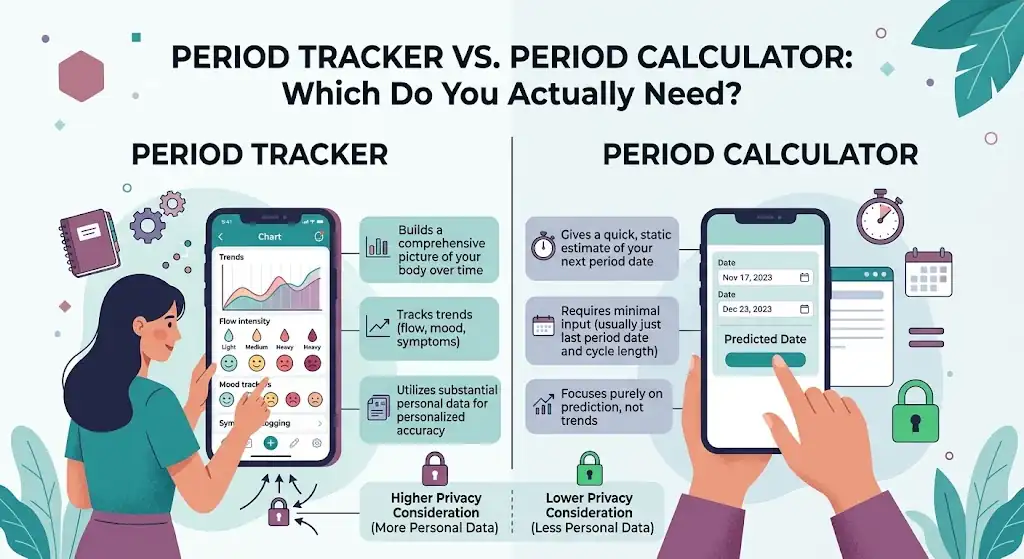
They sound interchangeable, but they solve different problems. One gives you a quick date. The other builds a picture of your body over time, at the cost of handing over a lot more personal data. Here’s the real difference, backed by actual privacy and accuracy research.
Searching for period tracker vs. period calculator usually means you’re trying to decide which one actually fits what you need, and most comparison content out there doesn’t give a straight answer, blurring the two together or listing app features without addressing the real trade-offs.
A period calculator gives you a quick, one-time date estimate from two numbers, usually with no signup and no data stored. A period tracker is an ongoing app that logs your cycles over time, adds symptoms and pattern analysis, and typically requires an account, which means more insight, but also more personal data leaving your hands. Neither is automatically “better”; they solve different problems.
Key Takeaways
- Period tracker vs. period calculator: one gives a quick date, the other builds a picture over time.
- A calculator usually needs no account and stores little or no data.
- Both often rely on the same calendar math, so neither is much more accurate for irregular cycles.
- Mozilla’s July 2026 privacy scores for six trackers ranged from 2 to 10 out of 10.
- Start with a calculator, move to a tracker for patterns and add direct methods if you are trying to conceive.
Period Tracker vs. Period Calculator: Side by Side
A calculator gives a quick one-time date with little data. A tracker builds a longer picture and collects more.
The Two Tools Compared
At a Glance
| Question | Period calculator | Period tracker |
|---|---|---|
| Quick answer? | Yes, in seconds | Needs setup and logging |
| Account needed? | Usually no | Usually yes |
| Builds a history? | No | Yes |
| Best for irregular cycles? | Weakest | Better, if it uses more than dates |
| Data footprint | Low | Higher |
Which Should You Choose? Scenario by Scenario
Use a calculator for a quick date or low data. Use a tracker for symptoms and patterns. Add direct methods for conception.
Four Common Situations
The decision usually isn’t about which tool is objectively “better”, it’s about matching the tool to what you’re actually trying to do right now. Here’s how that plays out in practice:
A calculator does exactly this in seconds, with no account and typically no data stored. You don’t need an app relationship for a single date.
Use a CalculatorThis needs ongoing logging a calculator can’t provide. A tracker that lets you record mood, pain, flow, and other symptoms alongside cycle dates will surface patterns a single calculation never could.
Use a TrackerNeither a basic calculator nor a calendar-only tracker is precise enough here on its own, both rely on the same limited calendar math. Look specifically for a tracker or method that incorporates basal body temperature, LH testing, or wearable data, not just logged dates.
Use an Advanced Fertility TrackerThis is a legitimate, common concern, especially post-Dobbs. A browser-based calculator that doesn’t require an account is the lower-data-footprint choice by design.
Use a CalculatorWhich Tool for Which Goal
| Goal | Best fit |
|---|---|
| Know my next period date now | Period calculator |
| Understand symptoms and patterns over months | Period tracker |
| Trying to conceive or avoid pregnancy | Tracker or method with temperature, LH tests or wearable data |
| Keep my data private | Browser-based calculator with no account |
How Accurate Is Each, Really?
Both often use the same calendar math. For irregular cycles it was right within 2 days only 32.5% of the time.
Why Both Hit the Same Limit
This is the part most comparison pages skip entirely: both calculators and basic trackers commonly rely on the same underlying calendar math, and that math has real, measured limits, especially for irregular cycles. Any honest accuracy comparison has to start from that shared limitation, not from marketing claims.
of calendar-method ovulation estimates for irregular cycles landed within 2 days of the actual date, in a 2025 validation study of 964 participants across 1,155 cycles, compared to 82% for physiology-based tracking (the Oura Ring) in the same study.
was the average error for calendar-method predictions in irregular cyclers in that same study, versus just 1.48 days for the physiology-based method, a striking gap that calendar math alone can’t close, no matter how polished the app is.
The takeaway isn’t that calculators or basic trackers are useless, it’s that neither is meaningfully more accurate than the other for irregular cycles specifically, since the underlying math is often the same. A tracker only pulls ahead in accuracy once it incorporates more than just logged dates.
Calendar vs. Physiology-Based Prediction in Irregular Cycles
| Measure | Calendar method | Physiology-based (Oura Ring) |
|---|---|---|
| Estimates within 2 days | 32.5% | About 82% |
| Average error | 6.63 days | 1.48 days |
Figures from the 2025 validation study linked above.
The Privacy Difference Nobody Talks About
Mozilla scored six apps from 2 to 10 out of 10. A browser-based calculator with no account sidesteps most of the risk.
What Mozilla Found
This is arguably the most under-discussed part of the comparison. Mozilla’s July 2026 investigation tested six popular period tracking apps for how they handle your data, and the spread was significant:
Euki scored highest specifically because it stores data locally and requires no account at all, structurally similar to how a good browser-based calculator works. Mozilla also warns that a period app that signals to advertisers that you use it adds that fact to your ad profile, which can make your reproductive health part of future ad targeting.
A period calculator that runs entirely in your browser sidesteps most of this by design: there’s no account, no ongoing history, and often nothing sent to a server at all.
Privacy Scores in a Table
| App | Score out of 10 |
|---|---|
| Euki | 10 |
| Clue | 8 |
| Flo | 7 |
| Period Calendar | 6 |
| Planned Parenthood Spot On | 5 |
| Stardust | 2 |
What to Check Before You Choose
- Does it need an account?
- Is the data stored on your device or on a server?
- Does it show ads or share data with advertisers?
- Can you delete your data?
The Hybrid Approach: Use Both, Strategically
Start with a calculator, move to a tracker for patterns and add direct methods if conceiving or avoiding pregnancy.
A Three-Step Plan
Almost no comparison content actually recommends this, but it’s the most practical answer for most people: the real debate doesn’t have to end in picking one and abandoning the other.
Start with a free, no-signup period calculator for an immediate estimate when you just need a date.
If you find yourself wanting to understand symptoms, mood, or longer-term patterns, move to a tracker, but check its privacy score first, not just its feature list.
If you’re trying to conceive or avoid pregnancy, don’t rely on calendar-only prediction from either tool. Layer in a direct method like LH testing or basal body temperature tracking.
Frequently Asked Questions
9 questions answeredWhat’s the difference between a period tracker and a period calculator?
Is a period calculator or a period tracker more accurate?
Are period tracking apps safe to use, privacy-wise?
Does a period calculator store my data?
Should I use a calculator or a tracker if I have irregular periods?
Can I use both a period calculator and a period tracker?
Period tracker vs. period calculator: which should I use?
Do period calculators need an account?
What should I check before choosing a period tracker?
Whichever way the period tracker vs. period calculator question lands for you, the calculator is the lower-commitment place to start, no account, no history to manage, just today’s estimate.


Sources & References
- Mozilla Foundation. Period and Ovulation Apps Privacy Review 2026: Is Your Period Tracker Safe? Published July 16, 2026. Hands-on privacy investigation of six period tracking apps (Euki, Clue, Flo, Period Calendar, Spot On, Stardust) combining manual testing, network traffic analysis, and historical privacy policy review with Harvard’s Berkman Klein Center. mozillafoundation.org
- Oura Health. Oura’s Ovulation Detection Algorithm Outperforms Calendar Tracking Method in New Validation Study. 964 participants, 1,155 ovulatory cycles; found calendar-method accuracy of 32.5% within 2 days for irregular cyclers (average error 6.63 days) versus 82% for physiology-based tracking (average error 1.48 days). ouraring.com
- Johnson S, Marriott L, Zinaman M. Can Apps and Calendar Methods Predict Ovulation With Accuracy? Current Medical Research and Opinion. 2018;34(9):1587–1594. 949-woman study; calendar/app methods using only cycle length showed limited accuracy for the exact ovulation day.