
Why Is My Period Late? – Late or Missed Period Causes Explained
Why is my period late? In most cases the explanation is something ordinary, like stress, travel, or a shift in routine, but a delayed period can also point to pregnancy or a hormonal condition. This guide covers how many days late is normal, when to take a pregnancy test, the most common causes, and when to see a doctor.
Not sure when your period was actually due? Enter your last cycle dates into our Period Calculator to estimate your expected date, then compare it with what is a normal menstrual cycle to see whether you are really late.
How Many Days Late Is a Period Still Normal?
Since a normal menstrual cycle can range from 21 to 35 days, a period that arrives a few days after you expected it is often not a cause for concern on its own. Cycle length naturally shifts by a few days from month to month, because the phases of the cycle do not run on an exact clock. You can estimate your expected date with the period calculator.
Late Period vs. Missed Period
| Term | What it means |
|---|---|
| Late period | Not started by your expected date; often a few days to a couple of weeks |
| Missed period | A whole cycle passes with no bleeding |
| Absent periods (amenorrhea) | No periods for three months or more while not pregnant; needs a medical check |
A period is generally called late when it has not started by your expected date, and many doctors start paying attention once it is about a week overdue. A missed period usually means a whole cycle has passed without bleeding. Skipping one period, especially after a stressful month, is common. Missing several in a row is different and deserves a medical check.
How late can a period be if you are not pregnant?
A delayed period can run from a few days to several weeks when the cause is stress, travel, weight change, or intense exercise. If you have gone three months or more without bleeding and you are not pregnant, doctors call this secondary amenorrhea (see ACOG on amenorrhea), and it needs evaluation rather than waiting.
Could It Be Pregnancy? When to Take a Test
If there is any chance you could be pregnant, a missed period is one of the earliest signs, so this is the first thing to rule out. Home pregnancy tests work by detecting the hormone hCG in urine, and most are reliable from the first day of a missed period. Testing too early, before hCG has built up, is the most common reason for a false negative.
Negative test but still no period
A negative result a few days after your expected date does not always settle the question. If your period still has not arrived after about a week, repeat the test with first-morning urine. If it stays negative and the delay continues, the cause is likely one of the non-pregnancy reasons below, and a doctor can check with a blood test.
Late period with no pregnancy symptoms
Many people notice no symptoms at all in early pregnancy, and many late periods have nothing to do with pregnancy. Breast tenderness, bloating, mood changes, and mild cramps can happen with either, which is why a test is more reliable than symptoms. If you are also having PMS-like signs, our guide to the signs your period is coming soon explains how to tell them apart.
Why Is My Period 7 Days Late With No Pregnancy Symptoms?
A period that is a week late with a negative test and no symptoms is usually caused by delayed ovulation, not a serious problem. It is still worth checking, because a week without a clear reason is the point where doctors suggest a visit.
| Possible reason | Clue |
|---|---|
| Delayed ovulation | Recent stress, illness, travel or poor sleep |
| Testing too early | Test taken before hCG built up; a retest may turn positive |
| Weight or exercise change | Rapid weight loss, heavy training or under-eating |
| PCOS or thyroid condition | Periods often irregular, plus other symptoms |
| Hormonal birth control change | Recently started, stopped or switched |
| Perimenopause | Common in the late 30s and 40s |
What to Do Next
- Retest with first-morning urine after about a week if you have not had a period.
- Note recent stress, travel, illness, weight change or new medicines.
- Log your dates in the period calculator to see your real cycle pattern.
- See a doctor if your period is still missing or you have pain or unusual bleeding.
Common Reasons Your Period Might Be Late or Missed
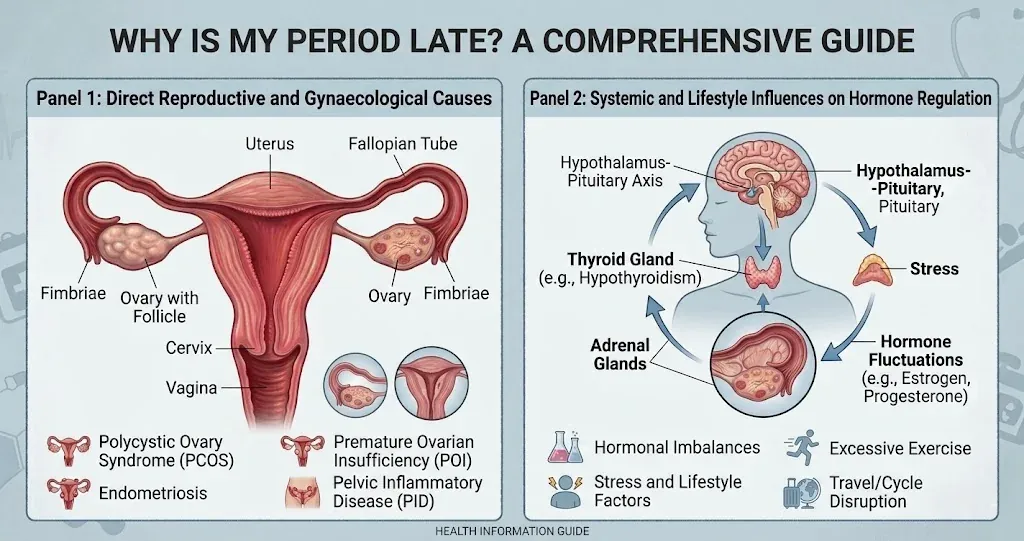
If you’re asking “why is my period late?” and a pregnancy test is negative, the answer usually comes down to one of the common triggers below. Most are temporary and treatable, and the same triggers are listed by the NHS and Healthline.
Stress
Stress affects the hormonal signals between your brain and ovaries that regulate ovulation timing. A stressful period, such as work pressure, a big life change or poor sleep, can delay ovulation and, in turn, push back your next period. This effect is usually temporary.
Travel and Disrupted Routine
Crossing time zones, irregular sleep, and a disrupted daily routine can temporarily throw off your body’s internal clock, which in turn can delay ovulation and your next period.
Lower Body Weight or Intense Exercise
Rapid weight loss, being significantly underweight, or a sudden jump in intense training (such as marathon prep) can leave your body without enough energy to keep reproductive hormones running normally. This can delay ovulation, push your period later, or stop it altogether for a while.
Eating Disorders and Under-Eating
Not eating enough energy, whether through dieting, restrictive eating, or an eating disorder, can switch off the signals that trigger ovulation, and periods can become late or stop. Restoring regular, adequate nutrition is the main treatment, and support from a doctor or dietitian helps.
Higher Body Weight
Just as being underweight can throw off your hormones, carrying significantly more body weight can too. Extra body fat can lead to higher estrogen production, and since estrogen helps regulate your cycle, too much of it can make periods irregular or, in some cases, cause them to stop. If a doctor identifies weight as a factor behind your irregular cycle, they may suggest gradual lifestyle changes rather than anything drastic.
Breastfeeding
If you’ve recently had a baby and are exclusively breastfeeding, your periods may pause for a while. This happens because prolactin, the hormone responsible for milk production, suppresses the hormones that drive your cycle. Combining breastfeeding with formula or bottle feeding tends to have less of this effect, and periods can return as early as five to six weeks after birth.
Hormonal Birth Control
Starting, stopping, or switching hormonal birth control can cause your cycle to become irregular for a few months while your body adjusts to the change in hormone levels.
Polycystic Ovary Syndrome (PCOS)
If PCOS is the reason for a delayed cycle, you are in good company, because PCOS and ovulation problems are among the most common hormonal reasons behind irregular periods. PCOS leads the body to produce more androgens than usual, which can prevent an egg from being released each cycle, resulting in periods that arrive late or don’t show up at all. Beyond irregular cycles, PCOS is often associated with:
- Excess facial or body hair growth (hirsutism)
- Difficulty conceiving
- Weight gain
- Persistent acne
- Thinning hair on the scalp
If you’re noticing several of these alongside a late or irregular cycle, a doctor can run tests to check for PCOS and talk through treatment options, according to the Cleveland Clinic’s PCOS guide.
Early Perimenopause
Perimenopause is the transitional stretch of years leading up to menopause, and it typically begins in the mid-40s, though for some people it can start as early as the mid-30s, according to the Cleveland Clinic’s perimenopause guide. During this phase, estrogen levels gradually decline, which throws off the usual balance with progesterone and makes cycles less predictable. If you’re in perimenopause and still getting periods now and then, it means you’re still ovulating, just less consistently. Menopause itself is only confirmed once a full 12 months have passed without a period.
Primary Ovarian Insufficiency (POI)
Primary ovarian insufficiency happens when the ovaries stop functioning normally before age 40, and it’s another possible reason behind a persistently late cycle. Unlike early menopause, POI doesn’t necessarily mean periods are gone for good, since some people with POI continue to have occasional periods, and pregnancy is still possible in some cases. If you’re under 40 and periods have been irregular for four months or longer, a doctor may test for POI, though it’s worth knowing this condition is uncommon, affecting only about 1% of women aged 15 to 44.
Thyroid Conditions
Your thyroid produces hormones that influence nearly every system in your body, including your reproductive cycle. When thyroid hormone levels run too high or too low, it can lead to prolonged bleeding, cycles without ovulation, or irregular timing. In more pronounced cases, thyroid imbalances can cause periods to stop entirely for several months. If a thyroid issue is behind the delay, treatment typically involves hormone replacement for an underactive thyroid or medication to calm an overactive one. A doctor can determine which applies to you with a simple blood test.
Other Chronic Conditions
Conditions such as poorly controlled diabetes, celiac disease, and elevated prolactin levels can all disrupt the hormones that control ovulation. If your delay comes with other ongoing symptoms, mention them to your doctor so the underlying condition can be checked.
Recent Illness or Medication
A bad infection, a high fever, or major surgery can delay ovulation for a cycle. Some medicines, including certain antidepressants, antipsychotics, steroids, and emergency contraception, can also shift the timing of your next period. Check the leaflet or ask a pharmacist if the delay began after starting something new.
Other Possible Causes of Late Periods
- Early pregnancy loss or ectopic pregnancy: a late period followed by heavy bleeding or one-sided pain needs urgent care.
- Pituitary problems: can raise prolactin and stop ovulation.
- Uterine scarring: scarring after surgery or infection can block bleeding.
- Stopping breastfeeding or a recent miscarriage: cycles can take weeks to settle.
Symptoms You May Notice With a Late Period
Late periods often come with body changes that look like early pregnancy or PMS. None of them confirm pregnancy on their own.
| Symptom | Why it can happen |
|---|---|
| Stronger emotional swings | Shifting estrogen and progesterone, stress or poor sleep |
| Bloating that lingers | Progesterone can stay high when a period is delayed; see period bloating causes and relief |
| Period-like cramps without bleeding | The uterus can cramp before a delayed period or in early pregnancy; see period cramps |
| Breast tenderness or swelling | Hormone changes before a period or in early pregnancy |
| Changes in vaginal discharge | Cervical mucus changes with hormones; a strong smell, itching or unusual color needs a check |
Because these overlap, a pregnancy test is the reliable check. Our guide to the signs your period is coming soon explains how PMS looks.
How Late Is “Too Late”?
If you are still unsure after ruling out the causes above, timing is usually the next clue. A period that is a few days later than usual is common and rarely a concern on its own, especially if you can point to an obvious cause like travel or a stressful week. It is a longer delay, or a repeating pattern, that deserves closer attention, and the NHS guidance on missed or late periods explains when to seek help.
How to Support a Healthy Cycle and Get Your Period Back on Track
What helps depends on the cause, but these steps support a regular cycle for most people once pregnancy and medical causes are ruled out.
Reduce stress and protect your sleep
Regular sleep, gentle movement, and realistic workloads calm the stress signals that interfere with ovulation. Cycles often return to normal within one to three months once stress settles.
Eat enough and balance training
Regular meals with enough energy, protein, and healthy fats support reproductive hormones. If you train hard, build in rest days and avoid sudden jumps in intensity or rapid weight loss.
Track your cycle
Logging start dates for a few months shows your real pattern, which makes a true delay easier to spot. The period calculator and ovulation calculator can help you estimate when to expect bleeding. For more on patterns, see common causes of menstrual cycle irregularities.
Get the underlying cause treated
If PCOS, a thyroid condition, or another medical cause is found, treatment of that condition is what restores regular periods. Do not start hormonal pills or supplements to force a period without medical advice.
Why Repeated Late Periods Are Worth Checking
An occasional late period is usually harmless, but cycles that keep stopping or arriving very late can signal that ovulation is not happening regularly. That can affect fertility, and long stretches of low estrogen can affect bone health over time. Finding the cause early makes it easier to treat.
When to See a Doctor About a Late Period
Talk to a doctor if:
- Your period is more than 7 days late and you’re not pregnant
- You’ve missed periods for three months or more
- A late period comes with severe pain, unusual bleeding, or other symptoms that concern you
- Your cycles are consistently unpredictable rather than occasionally late
Seek prompt medical care if you experience:
- Heavy bleeding that soaks through protection quickly
- Fever
- Severe pain
- Nausea or vomiting
- Bleeding that continues beyond 7 days
- Any bleeding after menopause
Conclusion
- A few days late is common; a week or more with no clear reason deserves a check.
- Take a pregnancy test first, then think about stress, weight, hormones and medicines.
- Track your cycle for a few months so you can spot a real change.
- See a doctor if periods stop for three months or come with severe pain or unusual bleeding.
Frequently Asked Questions
Quick answers about delayed periods, pregnancy tests, and what to do next.