
Safe Days Chart for 21 to 35 Day Cycles
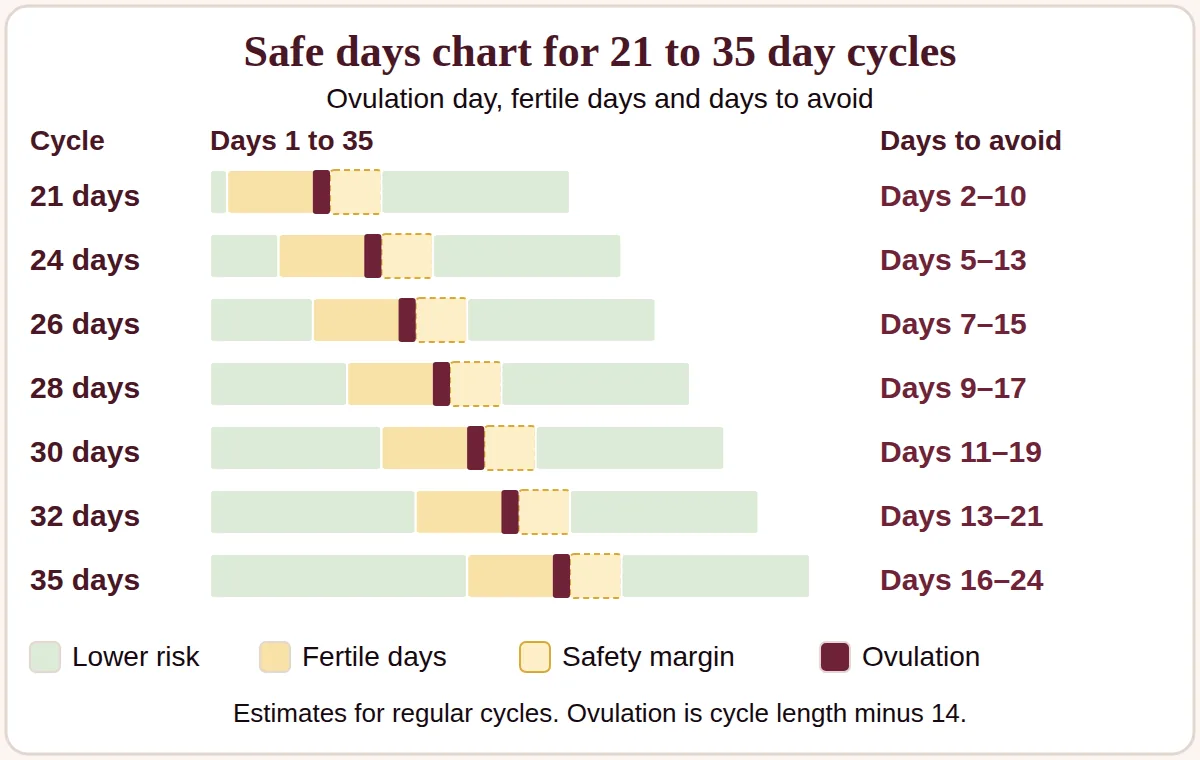
A safe days chart for 21 to 35 day cycles: estimated ovulation, fertile days and the lower-risk days before and after, plus a day-by-day view of a 28-day cycle. Every figure is an estimate for regular cycles.
Safe Days Chart by Cycle Length
- Day 1 is the first day of bleeding.
- Ovulation is estimated at your cycle length minus 14 days.
- The fertile days run from five days before ovulation to ovulation day.
- The “avoid” range adds the calendar method’s safety margin on the late side (cycle length minus 11).
Prefer your own dates to a table? Enter your last period into the safe days calculator to get these days on a calendar for your cycle.
| Cycle length | Estimated ovulation | Fertile days | Days to avoid (with margin) | Lower risk before | Lower risk after |
|---|---|---|---|---|---|
| 21 days | Day 7 | Days 2–7 | Days 2–10 | Day 1 | Days 11–21 |
| 24 days | Day 10 | Days 5–10 | Days 5–13 | Days 1–4 | Days 14–24 |
| 26 days | Day 12 | Days 7–12 | Days 7–15 | Days 1–6 | Days 16–26 |
| 28 days | Day 14 | Days 9–14 | Days 9–17 | Days 1–8 | Days 18–28 |
| 30 days | Day 16 | Days 11–16 | Days 11–19 | Days 1–10 | Days 20–30 |
| 32 days | Day 18 | Days 13–18 | Days 13–21 | Days 1–12 | Days 22–32 |
| 35 days | Day 21 | Days 16–21 | Days 16–24 | Days 1–15 | Days 25–35 |
Regular cycles only. “Lower risk before” includes your period days, which are not risk-free in short cycles. In a 21-day cycle the fertile window starts on day 2, so there is almost no safe time before it.
In a regular 28-day cycle, ovulation is around day 14, the fertile days are about 9 to 14 and the days to avoid run to day 17. Days 1 to 8 and 18 to 28 are the lower-risk days. Shorter cycles shift everything earlier, longer cycles later.
Safe and Unsafe Days in a 28-Day Cycle
Here is the same chart as a calendar for a regular 28-day cycle. Dates are cycle days, not calendar dates.
- 1
- 2
- 3
- 4
- 5
- 6
- 7
- 8
- 9
- 10
- 11
- 12
- 13
- 14
- 15
- 16
- 17
- 18
- 19
- 20
- 21
- 22
- 23
- 24
- 25
- 26
- 27
- 28
- Period (days 1–5)
- Lower risk
- Fertile window plus safety margin
- Estimated ovulation (day 14)
- Days 1 to 5: your period.
- Days 6 to 8: lower risk.
- Days 9 to 17: fertile window plus margin (ovulation near day 14).
- Days 18 to 28: lower risk again.
How to Read This Chart
- Find your cycle length. Use your usual number of days from the first day of one period to the day before the next. If it varies, see menstrual cycle irregularities.
- Fertile days are the five days before ovulation plus ovulation day, because sperm can survive up to five days and the egg lives about a day (ACOG).
- Days to avoid stretch the fertile days to day (cycle length − 11), which is the late edge used by the calendar method.
- Lower risk means outside that range. It never means zero risk.
Safe Days by Cycle Length
21 to 24 Day Cycles
- Ovulation comes early, around day 7 to 10.
- The fertile window can overlap your period, so there is very little safe time after bleeding.
- See safe days after your period.
26 to 28 Day Cycles
- These are close to average.
- In a 26-day cycle the days to avoid are 7 to 15; in a 28-day cycle they are 9 to 17.
30 to 32 Day Cycles
- Ovulation is later (day 16 to 18).
- You get more lower-risk days at the start of the cycle (days 1 to 10 in a 30-day cycle).
35 Day Cycles
- Ovulation is around day 21 and the days to avoid run from 16 to 24.
- Long cycles are also more likely to vary, which makes the estimate less reliable.
The Standard Days Method (26 to 32 Day Cycles)
- If every one of your cycles is between 26 and 32 days, the Standard Days Method (CDC, Global Handbook for Providers) uses one fixed rule: days 8 to 19 are fertile, and the rest are lower risk.
- It is simple, but it is wider than the chart above for some cycle lengths.
- It does not work if even one cycle falls outside 26 to 32 days.
- Details and failure rates are on the rhythm method failure rate and reliability page.
Why a Chart Is Only an Estimate
- Ovulation can shift earlier or later in any month, even with regular cycles.
- The chart uses one cycle length, not your shortest and longest. Use the hand calculation if yours varies.
- It cannot see stress, illness, travel, postpartum changes or hormonal birth control. The Mayo Clinic notes that medicines, stress and illness can all change the timing of ovulation (Mayo Clinic).
- In a study of 696 cycles, only about 30% of women had their whole fertile window within days 10 to 17 (Wilcox et al., 2000).
- It does not protect against sexually transmitted infections.
Make Your Own Chart
- Enter your last period date and average cycle length into our safe days calculator to see these days on your own calendar.
- Learn how the numbers are built in how to calculate safe days.
- Read the safe days guide for the overview.
Frequently Asked Questions
8 questionsWhat are safe and unsafe days?
What are the safe days in a 28 day cycle?
What are the safe days for a 21 day cycle?
What are the safe days in a 26 day cycle?
What are the safe days for a 35 day cycle?
Does this chart work for irregular periods?
Can I print this chart?
What is the difference between fertile days and unsafe days?
Medical Disclaimer
This article is general education, not personal medical advice. Safe days are estimates and never a guarantee. If avoiding pregnancy matters to you, talk to a doctor, nurse or pharmacist about a method that fits your health and cycle. Calendar tracking does not protect against sexually transmitted infections.


Scientific References
- Family Planning: A Global Handbook for Providers. “Fertility Awareness Methods: How to Use.” WHO / Johns Hopkins CCP / USAID. Accessed 2026. Standard Days Method: days 8 to 19 are fertile for cycles of 26 to 32 days; unprotected sex is acceptable on days 1 to 7 and from day 20. fphandbook.org
- Centers for Disease Control and Prevention (CDC). “Standard Days Method.” U.S. Selected Practice Recommendations for Contraceptive Use. Accessed 2026. The days 8–19 rule and the 26–32 day cycle requirement. cdc.gov
- Mayo Clinic. “Rhythm Method for Birth Control.” Mayo Clinic Tests & Procedures. Accessed 2026. The calendar method calculation (shortest cycle minus 18, longest minus 11), about 1 in 4 people becoming pregnant with typical use, and who it may not suit. mayoclinic.org
- American College of Obstetricians and Gynecologists (ACOG). “Trying to Get Pregnant? Here’s When to Have Sex.” Accessed 2026. The fertile window is about six days a cycle; sperm can live up to 5 days and an egg about 12 to 24 hours. acog.org
- Wilcox, Allen J., David Dunson, and Donna Day Baird. “The Timing of the ‘Fertile Window’ in the Menstrual Cycle: Day Specific Estimates from a Prospective Study.” BMJ 321, no. 7271 (2000): 1259–62. Day-specific estimates from 696 cycles showing the fertile window falls on different days in different women. doi.org