
Luteal Phase Length Normal Range, Symptoms & Fertility Impact
The luteal phase is more variable than the “always 14 days” rule most guides repeat. Real research puts the range at 7 to 19 days, even in 28-day cycles. Here is what shapes your luteal phase length, symptoms and fertility odds.
Key Takeaways
- The luteal phase is the second half of your cycle, from ovulation to the day before your next period.
- Luteal phase length averages 12 to 14 days, with 11 to 17 days widely seen as normal.
- A short phase (about 10 to 11 days or less) may affect implantation. A long phase (18 days or more) often means pregnancy.
- Real cycles vary more than the “always 14 days” rule suggests, with observed lengths from 7 to 19 days.
- Track ovulation for several cycles to learn your own number, and see a doctor if it is consistently under 10 days.
The luteal phase is the second half of your menstrual cycle. It begins right after ovulation and ends the day before your next period starts. During this phase, your body prepares the uterus for a possible pregnancy.
Luteal phase length typically averages 12 to 14 days, and 11 to 17 days is a normal range. Ten days or less is considered short, and 18 days or more is considered long. The luteal phase stays steadier than the follicular phase for most people, but steady does not mean fixed.
What Is the Luteal Phase?
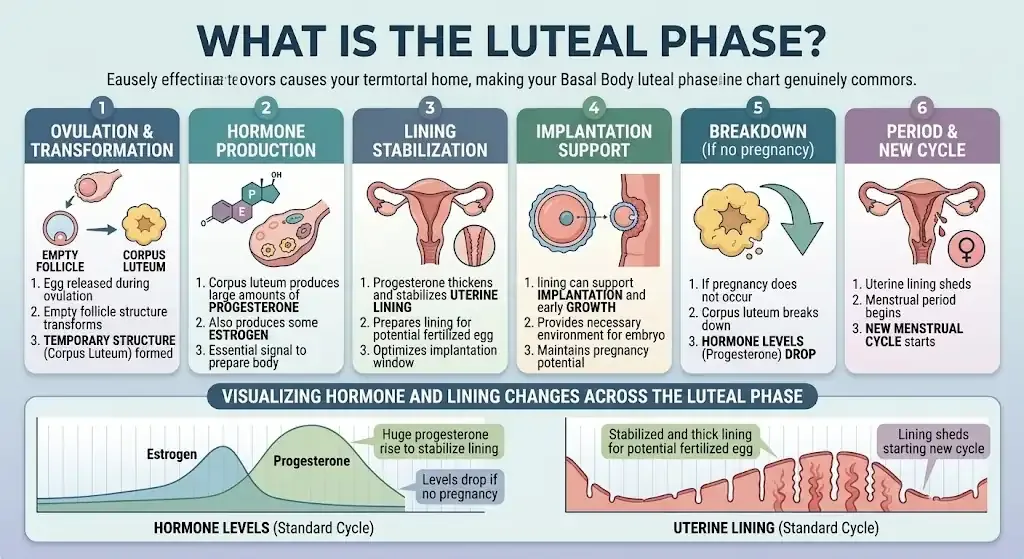
After ovulation the empty follicle becomes the corpus luteum, which makes progesterone to prepare and hold the uterine lining.
What Happens After Ovulation
After an egg is released during ovulation, the empty follicle transforms into a temporary structure called the corpus luteum. As Cleveland Clinic explains, the corpus luteum produces progesterone, along with some estrogen. Progesterone thickens and stabilizes the uterine lining so a fertilized egg has a place to implant and grow.
If pregnancy does not occur, the corpus luteum breaks down. Progesterone levels drop, the uterine lining sheds, and your period begins, starting a new cycle.
Luteal vs Follicular Phase
| Feature | Follicular phase | Luteal phase |
|---|---|---|
| Starts | First day of your period | Right after ovulation |
| Ends | At ovulation | The day before your next period |
| Main hormone | Estrogen rising | Progesterone rising |
| Length | Varies a lot between cycles | Usually steadier |
See the four phases of the menstrual cycle for how both fit together.
When Does the Luteal Phase Start?
It starts as soon as the egg is released and ends the day before your next period.
Where the Start Falls
The luteal phase begins right after ovulation, so its first day depends on when you ovulate. In a 28-day cycle that is around the middle of the cycle, but it comes earlier in shorter cycles and later in longer ones.
Why the Calendar Alone Is Not Enough
Ovulation can shift from cycle to cycle, so the start of your luteal phase can shift too. Body signs such as the signs of ovulation help you place it more precisely than a date count.
What Happens During the Luteal Phase?
Progesterone rises, the lining is prepared, and your body either maintains a pregnancy or lets the lining go.
The Phase in Three Stages
| Stage | What happens |
|---|---|
| Early | The corpus luteum forms and progesterone begins to rise. Resting body temperature starts to climb. |
| Middle | Progesterone is at its highest and the uterine lining is thick and ready for implantation. |
| Late, no pregnancy | The corpus luteum breaks down, hormone levels fall, and PMS-type symptoms can appear before your period. |
| Late, pregnancy | A fertilized egg implants, and the pregnancy hormone hCG tells the corpus luteum to keep making progesterone. |
The Temperature Shift
Progesterone slightly raises your resting body temperature, which is why a sustained rise on a basal thermometer is used as a sign that ovulation has happened.
How Long Is a Normal Luteal Phase?
Most luteal phases last 12 to 14 days, 11 to 17 days is widely accepted as normal, and real research shows even wider variation.
Normal vs Short vs Long Chart
| Classification | Length | Notes |
|---|---|---|
| Typical or average | 12 to 14 days | Most common |
| Normal range | 11 to 17 days | Widely accepted clinically |
| Short luteal phase | 10 to 11 days or less | May affect implantation |
| Long luteal phase | 18 days or more | Can signal pregnancy or hormonal imbalance |
Is the Luteal Phase Always 14 Days?
Here is the part most guides skip: a large prospective study of 1,635 cycles from 284 women found the luteal phase ranged from 7 to 19 days even among women with 28-day cycles, with a mean of 14 days. Luteal phase length varies, so the “always exactly 14 days” idea is a simplification. It is useful as a starting estimate, but not a hard rule for any individual cycle.
How to Calculate Your Luteal Phase Length
Find your ovulation day, then count the days until the day before your next period. Repeat over several cycles.
Three Steps
Identify your ovulation day using an LH test, cervical mucus changes or a basal body temperature shift.
Count the days from ovulation until the day before your next period starts.
Example: ovulation on cycle day 15, period starts on cycle day 29, so your luteal phase = 14 days.
Why Track More Than One Cycle
A single cycle is not necessarily representative, so tracking several gives the most accurate picture of your personal average. Our guide to using an ovulation calculator accurately and the basal body temperature tracking guide explain how to pinpoint ovulation, and you can estimate your next period date with the Period Calculator. To work out the ovulation day itself, see how to calculate your ovulation day.
How Do I Know If I Am in the Luteal Phase?
You can only be sure afterwards. A sustained temperature rise, a positive LH test followed by days of change, and drier mucus all point to it.
Signs You Have Entered It
| Sign | What it suggests |
|---|---|
| Temperature stays higher for 3 or more days | Ovulation has probably happened (basal body temperature) |
| Positive ovulation test followed by a few days | Ovulation happened around the surge, so the luteal phase has begun. See ovulation predictor kits. |
| Cervical mucus turns thicker or dry | Fertile mucus has ended after ovulation |
| PMS-type symptoms appear | Common in the second half of the cycle |
Because these signs confirm ovulation only in hindsight, a doctor can also check a progesterone blood test in the middle of this phase.
Short Luteal Phase: What the Research Actually Shows
A short luteal phase may modestly lower the chance of pregnancy in the next cycle, but one large study found no higher overall infertility.
What Is a Short Luteal Phase?
A luteal phase of 10 days or less is sometimes called luteal phase deficiency (LPD). A shorter phase may not give the uterine lining enough time to thicken properly, which can make implantation harder for some people. Here is real data, not just a vague warning:
of observed cycles in a large prospective study had a short luteal phase (11 days or less), and it was significantly more common among smokers.
the odds of pregnancy in the cycle immediately following a short luteal phase, compared with cycles without one. A real but modest effect, not a dramatic one.
What It Means for You
That same study found no significantly higher overall infertility rate at 12 months among women who occasionally had a short luteal phase. If you consistently see a short luteal phase and are trying to conceive, discuss it with a healthcare provider. Progesterone blood tests can help evaluate the situation.
How Long Does a Luteal Phase Need to Be to Get Pregnant?
No exact minimum is proven. Many clinicians watch for about 10 days or more, since implantation usually happens within about 6 to 12 days of ovulation.
Why Length Matters
The fertilized egg needs time to implant, and the lining needs progesterone to stay in place until then. Implantation usually happens roughly 6 to 12 days after ovulation, as explained in our guide on how long after ovulation you can get pregnant.
What the Research Says
A shorter phase may leave less time, but pregnancy is still possible, and the study quoted in the next section found only a modest drop in odds. If your phase is short on several tracked cycles and you are trying to conceive, ask a doctor about testing rather than guessing.
Long Luteal Phase
A luteal phase of 18 days or more usually points to pregnancy. Take a test first before looking for other causes.
Why It Runs Long
A luteal phase lasting 18 days or longer is considered long. The most common explanation is pregnancy, since progesterone remains elevated once implantation occurs. Other possible causes include hormonal imbalances such as PCOS and ovulation problems.
What to Do First
If your period is significantly delayed, take a pregnancy test before assuming anything else. Our guide on why your period might be late covers other causes.
Common Luteal Phase Symptoms
Rising progesterone can cause PMS-like symptoms that ease once your period starts.
What You May Notice
Rising progesterone often causes symptoms that overlap heavily with classic PMS:
- Breast tenderness
- Bloating
- Fatigue
- Mood changes or irritability
- Mild cramps
- Headaches
- Changes in appetite
- Acne flare-ups
These symptoms usually appear in the second half of the luteal phase and ease once your period starts, or continue if pregnancy occurs. If they are severe, see PMS vs PMDD.
Why the Luteal Phase Matters for Fertility
A healthy luteal phase supports the lining, implantation and early pregnancy until the placenta takes over.
Three Jobs of the Luteal Phase
- Proper thickening of the uterine lining
- Successful implantation
- Early pregnancy maintenance until the placenta takes over hormone production
Tracking your luteal phase, especially with basal body temperature, can reveal useful patterns for you and your doctor. It also pairs well with understanding what the fertile window is earlier in the same cycle.
How to Support a Healthy Luteal Phase
Everyday habits help overall cycle health. They are not a proven fix for a short luteal phase.
Everyday Habits
- Eating a balanced diet rich in whole foods
- Managing stress
- Getting consistent, quality sleep
- Moderate exercise
- Limiting alcohol and avoiding smoking
When It Might Be Something Else
Medical evaluation is recommended if cycles are consistently irregular or if you have been trying to conceive without success. If a thyroid condition might be part of the picture, our guide to the thyroid and menstrual cycle covers one of the most common underlying causes of cycle irregularity.
When to See a Doctor
See a healthcare provider if your luteal phase is consistently under 10 days, your cycles are very irregular, or you have been trying to conceive for 6 to 12 months.
Signs to Get Checked
Your luteal phase is consistently shorter than 10 days · You have very irregular cycles · You have been trying to conceive for 6 to 12 months (depending on age) without success · You experience unusually heavy or painful periods.
Frequently Asked Questions
18 questions answeredWhat is the luteal phase?
How long is a normal luteal phase?
What is a short luteal phase?
Can you get pregnant with a short luteal phase?
What causes a short luteal phase?
What is a long luteal phase?
How do I calculate my luteal phase length?
What are common luteal phase symptoms?
Does a long luteal phase mean I am pregnant?
How can I track my luteal phase accurately?
When should I see a doctor about my luteal phase?
Is luteal phase deficiency a real diagnosis?
When does the luteal phase start?
How do I know if I am in the luteal phase?
How long does a luteal phase need to be to get pregnant?
Is the luteal phase always 14 days?
Can stress change my luteal phase?
How is the luteal phase different from the follicular phase?


Sources & References
- Crawford NM, Pritchard DA, Herring AH, Steiner AZ. Prospective Evaluation of Luteal Phase Length and Natural Fertility. Fertility and Sterility. 2017;107(3):749–755. doi:10.1016/j.fertnstert.2016.11.022. 1,635 cycles, 284 women; source of the 18% short-luteal-phase rate and 0.82 odds ratio for next-cycle pregnancy. Full text (Fertility and Sterility)
- Cleveland Clinic. Luteal Phase of the Menstrual Cycle: Symptoms & Length. clevelandclinic.org
- Clearblue, citing Crawford et al. (2018) and Soumpasis et al. (2020). Luteal Phase: Length, Symptoms and How to Calculate. Reports the 7–19 day observed range in 28-day cycles and that only 12.4% of women had a typical 28-day cycle. clearblue.com
- Practice Committee of the American Society for Reproductive Medicine. Diagnosis and Treatment of Luteal Phase Deficiency: A Committee Opinion. Fertility and Sterility. 2021;112(3):378–386. Current ASRM guidance; replaces the 2015 opinion “Current Clinical Irrelevance of Luteal Phase Deficiency.” Full text (Fertility and Sterility)
- American College of Obstetricians and Gynecologists (ACOG). Fertility Awareness-Based Methods of Family Planning. acog.org
- Wilcox AJ, Weinberg CR, Baird DD. Timing of Sexual Intercourse in Relation to Ovulation. New England Journal of Medicine. 1995;333(23):1517–1521. doi:10.1056/NEJM199512073332301.