
How Accurate Are Ovulation Calculators and Fertility Apps?
What studies with hormone-confirmed ovulation found, why predictions miss, and which methods give you better evidence of your fertile days.
How accurate are ovulation calculators? They are useful for estimating your fertile window when your cycles are regular, but they predict the exact day of ovulation far less often than most people expect. In a study of 949 women whose ovulation was confirmed with hormone tests, even the best calendar guess was right for only about 1 in 5. A predicted ovulation date is an estimate, not proof that you ovulated.
Fertility apps that use only your period dates work the same way and share the same limits. Tools that read body signs, such as LH tests or temperature, do better. If you want an estimate first, use our free ovulation date calculator, then follow our tips on getting the most reliable result from it.
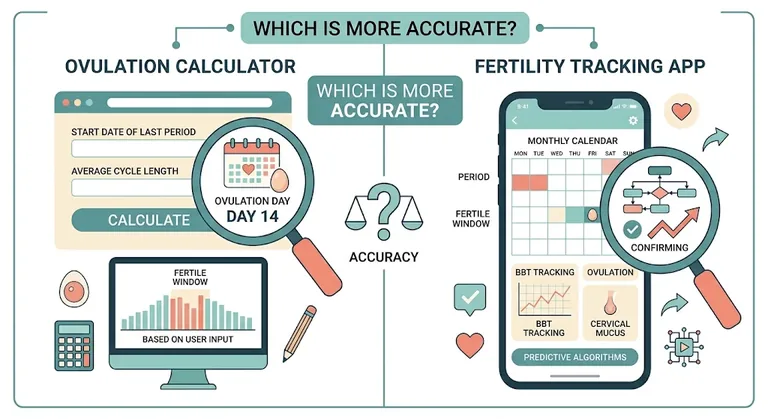
How Accurate Are Ovulation Calculators?
- Fertile window: a fair estimate if your cycles are regular.
- Exact ovulation day: often wrong, even in regular 28-day cycles.
- Irregular cycles: not reliable on their own.
- Confirmation: a calculator cannot tell you whether you ovulated at all.
Can an ovulation calculator predict your exact ovulation day?
No. Most calculators assume ovulation on day 14 of a 28-day cycle. Research with daily LH tests shows that is only one of many possible days.
| What the calculator assumes | What research found |
|---|---|
| Ovulation on day 14 | Ovulation anywhere from day 11 to day 20 |
| One fixed day | The most common day was day 16, and only about 21% of women ovulated on it |
| A 28-day cycle is typical | Only about 13% of 600,000+ real cycles were exactly 28 days |
Does a regular menstrual cycle improve accuracy?
Yes, for the fertile window. A regular cycle makes the general timing more predictable. It still does not fix the exact day: in a study of 696 cycles, only about 30% of women had their whole fertile window inside days 10 to 17, even though most cycles were regular.
Why ovulation dates change from one cycle to another
- The follicular phase varies most. The days before ovulation stretch or shrink with stress, illness and hormones, and this explains most of the difference between short and long cycles.
- The luteal phase is not fixed at 14 days. A year-long study of 676 cycles found it ranges from about 10 to 16 days. Read more about the luteal phase and why it varies.
How Do Ovulation Calculators and Apps Work?
Date-based calculators and apps follow the same calendar algorithm:
- Inputs: the first day of your last menstrual period (LMP) and your average cycle length.
- Next period: LMP plus cycle length.
- Ovulation date: about 14 days before the next period.
- Fertile window: the 5 days before ovulation plus ovulation day.
How period-tracking history changes predictions
Apps recalculate your average every time you log a period. That is why your predicted fertile days often move during the first few months. More logged cycles give a steadier average, but it is still an average of past cycles, not a reading of the current one.
Calendar algorithms vs biological fertility signs
| Signal | Chain of events | What it tells you |
|---|---|---|
| Calendar dates | LMP and cycle length lead to an estimated next period, then an estimated ovulation date | A guess based on past cycles |
| LH test | LH surge in urine, then ovulation usually in the next 24 to 36 hours | Ovulation is coming soon |
| Cervical mucus | Rising estrogen makes mucus clear, slippery and stretchy | Fertile days are starting |
| Basal body temperature | Progesterone rises after ovulation and lifts resting temperature | Ovulation has probably already happened |
Why two apps can give different dates for the same cycle
Each app uses its own algorithm, and most do not say what it is. A 2016 study tested 20 websites and 33 apps against a standard fertile window: only 1 website and 3 apps got it exactly right. A 2018 review of 73 apps found that none explained how it calculated ovulation. Before you trust an app, check which inputs it uses: dates only, or body signs too.
Can Apps and Calendar Methods Predict Ovulation With Accuracy?
This was the exact question asked by a 2018 study indexed on PubMed. For date-only methods, the answer was no. Here is what the main studies found.
| Study | What was measured | Key finding |
|---|---|---|
| Johnson et al., 2018 | 949 women, ovulation confirmed by daily urine LH tests; 73 apps reviewed | Ovulation in 28-day cycles fell between day 11 and day 20. Most apps predicted day 15, correct in about 19% of cycles. |
| Setton et al., 2016 | 20 websites and 33 apps | Only 1 website and 3 apps predicted the exact fertile window. |
| Bull et al., 2019 | More than 600,000 cycles from 124,648 app users | Average cycle 29.3 days; follicular phase 16.9 days; luteal phase 12.4 days. |
| Henry et al., 2024 | 676 ovulatory cycles over a year | Luteal phase ranged from about 10 to 16 days, so a fixed 14 days is often wrong. |
| Wilcox et al., 1995 | 221 women, hormone-confirmed ovulation | Pregnancy came only from sex in the 6 days ending on ovulation day. |
| Rabe and Ehlers, 2025 | Systematic review of 19 studies on cycle apps | Study quality varied widely. Some apps may help people trying to conceive, but independent controlled research is still needed. |
The 2018 study was funded by the maker of Clearblue ovulation tests, so it favours LH testing. Its LH data is still strong evidence that calendar predictions miss. The 2025 review is a useful balance: apps are not useless, but their accuracy depends on the method and the data you give them.
Ovulation Calculator vs Fertility Apps: What’s the Difference?
| Feature | Online calculator | Basic period app | Advanced fertility app |
|---|---|---|---|
| Uses | LMP and cycle length | Logged period dates | Dates plus LH tests, BBT, mucus or wearable data |
| Accuracy | Estimate | Similar estimate | Better, because it reads body signs |
| Time needed | Under a minute | A few taps a month | Daily logging |
| Cost | Free | Usually free | Often a subscription, plus tests or devices |
| Extras | None | Reminders, cycle history | Charts, symptom tracking, test reading |
- Benefits of an online calculator: instant result, no download or account, free, no daily logging.
- Benefits of a tracking app: cycle history, reminders, symptom and test logs, and a record to show your doctor.
- Privacy: most apps store health data on company servers, so read the privacy policy first.
Popular fertility apps at a glance
| App | Best for | Pros | Cons |
|---|---|---|---|
| Premom | Reading LH tests | Turns a photo of a test strip into a number; charts LH, BBT and mucus; core features free | Works best with the company’s own strips; you still buy tests |
| Clue | Everyday tracking | Simple design; free period and symptom tracking | Conceive mode needs the paid Clue Plus plan |
| Natural Cycles | Temperature-based fertility | Uses a thermometer or wearable (Oura, Apple Watch, Garmin); FDA-cleared as birth control since 2018; company reports 93% typical-use effectiveness | Paid subscription; needs daily temperature |
| Euki | Privacy | Free; data stays on your phone; no account; PIN lock | Few fertility features |
We chose these apps by what they measure, how they handle data and whether they have regulatory clearance. We did not run our own accuracy tests, and no app paid to be listed.
Which tool is more useful when trying to conceive?
| Your situation | Best choice |
|---|---|
| Regular cycles, just starting to try | Online calculator |
| Trying for a few months | Calculator plus LH tests |
| Cycles change by more than 7 days, or PCOS | App that logs LH tests and BBT |
| Want to avoid pregnancy | Not a calculator; ask a doctor about contraception |
| Trying for 12 months (6 if 35 or older) | See a doctor |
What Factors Affect Ovulation Calculator Accuracy?
| Factor | Why it affects predictions | What to do |
|---|---|---|
| Irregular periods | Past cycles do not predict the next one | Use LH tests; see ovulation with irregular periods |
| Cycle length variation | An average hides short and long months | Log at least 6 cycles |
| PCOS and hormonal imbalance | Ovulation may be late or absent; LH can stay high | Track BBT; read about PCOS and ovulation |
| Thyroid disorders or high prolactin | Can delay or stop ovulation | Ask a doctor for blood tests |
| Stress, illness, travel, poor sleep | Can delay ovulation in any cycle | Rely on body signs that month |
| Postpartum and breastfeeding | Ovulation can return before the first period | Do not rely on dates; see periods while breastfeeding |
| Perimenopause | Cycles become shorter, longer and less regular | Use body signs; talk to a doctor |
| Missing or wrong period dates | Wrong inputs give wrong outputs | Log day 1 as the first day of real bleeding |
| Anovulation | No egg is released, but the app still shows a fertile window | Watch for LH tests that never turn positive |
Ovulation Predictor Kits vs. Fertility Apps: Which Is More Reliable?
Ovulation predictor kits (OPKs) are urine tests that detect the luteinizing hormone (LH) surge, the hormone signal that triggers egg release. Because they react to your body in the current cycle, they are more reliable for timing than any date-only calculator or app.
| Factor | Ovulation predictor kits | Fertility apps (dates only) |
|---|---|---|
| Accuracy | 91.75% to 96.90% for detecting the LH surge, in a study of five brands | Exact day often wrong |
| What it shows | Ovulation likely in the next 1 to 2 days | An estimated fertile window |
| Convenience | A urine test each day near expected ovulation | A few taps; reminders built in |
| Cost | Test strips each cycle; digital tests cost more | Free basic plans |
| Confirms ovulation? | No | No |
What a positive LH test means, and what it does not
- Positive: the LH surge has started, and ovulation usually follows within 24 to 36 hours. Have sex that day and the next 2 days.
- Not proof: a surge shows the signal, not that an egg was released. Some cycles surge without ovulating.
- Limits: a short surge can be missed with one test a day, diluted urine can hide it, and PCOS or perimenopause can cause repeated positives.
The best setup uses both: an app such as Premom to read and store your OPK results. Read how to use ovulation predictor kits step by step.
Better Ways to Track and Identify Ovulation
The key difference is prediction vs confirmation. Some methods warn you before ovulation; others show it happened afterwards. Combining one of each, such as LH tests with BBT or cervical mucus (the symptothermal approach), gives the clearest picture.
| Method | What it uses | Predicts ahead? | Confirms ovulation? |
|---|---|---|---|
| Ovulation calculator | Period dates and cycle length | Estimate only | No |
| Fertility app (dates only) | Cycle history | Estimate only | No |
| Cervical mucus | Changes in cervical fluid | Yes, a few days ahead | No |
| LH ovulation tests | Urine LH surge | Yes, 1 to 2 days ahead | No |
| Basal body temperature | Resting temperature | No | Yes, after it happens |
| Serum progesterone test | Blood test about 7 days before your period | No | Yes |
| Ultrasound monitoring | Follicle growth in the ovary | Yes | Yes |
- Learn to read cervical mucus changes and the other body signs of ovulation.
- For a plan that combines every method, see how to track ovulation with OPKs, BBT and apps.
- The NHS guide to telling when you are ovulating and Cleveland Clinic’s basal body temperature guide explain these signs in more detail.
Can Ovulation Calculators and Apps Help You Get Pregnant?
They can help you plan, but they cannot guarantee pregnancy. Use the estimated fertile days as a range, not one target date.
- The six-day fertile window: sperm can live up to 5 days and the egg 12 to 24 hours, so pregnancy is possible from 5 days before ovulation to ovulation day. Read more about what the fertile window is.
- Timing: sex every 1 to 2 days during the window gives the best chance, according to an ASRM committee opinion on natural fertility. The 2 days before ovulation and ovulation day matter most.
- No tracking needed: sex every 2 to 3 days through the whole cycle also covers the window, as advised in UK fertility guidance from NICE. It also takes away the stress of chasing one predicted day.
- No guarantee: age, egg and sperm quality and other health factors affect your chances in every cycle.
When Should You Stop Relying on App Predictions and See a Doctor?
- Irregular or absent periods: cycles shorter than 21 or longer than 35 days, or no period for 3 months.
- Suspected anovulation: LH tests never turn positive, or your temperature never rises in a cycle.
- Possible PCOS or thyroid problems: irregular periods with acne, extra hair growth, weight change or tiredness.
- Infertility evaluation: no pregnancy after 12 months of trying (6 months if you are 35 or older).
An app cannot confirm ovulation or diagnose PCOS, thyroid disease or low progesterone. A doctor can, with blood tests such as serum progesterone, FSH, LH, prolactin and thyroid hormones, or an ultrasound. The NHS guide to fertility in the menstrual cycle is a good place to start.
Frequently Asked Questions About Ovulation Calculator Accuracy
Are free ovulation calculators accurate?
They give a useful estimate of your fertile window if your cycles are regular, but they often miss the exact ovulation day. Paid tools that use only dates are no more accurate.
Are fertility apps more accurate than online calculators?
Not when they use only period dates. Apps become more accurate when you add LH test results, basal body temperature or wearable data.
Can an ovulation calculator predict ovulation with irregular periods?
Not reliably. With irregular periods, past cycles do not predict the next one. Use LH tests or cervical mucus to find your fertile days.
Can an app confirm that I have ovulated?
No. An app can suggest it from a temperature rise you log, but only a blood progesterone test or ultrasound confirms ovulation.
Why does my ovulation app change my fertile dates?
Apps recalculate your average cycle every time you log a period. Predictions often shift in the first few months, and again whenever a cycle is shorter or longer than usual.
Is an ovulation predictor kit more accurate than an app?
Yes, for timing. An OPK detects the LH surge in the current cycle, while a date-only app guesses from past cycles. Using both together works best.
Can ovulation apps detect PCOS?
No. An app can show long or irregular cycles worth discussing with a doctor, but PCOS is diagnosed with a medical history, an exam, blood tests and sometimes an ultrasound.
Can I use an ovulation calculator to avoid pregnancy?
No. Date-based estimates miss ovulation too often to work as birth control. Some temperature-based apps are FDA-cleared for contraception but need careful daily use. Talk to a doctor about the right method for you.
Do fertility apps keep my data private?
It depends on the app. Most store data on company servers, so read the privacy policy. Some, such as Euki, keep data only on your phone and need no account.
What is the most reliable way to track ovulation at home?
Combine methods: a calculator to know when to start, LH tests to catch the surge, and cervical mucus or BBT to back it up.
Final Verdict: Should You Trust Ovulation Calculators and Apps?
So, how accurate are ovulation calculators? Accurate enough to show your likely fertile window, not accurate enough to name your ovulation day or confirm it. Date-only apps are no better. Use a calculator or app as a starting guide, add LH tests or temperature tracking for timing, have sex every 1 to 3 days around your fertile days, and see a doctor if your cycles are irregular or pregnancy does not happen within the expected time.
Medical Disclaimer
This article is for general information only and is not medical advice, a diagnosis or a substitute for guidance from a qualified healthcare provider. Ovulation calculators and apps give estimates and should not be used as birth control. If you have irregular cycles, difficulty conceiving or any health concern, please talk to a healthcare provider.


Scientific References
- Johnson, Sarah, Lorrae Marriott, and Michael Zinaman. “Can Apps and Calendar Methods Predict Ovulation with Accuracy?” Current Medical Research and Opinion 34, no. 9 (2018): 1587–94. Study of 949 women whose ovulation was confirmed with daily urine LH tests. In 28-day cycles, ovulation occurred from day 11 to day 20, most apps predicted day 15 (correct in about 19% of cycles), and none of 73 apps explained its method. Funded by the maker of Clearblue ovulation tests. The main source for this article’s “Can Apps and Calendar Methods Predict Ovulation With Accuracy?” section. doi.org · PubMed
- Setton, R., C. Tierney, and T. Tsai. “The Accuracy of Web Sites and Cellular Phone Applications in Predicting the Fertile Window.” Obstetrics & Gynecology (2016). Tested 20 websites and 33 apps against a standard fertile window; only 1 website and 3 apps predicted it exactly. Supports this article’s explanation of why two apps can give different dates for the same cycle. doi.org
- Rabe, Isabell, and Jan P. Ehlers. “Reliability of Cycle Applications for Pregnancy Planning and Contraception: A Systematic Review.” Mayo Clinic Proceedings: Digital Health 3, no. 4 (2025): 100239. Systematic review of 19 studies. Found widely varying study quality, some benefit of apps for people trying to conceive, and a need for independent controlled research. Used for this article’s balanced view that apps are not useless but depend on their method and data. doi.org
- Bull, Jonathan R., Simon P. Rowland, Elina Berglund Scherwitzl, Raoul Scherwitzl, Kristina Gemzell Danielsson, and Joyce Harper. “Real-world Menstrual Cycle Characteristics of More Than 600,000 Menstrual Cycles.” npj Digital Medicine 2 (2019): 83. Analysis of more than 600,000 cycles from 124,648 app users, with an average cycle of 29.3 days and only about 13% of cycles lasting exactly 28 days. Shows why a fixed 28-day assumption misses many women. ncbi.nlm.nih.gov
- Henry, Sarah, Sonia Shirin, Azita Goshtasebi, and Jerilynn C. Prior. “Within-Woman Variability of Follicular and Luteal Phase Lengths in Healthy Women.” Human Reproduction 39, no. 11 (2024): 2565–74. Year-long study of 676 ovulatory cycles showing the luteal phase ranges from about 10 to 16 days, the main reason calendar tools that assume 14 days can miss ovulation. doi.org
- Wilcox, Allen J., Clarice R. Weinberg, and Donna D. Baird. “Timing of Sexual Intercourse in Relation to Ovulation: Effects on the Probability of Conception, Survival of the Pregnancy, and Sex of the Baby.” New England Journal of Medicine 333, no. 23 (1995): 1517–21. Study of 221 women showing that conception happened only from intercourse in the six days ending on ovulation day. doi.org
- Wilcox, Allen J., David Dunson, and Donna D. Baird. “The Timing of the ‘Fertile Window’ in the Menstrual Cycle: Day Specific Estimates from a Prospective Study.” BMJ 321, no. 7271 (2000): 1259–62. Found that only about 30% of women had their whole fertile window within days 10 to 17, even with regular cycles. doi.org
- Fertility and Sterility (ScienceDirect). Similar Accuracy and Patient Experience With Different One-Step Ovulation Predictor Kits. Peer-reviewed study of five ovulation predictor kit brands, finding 91.75% to 96.90% accuracy for detecting the LH surge. The source for this article’s “Ovulation Predictor Kits vs. Fertility Apps” section. sciencedirect.com
- Practice Committee of the American Society for Reproductive Medicine. “Optimizing Natural Fertility: A Committee Opinion.” Accessed 2026. Professional guidance on timing intercourse every 1 to 2 days during the fertile window, the basis for this article’s “Can Ovulation Calculators and Apps Help You Get Pregnant?” section. asrm.org
- National Institute for Health and Care Excellence (NICE). Fertility Problems: Assessment and Treatment (CG156): How Long Does It Take to Get Pregnant? Accessed 2026. UK national guidance advising regular sexual intercourse every 2 to 3 days when trying to conceive, the basis for this article’s advice that exact timing is not required. nice.org.uk
- NHS. “Fertility in the Menstrual Cycle.” Accessed 2026. Patient guide to how the menstrual cycle affects the chance of pregnancy, cited in this article’s “When Should You Stop Relying on App Predictions and See a Doctor?” section. nhs.uk
- NHS. “How Can I Tell When I Am Ovulating?” Accessed 2026. Patient guide to the body signs of ovulation, including cervical mucus, temperature and ovulation tests. nhs.uk
- Cleveland Clinic. “Basal Body Temperature.” Accessed 2026. Clinical reference on how resting body temperature rises after ovulation and how to chart it. my.clevelandclinic.org
- Contemporary OB/GYN. “Natural Cycles Receives FDA Clearance for AI-Powered Fertility Algorithm.” July 2026. Summary of Natural Cycles’ FDA clearances since 2018, its supported wearables and the company-reported 93% typical-use and 98% perfect-use effectiveness. contemporaryobgyn.net
- Clue Help Center. “How Much Does Clue Conceive Cost?” Accessed 2026. States that Clue Conceive requires a Clue Plus subscription and that prices vary by region. support.helloclue.com
- Mozilla Foundation. “Euki,” Privacy Not Included. Accessed 2026. Privacy review confirming that Euki stores data only on the user’s device, needs no account and is free. foundation.mozilla.org
- Premom. “Premom Ovulation Tracker App.” Accessed 2026. Describes how the app reads LH test strip photos and charts BBT, cervical mucus and symptoms. premom.com